
Memes and Medievalism: Reimagining Boccaccio’s Fourteenth Century
By Lucy C. Barnhouse
Boccaccio’s Decameron has been called “the privileged text of the contradictory, rich, and unpredictable experiences of life.”[1] Netflix’s Decameron, while it is interested in the contradictions of how we experience life in the twenty-first century, is perhaps even more interested in how we mediate those rich, unpredictable experiences through memes, screens, and filters. The show is clearly designed as a wry commentary on our own pandemic era, its inequities, and its instabilities. But in providing this commentary, rather than using the fourteenth century, it relies on what Megan L. Cook has called dirtbag medievalism. Rather than seeking “some type of connection with the medieval past that is both intimate and authentic,” Cook argues, “dirtbag medievalism is a vibe.”[2] This definition neatly encapsulates, in my view, the strategies embraced by Netflix’s Decameron. In watching it as a medievalist, I was often struck by how historical accuracies were snuck in: references to Boccaccio’s tales are frequent, and many of the show’s jokes—about medical theory, about relics, about sexual desire—are layered in ways apparently designed to be appreciated by viewers who know a considerable amount about the fourteenth century. Far more often, however, the show expects a range of pop culture literacies from its audience, gleefully concocting a vibes-based version of the premodern past, where baroque music, nineteenth-century ideas about sexuality, and decidedly contemporary ideas about gender and social inequalities coexist.
The world of Netflix’s Decameron is a world devoid of certainties. The same could arguably be said of Boccaccio’s Decameron: its frequently-excerpted prologue is often used to illustrate how destabilizing the experience of pandemic was in fourteenth-century Europe.[3] But while both works are comedic, the tone of Netflix’s show, for all its saturated colors and sly pop culture references, is much darker. Neither the existence of God nor the possibility of human connection is axiomatic. The imaginary world of the show—as fictive as those of Boccaccio—is both achronistic and anachronistic: not only are elements of multiple eras mixed together, but a sense of the separateness of historical eras dissolves. Many of the themes of Boccaccio’s Decameron are present: hypocrisy; unhappiness turned to happiness; good fortune turned to its reverse.[4] But Boccaccio’s humor is largely made possible by the medieval idea that lability is the norm. Even as the pranks, disguises, and mistaken identities of Boccaccio’s subversive text highlight how unstable categories of virtue and power can be, they rely on the assumption that changes of personal fortune are always possible. A sinner can become a saint; fortunes can be made and lost; people can change lovers, spouses, religions. But this understanding of social instability, communicated through an elaborately organized text, is inconsistent with pop culture’s preferred Middle Ages, where everything is rigid.[5] In the show, both social realities and interpersonal relationships remain largely fixed; individual change is both temporary and ineffectual. The tension between Boccaccio’s imagination and the imagined Middle Ages is never fully resolved in Netflix’s version of the fourteenth century.
Medieval Perspectives: Boccaccio’s Prologue
Boccaccio, in his authorial preface, argues that it is human nature to experience compassion for the sorrows and misfortunes of others.[6] Netflix’s Decameron, on the other hand, suggests it is human nature to find others’ misfortunes funny. The ways in which the elegant storytellers and their servants are organized into a community have little in common with the dynamics of the show, although in both cases, they are clearly seeking to establish what became colloquially known as a “bubble” at the height of the COVID-19 pandemic. The show’s mixing up of names and roles—initially baffling to the reader of Boccaccio—facilitates an atmosphere conducive to as many different romances and rivalries as possible. The ironically-named Villa Santa, where most of the show is set, resembles the Big Brother house with a medieval veneer. There are also cinematic parallels to The Glass Onion (2022), with its exposure of elite hypocrisies, a resemblance that is further reinforced by the shared plot device of sisters swapping identities. In Boccaccio’s Decameron, the fact that several of the protagonists are distant cousins provides a convenient narrative pretext for unmarried women and men to socialize without fear of scandal; for Netflix, it drives very different narrative possibilities, as the protagonists compete for social and financial security.[7]
Adam Whittaker has argued that the Black Death “equipped the modern world with the original outbreak narrative.”[8] In many respects, however, Netflix’s Decameron frames the Black Death as unexceptional. In Boccaccio’s prologue, the plague is represented as transforming social, economic, and religious realities. In the Netflix show, however, it appears merely as one element of a grotesque medieval reality. While, as Winston Black has discussed, there are some jokes made at the expense of both medieval medicine and the protocols of the first years of COVID-19, the plague is portrayed as throwing existing social relationships into sharper relief, rather than radically altering them.[9] Desperation is expressed chiefly in selfishness. Religious and medical measures are shown as alike ineffective, whether in a noblewoman’s confession to a dead priest or a servant’s prophylactic use of amulets and flowers.[10] Whereas denial of the plague’s reality appears as a kind of magical thinking in the show, particularly in the first episode, Boccaccio depicts denial as part of a spectrum of human responses to pestilence.[11] Indeed, Boccaccio’s characters sidestep the punitive moral logic of looking for causes of plague in divine disapproval or malign conjunctions. In the constructed world of the Decameron, comedy plays out blamelessly for the benefit of an audience preoccupied with the plague.[12] The actions of the members of the brigata can be read as resembling those of groups engaging in propitiatory activities within the city walls, even as they declare that they will avoid both the dangers of the plague and the gloomy necessity of thinking about it.[13] This cheerful conversation, according to the dominant medieval medical theory linking physical, emotional, and mental health, could be understood as both therapeutic and prophylactic.[14] In the Netflix show, however, cheerful conversation is characterized either by hardened indifference or denial that is manic and desperate by turns.
Arguably, Boccaccio’s Decameron helped to lay the groundwork for a narrative tradition of plague as apocalypse.[15] But the ways in which Boccaccio deliberately crafted a literary narrative are, in my experience, often lost on undergraduates: for them, the medieval is always-already apocalyptic. Netflix’s Decameron seems to hold a similar set of assumptions: in the filmic Middle Ages, public health measures are non-existent, prayer is ineffective, and people are often driven to ruthless competition as they attempt to survive a world in which life is nasty, brutish, and short.[16] This is particularly true when the filmic Middle Ages engage with the Black Death, whether in The Seventh Seal (1957), Monty Python and the Holy Grail (1975), or The Black Death (2010). At the outset of the show, one of the protagonists abandons her father in order to escape to what the episode title calls “The Beautiful, Not-Infected Countryside.” In echoing Boccaccio, this incident takes his prologue at face value as a journalistic observation of the late medieval experience of plague, rather than a literary engagement with it. Elsewhere, too, Netflix appears to deliberately transform Boccaccio’s intent in order to create an imagined version of the Middle Ages.
Tropes Medieval and Modern
The characters of Netflix’s Decameron overlap with those of Boccaccio’s, but their screen versions are largely transformed. Misia and Licisca, mentioned as servants in the text, become important characters, as does Sirisco (reconfigured into the steward of the estate.) Calandrino becomes a recurring character as a somnolent servant in the series; in the text, he appears in four stories, on the eighth and ninth days, embroiled in bro-ish shenanigans. Filostrato, Fiametta, Elissa, Lauretta, and Emilia are absent entirely. The show, through both casting and the narrative, uses both its new and heavily-adapted characters to comment on modern memes, medieval tropes, and even, sometimes, medieval realities. In all cases, the show is preoccupied with sex and sexuality, more than with questions of transgression related to class, religion, or gender.
The prologue of the Decameron establishes that its female protagonists range in age from eighteen to twenty-eight. This makes them all exceptionally eligible… and ripe for experiencing desire, as they themselves are acutely aware.[17] In the show, however, Pampinea (Zosia Mamet), on the cusp of 30, is anxious to conceal her age. Her anxiety, moreover, is presented as justified; while her maid attempts to soothe her vanity, a handsome mercenary dismisses her as “vapid [and] old,” and the steward with whom she carries on a brief liaison scoffs at her social and sexual desperation for the status of a married woman.[18] Her self-description as “a shriveled-up twenty-eight-year-old maid” both projects an assumption about women’s eligibility on the medieval marriage market, and taps into tropes more common in twentieth-century sitcoms, from The Mary Tyler Moore Show to Friends to Sex and the City, than in medieval literature. This characterization contributes to the show’s layered anachronism and speaks to what is imagined as having been possible for medieval women.
Stratilia (Leila Farzad), an original character, is used to explore the sexual vulnerability of medieval servants. As many scholars have observed, domestic service for unmarried women was often accompanied by the danger of sexual violence. Legislation in late medieval Florence and elsewhere responded to this fact, attempting to regulate a civically responsible sexuality.[19] Boccaccio’s Panfilo frequently discusses hidden identities and desires. In the show, Panfilo (Karan Gill) is an elegant nobleman who is fond of his wife, but whose desire is exclusively for men. Late medieval Florence regarded sexual activity between men of his class as a source of anxiety because of its potential threat to the economic, social, and political bonds of marriage, though it appears to have been largely exceptional in this regard.[20] Similarly a threat to noble alliances is the physician Dioneo (Amar Chadha-Patel), the transgressive and subversive semi-outsider. The lusty doctor is, in turn, lusted over by Panfilo, his wife Neifile (Lou Gala), and Licisca (Tanya Reynolds). While the show films Chadha-Patel as an object of desire, the extent to which this is intentionally echoing late medieval concerns about the potential sexual improprieties of physicians is unclear.[21]
Neifile is the other character of Netflix’s brigata who comes closest to embodying a medieval trope, as a young noblewoman who is both devout and troubled by her own intense sexual desires. Boccaccio finds a happy solution for a young woman in a similar situation: the naive but passionate Alibech goes to the desert to learn pious devotion, and meets a hermit who is delighted to teach her how to “put the Devil back into hell” through the act of penetrative sex.[22] Alibech not only gains confidence in her own sexuality, but eventually gains a fortune and a husband. Neifile, however, remains anxiously guilt-ridden about the experience of pleasure until late in the show.[23] While Boccaccio cheerfully says that sex “is not only pleasing in the sight of God but also to the parties concerned,” Neifile has a mistrust of the body itself, ostensibly taught to her by nuns.[24] Her piety, too, sets her apart from others. She is dismissively described early on as “the wife with the Jesus,” and complains that she is regarded as “a freak” for praying.[25] While the experiences of Margery Kempe demonstrate that late medieval people certainly could find women’s emotional praying disruptive, the fact of Neifile’s piety itself is framed as an oddity, aligning her companions with an imagined modern, secular viewer.[26]
The other members of the brigata embody more contemporary types. Filomena (Jessica Plummer), Licisca’s entitled mistress, behaves with the assured self-absorption of a trust-fund student. Licisca herself begins the show, at least, as a manic pixie dream girl (a phrase closely paraphrased by Tindaro). Dioneo refers to her, admiringly, as not like other girls. Living up to these tropes, she slaughters and guts a fish while the men discuss her and themselves.[27] Pampinea—in Boccaccio the wise and mature leader of the group—has become an Instagram influencer avant la lettre, obsessed with the whiteness and evenness of her teeth, the shape of her breasts, the precise angle of her poses in an absurdly extensive collection of outfits. Tindaro, meanwhile, is very clearly both an incel and a Man Who Thinks About The Roman Empire. He concedes that women may not be completely evil, but is easily convinced to revert to assumptions about their basic untrustworthiness.

Tindaro with Roman gladius and round shield (Netflix)
He inflicts both discussion and reenactment of Roman history on others, until finding a willing audience (and an opportunity for character growth) in Stratilia’s adolescent son. While Misia’s identity as a lesbian with Catholic guilt might be more readily read as medieval than Tindaro’s, hers is no less a modern identity. She and her girlfriend, Parmena, mournfully self-identify as “sapphics” with a “cursed itch.”[28] Neither such labels nor such guilt are found in medieval writings, which treated sexuality as a matter of action rather than identity. An eleventh-century morality tale about a nun who succumbed “to the enticement of wanton lust with girls of [her] own age” is not focused on this transgression. Rather, the story has as its moral the fact that one should always remember to confess regularly. The nun, freed from purgatorial suffering by the intercession of the Blessed Virgin Mary, celebrates by visiting her goddaughter to deliver this cautionary tale.[29] As feminist medievalists have observed, moreover, lesbian or lesbian-like acts were largely absent not only from the discourses on sexuality authored by male clerics, but also from legal prosecution.[30] Misia and Parmena’s furtive, loving relationship may be plausibly medieval, but their conviction that it is linked to an identity that brings shame is borrowed from categories imposed by the nineteenth and twentieth centuries.
Medieval Possibilities
Despite its bleak vision of the Middle Ages, Netflix’s Decameron is classified as a comedy, and I concur with the assessment that “comic medievalism is particularly well placed to make nuanced and knowing use of temporal disjunctions and incongruities.”[31] While the show frequently makes use of rock music to create such incongruities, many other anachronisms—musical, visual, and otherwise—seem designed to pass unnoticed, part of the texture of the series’ imagined world. It has been argued that medievalism offers a site where a range of asynchronous ideas and images can come together to form a new synchronous simulacrum: a representation that can function as a plausible medieval reality in its own right.[32] But this simulacrum only works if the medievalism either allows you to believe in it, or encourages you to suspend disbelief. Hollywood has persuaded generations of viewers that the heroics of Errol Flynn’s Robin Hood are appropriately scored by a full post-Wagnerian orchestra, and that fourteenth-century peasants, if given the chance, would absolutely have sung along to Queen’s “We Will Rock You.”[33] For Netflix, however, the medieval past becomes “a fantastic playworld filled with barbarity and filth.”[34] In this world, a troop of mercenaries can be led by a Dominican friar, a cardinal can become the leader of a group of bandits, and his possibly-leprous toe can become cherished as a potential relic.[35]
Not only here, the possibilities of this medieval world are distinctly Gothic ones: like the eighteenth century, it chooses the European Middle Ages as a place and time to locate the titillating and the grotesque.[36] Forbidden sexuality and improbable violence reside side by side. This is perhaps most vividly illustrated in episode 5, where the protagonists return to the villa to find the raddled and velvet-draped corpses of the mercenaries and their whores, like an Alma-Tadema painting gone wrong.[37] When Filomena and Licisca are cast out of the villa as imposters—echoing the multiplayer game Among Us, popular during COVID-19 lockdowns—they eventually find themselves invited into a peasant’s hut for a meal. They are delighted; here, for an imagined moment, is the romantic Middle Ages of loyalty and generosity, found in the writings of Sir Walter Scott and others.[38] But when they enter the hut, they find that the woman offering them hospitality dines with corpses. “We are out here,” says one of the young women to the other, “with the insane and the dead.” I was unable to find such a story in Boccaccio, though there is a similar banquet of the dead (at a different level of society) in HBO’s The Borgias. If I am right in identifying this predecessor for the scene, it is one of the show’s examples of neomedievalism: a medievalism that refers primarily not to the European Middle Ages, but to earlier pop culture imaginings of this particular past. Another is found after the brigata is cast out of the villa, in Panfilo’s would-be heroic climb to rescue Neifile, who doesn’t want rescuing. Visually, this echoes Errol Flynn’s climb to reach the Maid Marian of Olivia De Havilland in The Adventures of Robin Hood (1938), a romantic scene so iconic that it was also parodied in The Court Jester (1955).[39] Here, the echoes extend to costuming: Panfilo’s dark blue velvet is a close match for Flynn’s cape in the relevant scene.
I confess that, as a medievalist—even as one who loves Monty Python—I was often unsure of when and why I was supposed to laugh as a viewer of Netflix’s Decameron. Care is taken to define Pampinea’s fictitious marriage as canonically valid, involving both a priest and consummation; but no allusion to the legal dimensions of it is made, so it’s only a humorous plot element if one knows the medieval canon law of marriage. Louise d’Arcens has argued that “the best medievalist comedy… has a double nature that enables audiences to engage in an atemporal laughter through which they both ridicule and sympathize with premodern characters.”[40] The show seems to invite such a response, mingling contempt and compassion. But it depends chiefly on ignorance for the effects it wants; when it deploys references requiring knowledge, it does so without a clear desired effect. I do find it funny when Panfilo asks his tipsy fellow card-players if they’ve heard “the one about Saladin and Messer Torello.” But the show’s primary audience is not expected to know that Panfilo is referring to a story told by Boccaccio in Decameron X,9.[41]
Conclusions
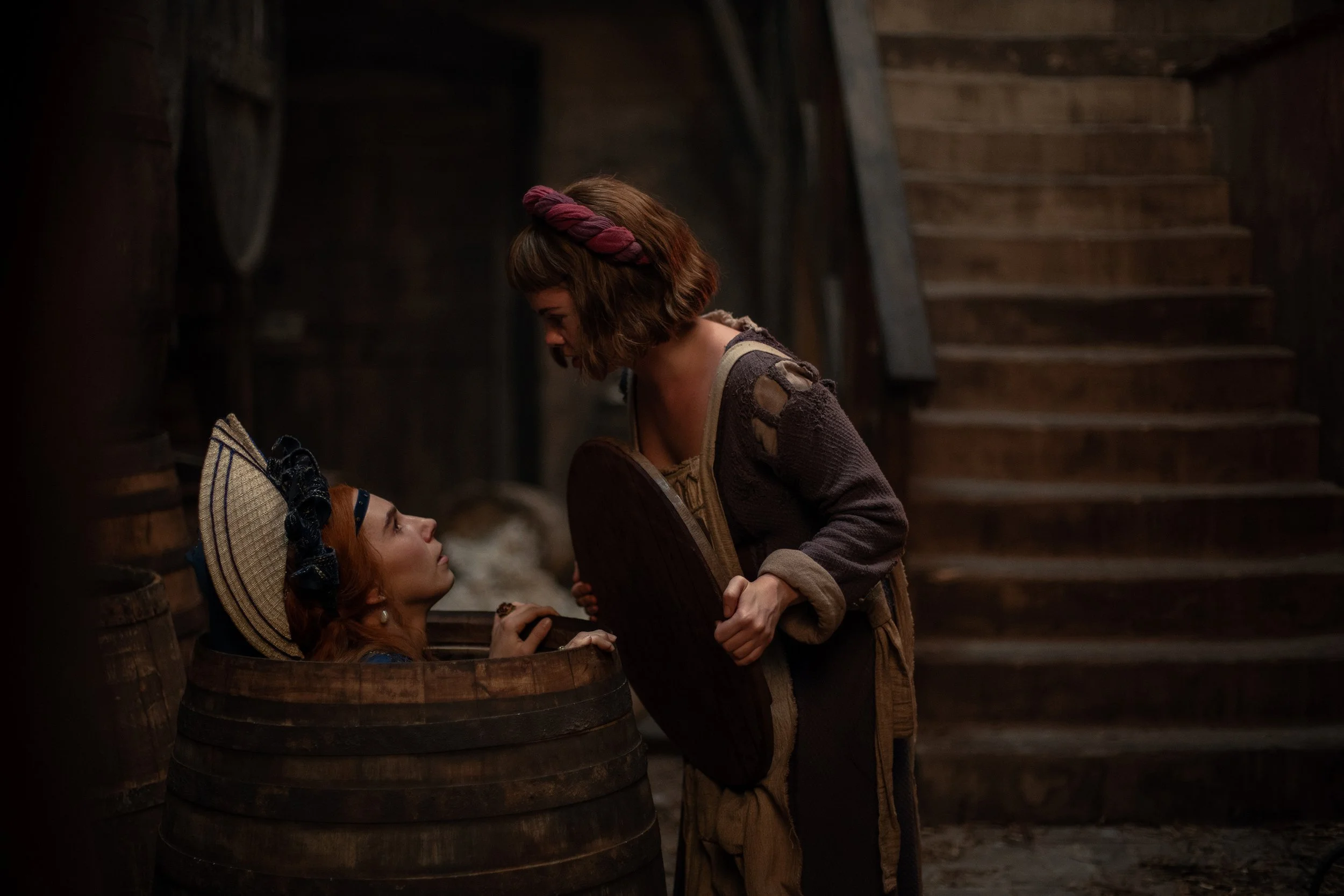
Misia shutting Pampinea in a barrel (Netflix)
Daniel Sangsue has asked if it is possible to parody the Middle Ages, an era that, in late medieval literature like that of Boccaccio, often and gleefully parodied its own absurdities.[42] Netflix’s Decameron is animated by the simultaneous and contradictory impulses to romanticize and parody the era, as a time of extravagant romance, bold deeds, and beautiful gardens—but also of laughable ignorance and endemic hypocrisy. Boccaccio’s comedy often relies on the subversion of expectations: putting an extra or unexpected twist at the end of a tale. But this subversion doesn’t function effectively if the improbable Middle Ages already serve as a space where anything is possible, and where coherent codes of conduct and consequences cannot be expected to apply. The absurdity and exaggeration that provide comedy in Boccaccio are already part of the show’s social and emotional landscape. Hiding someone in a barrel as a plot device, which occurs in Decameron VII,2 and which Misia does at the beginning and end of the series, is but one example.[43] The protagonist of Boccaccio’s story is a woman who finds a way to fulfill her sexual desires while convincing her husband that she shares his preoccupation with commerce. Misia, meanwhile, is forced to hide her forbidden lesbian lover, and murders her abusive mistress in an act that recalls Mrs. Danvers setting fire to Manderley.[44]
In a nod to the viewer who has read the Decameron, the series closes with Misia recounting Boccaccio’s tale of the barrel for the company. The dispirited survivors at last end up telling tales, but in a ruin. Their raucous laughter is cut off by Jacopo reminding everyone that their companions died and saying that both this and their own sadness are unalterable. They soon cheer up, however, sharing imaginary delicacies and listening to the opening of Decameron X,10 as recounted by Sirisco.[45] Boccaccio’s own conclusion similarly invites laughter, indulging in sex puns and self-deprecating remarks. The lightness of his tales, he says—“full of nonsense, jokes, and foolishness”—is entirely intentional, but the extent to which they are perceived as transgressive lies with the audience.[46] The same might be said of the insistent anachronism and achronicity of the Netflix Decameron. In a bedroom where much of the show’s action takes place are a series of Latin mottos. Opposite each other are “fortune favors the brave” and, more surprisingly given the show’s approach to historical plausibility, “history is the teacher of life.” Perhaps in a nod to the changeability of fortune explored by Boccaccio, the walls also declare Tempus omnia medetur: time cures all things. The show itself undermines all of these proverbs. But it does invite us to laugh.
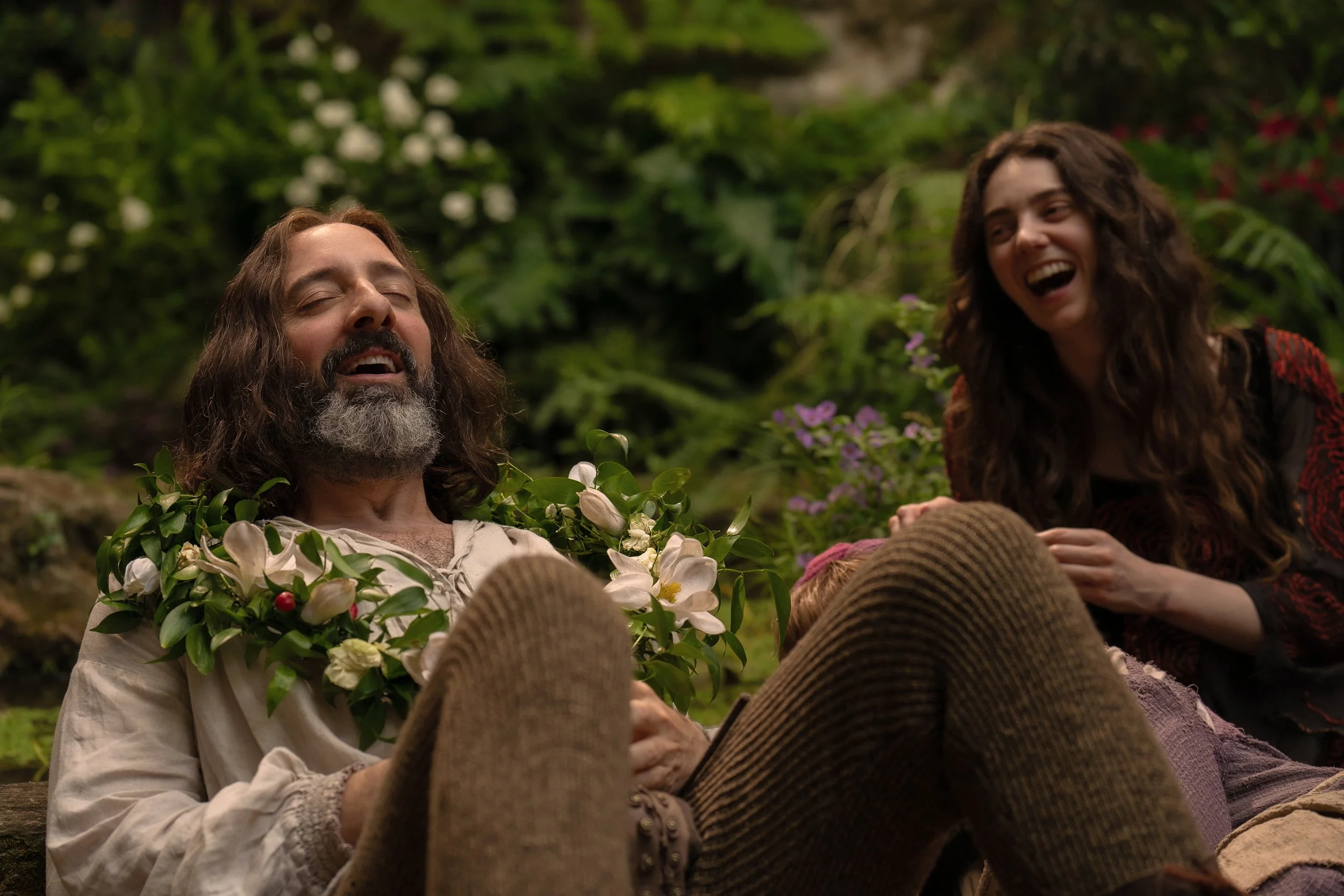
Sirisco and Licisca lounge on the ground, heads thrown back in laughter (Netflix)
D’Arcens has argued that “when laughing at the Middle Ages, we also laugh at ourselves, and at the recursive loopiness of time itself.”[47] In pondering the loops connecting the twenty-first century to the fourteenth, we may at least find, as Boccaccio hoped, the diversion of laughter.
Author Bio:
Lucy C. Barnhouse is Assistant Professor of History at Arkansas State University. Her recent publications include “Crossroads of Identity: The Late Medieval Evolutions of a Hospital Community” and, co-edited with Winston Black, Beyond Cadfael: Medieval Medicine and Medical Medievalisms. Her monograph, Hospitals in Communities of the Late Medieval Rhineland: Houses of God, Places for the Sick, recently appeared in paperback. She has been a podcaster with Footnoting History since 2013.
Notes:
[1] Julia M. Cozzarelli, “Love and Destruction in the Decameron: Cimone and Calandrino,” Forum Italicum 38, no. 2 (2004), 356.
[2] Megan L. Cook, “Dirtbag Medievalism,” LA Review of Books July 13, 2021, https://avidly.lareviewofbooks.org/2021/07/14/dirtbag-medievalism/, last accessed May 20, 2025.
[3] See e.g. Rosemary Horrox, ed. and trans., The Black Death (Manchester: Manchester University Press, 1994), 26-34.
[4] The Decameron season 1, episode 4, “The Mood is Soiled,” written by Anthony Natoli, directed by Andrew DeYoung, aired July 25, 2024, on Netflix, https://www.netflix.com/title/81417084, notably explores the Decameron’s themes of the porous boundaries between madness and reason, bestiality and civilization. Cf. Cozzarelli, “Love and Destruction in the Decameron,” 338-363.
[5] On the organization of the text as a method of inviting readers to explore its narratives, see Renzo Bragantini, “L’ordine del diletto. Racconto e pesto net Decameron,” Ludica 29 (2023), 111-120. On the lability, plurality, and playfulness of identity performance, see Piermario Vescovo, “Boccaccio, la peste, il teatro,” Studi sul Boccaccio 41 (2013), 171-205.
[6] Giovanni Boccaccio, The Decameron, ed. and trans. Mark Musa and Peter Bondanella (New York, NY: Norton, 1977), 1.
[7] Boccaccio, The Decameron, ed. and trans. Musa and Bondanella, 13-14.
[8] Adam Whittaker, “A Plague of Medievalism upon You All: Medievalism, Music, and the Plague,” in Studies in Medievalism XXVII: Authenticity, Medievalism, Music, ed. Karl Fugelso, (Woodbridge: Boydell & Brewer, 2018), 201. Whittaker also asserts that Black Death medievalism tends to create an “image of the medieval world as one that is preoccupied with the apocalypse, prone to descending into superstitious and ritual acts, and preoccupied with death itself, all in fear of God.” This is far from true in the show.
[9] I am grateful to Dr. Black for letting me read a draft of his essay.
[10] On flowers, see Boccaccio, The Decameron, ed. and trans. Musa and Bondanella, 6; The Decameron season 1, episode 1, “The Beautiful, Non-Infected Countryside,” written by Kathleen Jordan, directed by Michael Uppendahl, aired July 25, 2024, on Netflix, https://www.netflix.com/title/81417084,
[11] Boccaccio, The Decameron, ed. and trans. Musa and Bondanella, 3-9.
[12] Piermario Vescovo, “Boccaccio, la peste, il teatro.” Studi sul Boccaccio 41 (2013): 171-205, particularly 180f.
[13] Vescovo, “Boccaccio, la peste, il teatro,” 177-180.
[14] On the application of humoral theory to individual conduct during the Black Death see, for instance, John Aberth, Doctoring the Black Death: Medieval Europe’s Medical Response to Plague (London: Rowman & Littlefield, 2021), 236, 299. See also Black in this volume TK.
[15] Whittaker, “A Plague of Medievalism,” 203.
[16] See Laurie A. Finke and Martin B. Shichtman, “Apocalyptic Medievalism: Rape and Disease as Figures of Social Anomie,” in: Cinematic Illuminations: The Middle Ages on Film (Baltimore: The Johns Hopkins University Press, 2010), 288-334; and, of course, Michael White, Graham Chapman, John Cleese, Eric Idle, Terry Gilliam, Terry Jones, Michael Palin, John Goldstone, Mark Forstater, Monty Python and the Holy Grail, directed by Terry Gilliam and Terry Jones (Special ed., Widescreen ed. Burbank, CA: Columbia TriStar Home Entertainment, 2001.)
[17] Boccaccio, The Decameron, 10-13; On marriage in medieval Florence see Christiane Klapisch-Zuber, Women, Family, and Ritual in Renaissance Italy, trans. Lydia G. Cochrane (Chicago: University of Chicago Press, 1985), particularly Chapter 1.
[18] The Decameron season 1, episode 5, “Switcheroo.”
[19] Christiane Klapisch-Zuber, “Women Servants in Florence during the Fourteenth and Fifteenth Centuries,” in: Women and Work in Pre-Industrial Europe, ed. Barbara A. Hanawalt (Bloomington: Indiana University Press, 1986); Dennis Romano, “The Regulation of Domestic Service in Renaissance Venice,” The Sixteenth Century Journal 22, no. 4 (1991), 661–77, particularly 666-667. For primary sources, see Hannah Barker, trans., “Slave Labor and Free Service in Genoa,” Teaching Medieval Slavery and Captivity, http://medievalslavery.org/europe/source-slave-labor-and-free-service-in-genoa/, last accessed June 14, 2025.
[20] Ruth Mazo Karras, Sexuality in Medieval Europe: Doing Unto Others (New York, NY: Routledge, 2005), 134-144.
[21] See John of Arderne, trans. Faith Wallis, in: Medieval Medicine: A Reader, ed. Faith Wallis (Toronto: University of Toronto Press, 2010), 455-460.
[22] Boccaccio, The Decameron, 69-73.
[23] In The Decameron season 1, episode 5, “Switcheroo,” written by Megan King Kelly, directed by Anya Adams, aired July 25, 2024, on Netflix, https://www.netflix.com/title/81417084, she finally forms a liaison with a disreputable but attractive mercenary.
[24] The Decameron season 1, episode 3, “By Homer, It’s a Winner’s Wreath!” written by James Rogers III, directed by Andrew DeYoung, aired July 25, 2024, on Netflix, https://www.netflix.com/title/81417084.
[25] The Decameron season 1, episode 1, “The Beautiful, Non-Infected Countryside.”
[26] Margery Kempe, The Book of Margery Kempe, trans. Barry Windeatt (New York, NY: Penguin Books, 2000).
[27] The Decameron season 1, episode 1, “The Beautiful, Non-Infected Countryside.” On Licisca, cf. in this volume TK.
[28] The Decameron season 1, episode 1, “The Beautiful, Non-Infected Countryside.” The casting of Saoirse-Monica Jackson, most famous to international audiences for her role in Derry Girls (2018,) arguably contributes to the imaginary construction of transhistorical oppressions.
[29] Scott G. Bruce, ed., The Penguin Book of the Undead: Fifteen Hundred Years of Supernatural Encounters (New York, NY: Penguin Books, 2016), 98-99.
[30] Karras, Sexuality in Medieval Europe, 109-112; Judith M. Bennett, History Matters: Patriarchy and the Challenge of Feminism (Philadelphia: University of Pennsylvania Press, 2006), 108-127.
[31] Louise D’Arcens, “You Had To Be There: Anachronism and The Limits of Laughing at the Middle Ages,” Postmedieval 5, no. 2 (2014): 140-153, quoted at 144.
[32] Hans Ulrich Gumbrecht, “Intertextuality and Autumn / Autumn and the Modern Reception of the Middle Ages,” in The New Medievalism, ed. Marina S. Brownlee, Kevin Brownlee, and Stephen G. Nichols (Baltimore, MD, and London: Johns Hopkins University Press, 1991), 301–30.
[33] The Adventures of Robin Hood, directed by Michael Curtiz (1938; Burbank, CA: Warner Bros. Home Entertainment, 2010,) DVD; A Knight’s Tale, directed by Brian Helgelund (2001; Burbank, CA: Columbia Pictures), streaming via Apple TV.
[34] Whittaker, “A Plague of Medievalism upon You All,” 217-18.
[35] The Decameron season 1, episode 5, “Switcheroo,”; The Decameron season 1, episode 2, “Holiday State of Mind,” written by Kathleen Jordan, directed by Michael Uppendahl, aired July 25, 2024, on Netflix, https://www.netflix.com/title/81417084,
[36] Marcus Bull, Thinking Medieval: An Introduction to the Study of the Middle Ages (London: Palgrave Macmillan, 2005), 20-23; David Matthews, “How Many Middle Ages?” in: Medievalism: A Critical History (Woodbridge: Boydell and Brewer, 2015), 37-74. I am indebted to Dr. Rachel E. Clark for this reference.
[37] While Alma-Tadema is best known for his classical scenes, he also engaged extensively with medievalism in his early career. See, for instance, “Fredegonda at the Deathbed of Praetextatus,” 1863, https://collections.britishart.yale.edu/catalog/tms:9181, last accessed June 15, 2025.
[38] Bull, Thinking Medieval, 26-27.
[39] The Adventures of Robin Hood, dir. Michael Curtiz; The Court Jester, directed by Melvin Frank and Norman Panama (1955, Paramount Studios, streaming via Apple TV). While Flynn climbs a convenient vine, Danny Kaye swings on one like Tarzan.
[40] D’Arcens, “You Had To Be There,” 147.
[41] The Decameron season 1, episode 3, “By Homer, It’s a Winner’s Wreath!”
[42] Daniel Sangsue and Anne-Marie Baron, “Parodies romantiques du Moyen Age,” in: La Fabrique du Moyen Age au XIXe siècle. Réprésentations du Moyen Age dans la culture et la littérature françaises du XIXe siècle, eds. Simone Bernard-Griffiths, Pierre Glaudes, and Bertrand Vibert (Paris, Honoré Champion, 2006), 1101-1111, at 1101.
[43] Boccaccio, The Decameron, 116-119. The Decameron season 1, episode 1, “The Beautiful, Non-Infected Countryside,”; and The Decameron season 1, episode 8, “We’ve Had a Good Cry,” written by Kathleen Jordan and Steve Unckles, directed by Michael Uppendahl, aired July 25, 2024, on Netflix, https://www.netflix.com/title/81417084,
[44] See Daphne du Maurier, Rebecca (London: Victor Gollancz, 1938); and perhaps even more influentially, Rebecca, directed by Alfred Hitchcock (1940, Selznick International Pictures), with Judith Anderson as the housekeeper. On Misia and literary queerness, see in this volume TK.
[45] Boccaccio, The Decameron, 33-142; The Decameron season 1, episode 8, “We’ve Had a Good Cry.”
[46] Boccaccio, The Decameron, 143-147, quoted at 146.
[47] D’Arcens, “You Had To Be There,” 152.