
Shouting at the Air: Plague Medievalisms for the Covid Era in Netflix’s The Decameron
By Winston Black
Countless novels, comics, shows, movies, and video games present fictional retellings of the Black Death. From cinematic masterpieces like Ingmar Bergman’s The Seventh Seal (1957) and haunting narrative games like Plague Tale: Innocence (2019), to Monty Python’s comedic ‘Bring out yer dead!‘ (1975) and Hollywood bottom feeders like Season of the Witch (2012), popular culture has returned again and again to stories of disease and suffering in the Middle Ages. Each of these works is not about the Middle Ages as such, but rather employs medievalism, a term from literary and historical criticism for the borrowing and reframing of medieval themes in modern genres, often with little concern for historical accuracy. The Black Death occurs in so many instances of medievalism that ‘plague medievalism,’ the study of how medieval plagues are represented today, deserves to be examined in its own right, understood through the lenses of cultural studies and the history of medicine.
In most examples of plague medievalism, modern creators tell a story against the backdrop of medieval plague but frame it with the tropes of modern genres such as dark fantasy, time travel, body horror, or medical thriller. Medieval plague in these modern stories is used not as a tool for teaching history but (much like zombies in socially-conscious horror movies) as a frightening metaphor for current events and ideas. It was hardly surprising, then, that a studio would bring out a plague-themed show during the Covid-19 era. Ready comparisons between Covid and the Black Death had been circulating since early 2020, mostly in meme form online. We all remember the masked plague doctors who were employed humorously to teach pandemic lessons: Stay inside. Keep your distance. Wash your damn hands!
Evolution of Plague Medievalism
Most plague media before Covid focused on the shock and horror of difference between an imagined medieval past, suffering the supposed failures of the ‘Dark Ages,’ and a significantly cleaner and more technologically advanced present.[1] This disjunction is especially evident in stories about the Black Death that feature time travel or parallel narratives between the Middle Ages and the present or future, like Connie Willis’s 1992 novel Doomsday Book, Ann Benson’s Plague Tales trilogy (1997-2006), and Daniel Kalla’s We All Fall Down (2019). The supposed filth and superstition of the Middle Ages is made all the more pathetic in juxtaposition with the advanced technology and effective medicine of modern-day, or future, protagonists.
The Decameron, a limited series released on Netflix in 2024, presents a new take on plague medievalism, one that only makes sense in the wake of the Covid pandemic. The series is loosely based on Giovanni Boccaccio’s medieval frame story of the same name. The original is a collection of one hundred short tales told by a fictional group of young noble men and women who flee from the 1348 outbreak of plague in Florence to the safety of a country estate. Their stories variously provide moral lessons, exciting adventures, social mockery, and sexual titillation—in short, entertainments designed to distract each other from the horrors of the pandemic in their home city. The only part of the original Decameron that is actually about plague is Boccaccio’s introduction, in which he lays out the medical and social impacts of the disease that inspired him to write this book. Boccaccio finished The Decameron around 1353, after surviving the devastations of plague in Florence five years earlier and seeing many of his friends and family taken by the disease.
Creators and audiences by 2024 likewise had several years of pandemic experience (horrible enough, but nothing like the Black Death) that helped turn The Decameron series into something different from previous plague medievalisms. Netflix’s Decameron reframes medieval responses to the plague as an absurd echo of our own Covid experience. The character of Licisca sticks daisies up her nose to block the foul vapors of plague—a misguided but well-meaning act based on a shallow understanding of contemporary science, much like people wiping down groceries in 2020. Dioneo, a private physician, is forced to become a plague expert and public health official overnight for the Florentines hiding in Villa Santa. Other characters, like Misia, tragically hope that simple food and water will help her ailing lover improve. This presentation of medicine, doctors, and death in fourteenth-century Florence is not meant to alienate or shock modern viewers, as it does in so many other plague medievalisms (including some of those mentioned above), but to draw us in as sympathetic participants of another pandemic experience.
Boccaccio’s Decameron, as a work of fiction set against the events of an imaginative retelling of the Black Death, was arguably the first plague medievalism. Historian Shona Kelly Wray showed how the introduction to the Decameron, although it has been used for centuries by scholarly and popular authors as a historical record of the Black Death, is not an accurate account of the plague but rather Boccaccio’s personal and moral reaction to contemporary treatises about the disease, written by physicians who were as desperate as anyone to find a cure.[2] Netflix’s Decameron is likewise neither a history of the Black Death nor a faithful adaptation of Boccaccio’s work, but (in part) a comic meditation on social and medical responses to Covid.
Medievalism and the Lure of ‘Accuracy’
In the words of my colleague on The So What, Dr. Lucy Barnhouse, ‘the medieval has appeared as a signifier of inadequate medical knowledge, helplessness in the face of disease, and failures of both imagination and implementation in public health policy.’[3] This ‘inadequacy’ is often personified in plague medievalism by the ominous, masked plague doctor (an anachronistic intruder from the seventeenth century)[4] or is represented by hordes of pestiferous rats, swollen and bursting plague buboes, and witches blamed for the pestilence and burned at the stake. Plague, along with brutal warfare and endemic sexual violence (I’m looking at you, Game of Thrones), are some of the main themes used by modern creators to make a medieval setting feel ‘authentic’ but not necessarily ‘accurate.’[5]
Netflix’s Decameron is tailored to a new sort of audience: the millions of Covid survivors who are more ready than past audiences to laugh at and laugh with medieval Europeans during the Black Death. While the show includes a few of the obligatory rats, buboes, and pestilent corpses, they are not the point; they are the horrors on the fringe of the social comedy and sexcapades in the Villa Santa (just as they are in the original Decameron). The Decameron series is comic not only because its source material is comic, but because our Covid experience made us ready for a good dose of humor within plague medievalism. What was surprising, to this medievalist anyway, was how the show avoids most of the easy plague tropes and gives us both a self-aware dark comedy, rife with intentional anachronisms and knowing winks at other series about sex and awkward social relations (Girls, Sex Education, Derry Girls, each of which shares an actress with The Decameron), and one of the most historically accurate depictions of medieval doctors and medicine in any modern media.
But what’s the point of accuracy in a modern depiction of medieval medicine? By all accounts, it’s not what modern audiences want. Or, when they do, ‘accuracy’ is invoked to perpetuate present-day biases about race, gender, and politics. This is especially common in the world of medieval-themed video and roleplaying games, which sees frequent backlash among certain fans against games that include characters that do not fit a stereotypical, Hollywood vision of medieval warriors as white, cishet, male, and Christian-coded.[6] Historians of medievalism, such as Robert Houghton and Karl Alvestad, have stressed that accuracy in medieval media is not a desirable or realizable end in itself, but is rather a rhetorical tool employed by creators to validate or sell their product.[7] As such, we should ask what is the function of ‘accuracy’ in Netflix’s Decameron: Why do the creators care more about informed historical representations of medieval medicine and doctors at this time and in this medium than in other plague medievalisms?
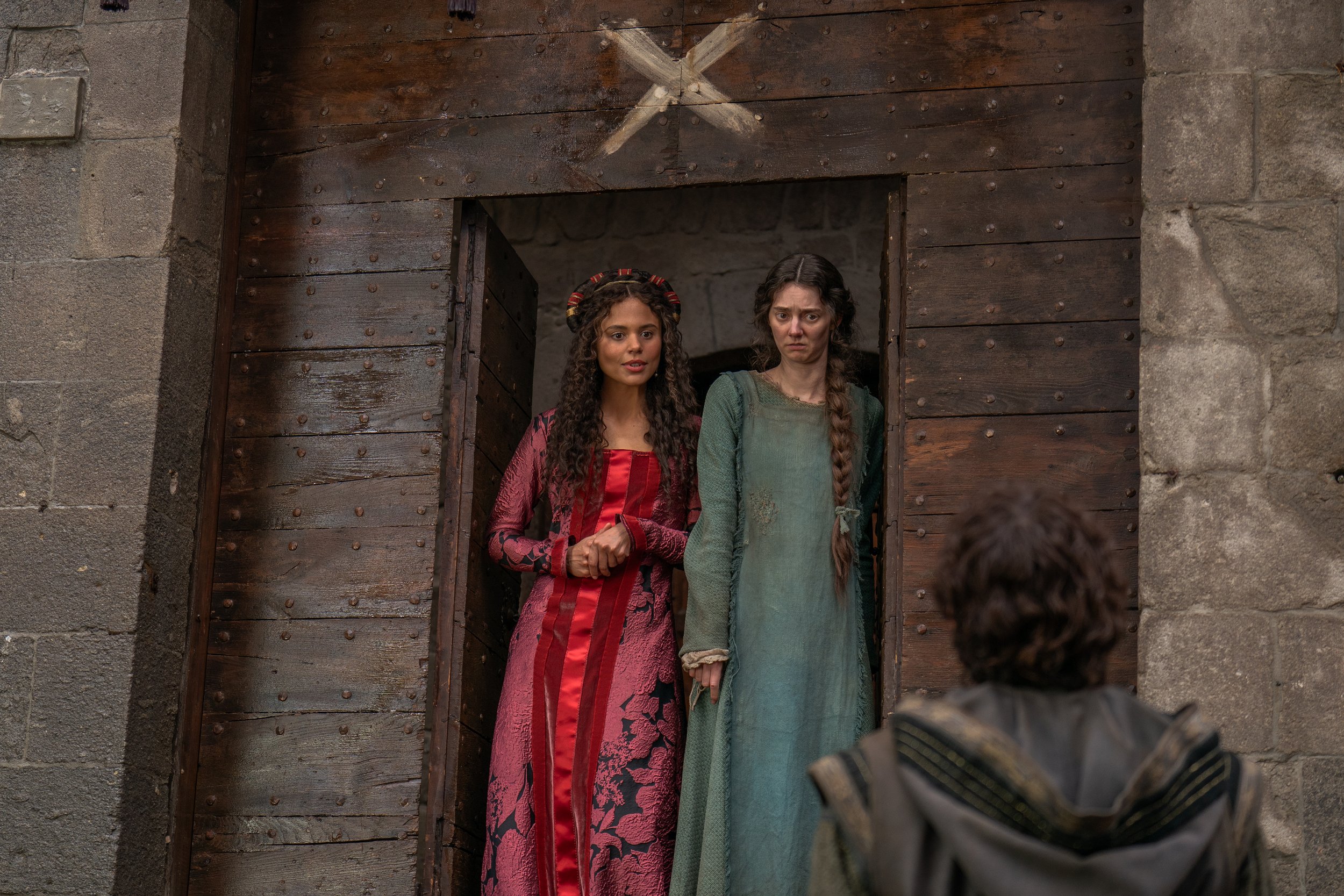
The young noblewoman Filomena (Jessica Plummer) and her handmaiden Licisca (Tanya Reynolds) greet a messenger at the door of their Florence house, marked with an ‘X’ as one infected with plague. (Netflix)
Plague Medicine as Entertainment
The first episode of The Decameron, ‘The Beautiful, Not-Infected Countryside,’ builds on Boccaccio’s narrative device of Florentine nobles fleeing the city for a supposedly healthier villa in the country, while also introducing an apparently more modern theory of infectious disease. The characters understand the plague more in the medieval sense as a pestilential miasma, a poisonous air hanging over places, rather than a pathogen infecting individuals. A messenger to Filomena’s house in Florence says of Leonardo, lord of Villa Santa, ‘He desires that you flee the pestilence-ridden city and enjoy a respite in the beautiful, not-infected countryside.’ Filomena is excited for several reasons to visit Villa Santa, not least because, as she says, ‘The pestilence has yet to reach the countryside.’
Other characters think more of the interpersonal transmission of disease, although not in the modern sense of infection by microorganisms. Misia’s lover Parmena, dying of plague and smuggled into Villa Santa in a wine cask, warns Misia away from her: ‘Further away. It might jump from my soul to yours. You can’t die too.’ This concept of a disease ‘jumping’ from soul to soul is touching, and certainly sounds ‘medieval,’ but it does not appear in any genuine medieval account of the plague. The scene builds on modern viewers’ expectations for medieval people to ‘spiritualize’ any condition. More pragmatically, Misia and the villa’s chamberlain Sirisco both try to hide the bodies of plague victims (the deceased lord, Leonardo, and Parmena, respectively) and accuse each other of possessing a ‘pestilence person.’ Leonardo and Parmena are imagined as bearing the plague still, whether alive or dead.
‘The Beautiful, Not-Infected Countryside’ also provides viewers, in the first few minutes, with a portrait of two doctors, representing two classes of medicine available in 1348 Florence, one for the rich, and one for everybody else. Whether intentionally ‘accurate’ or not, this depiction of the social stratification of medicine is already far closer to medieval realities than nearly any other plague medievalism.[8] One doctor is an unnamed, apparently lower-class healer (he wears the same dull and ratty clothing as everyone around him in the shit-spattered city streets) pushing his way through the crowded marketplace and rejecting the many desperate requests for help: ‘Prayer alone can save you now! Feck off!’ He echoes Boccaccio’s account of the plague in his introduction, ‘Against these maladies [i.e. the symptoms of plague], it seemed that all the advice of physicians and all the power of medicine were profitless and unavailing.’[9] But in the show, we immediately meet this doctor’s more successful counterpart, Dioneo, personal physician to the immensely wealthy and profoundly pathetic young lord Tindaro, the only surviving son of a noble Florentine dynasty. Dioneo, portrayed by Amar Chadha-Patel, dressed in elegant green and purple brocade, and safe behind the high walls of a palatial compound, is bothered only by his patron Tindaro’s ridiculous demands and hypochondria.
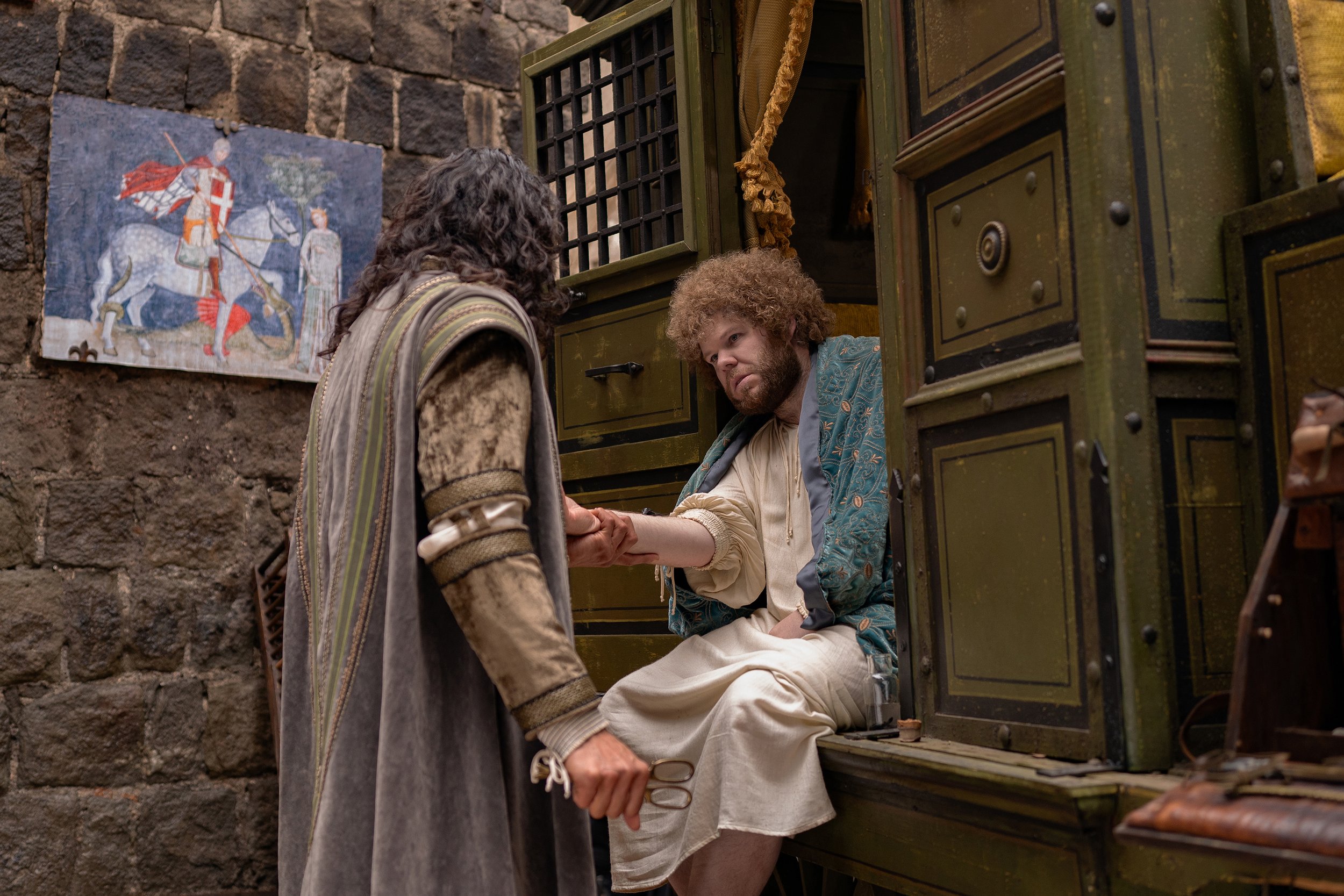
The physician Dioneo (Amar Chadha-Patel) takes the pulse of his hypochondriac patron Tindaro (Douggie McMeekin), who is looking miserable in his bedclothes. (Netflix)
The Decameron (both the original and the Netflix series) is more about social relationships than about the Black Death. Yet the relationship between Tindaro and Dioneo in the series is explored primarily through the practice of holistic medicine: Dioneo cares for every aspect of Tindaro’s diet and drink, exercise, sexual activity, and emotions, just as prescribed in medieval health manuals known as regimina sanitatis (regimens of health).[10] As a medical character, Dioneo is not a ‘plague doctor’ but a ‘doctor during the plague.’ The writers use Dioneo to play with modern expectations of plague medievalism: he is not the masked monster found in most plague tales, but a combination of the brooding hunk in an ensemble dramedy and the kindly face of a public health advisor. Rather than being a feared harbinger of plague, he is clever, charming, socially and sexually dissatisfied, an object of desire and sympathy for the audience: in short, a new plague doctor for the post-Covid era.

Sirisco (Tony Hale), the chamberlain of Villa Santa, examines the shirtless torso of an absurdly ripped Dioneo (Amar Chadha-Patel) for signs of plague. (Netflix)
Dioneo employs remedies and explanations for disease that are right at home in later medieval medical manuals, based on a simplified version of Galen’s humoral theory, as adapted to later medieval society. As a private physician, Dioneo is the full-time caretaker of Tindaro’s body, tasked first with preserving his health from all onslaughts, physical, social, and emotional. To do so, he needs to understand the unique complexion or temperament of his master’s body, and the effects of foods, drinks, activities, and environments upon it. He warns Tindaro, ‘Pestilence is everywhere in Firenze. With your fragile constitution, its slightest touch would be your certain doom. But a few weeks in the countryside could do wonders for your health… I care only for what benefits your health.’
Dioneo suggests that the women they meet at Villa Santa could raise Tindaro’s spirits and ‘help balance your humors,’ an idea the deeply misogynistic Tindaro finds hard to swallow. Dioneo, however, encourages Tindaro in his hypochondriac fantasies, and frequently confirms his belief that he is weak and ill. Once at the villa, Dioneo warns Tindaro away from physical activity: ‘Please be careful. Your bones are incredibly brittle.’ And when Dioneo grows jealous of Tindaro’s affections for Licisca (pretending to be her lady, Filomena), he plays on Tindaro’s fears of sickness using ideas from humoral medicine that would not be out of place in a fourteenth-century textbook: ‘I examined your morning urine. It appears that you are enduring a severe imbalance of red and yellow humors.’ (Never mind the fact that ‘red’ and ‘yellow’ were used by medieval doctors to refer to the same humor, choler, but that may be a deep cut intended for medical historians). He attributes this supposed humoral imbalance to the strenuous journey to the villa and Tindaro’s unaccustomed activity levels.
Dioneo fills several roles as physician, attendant, and confidant to the hapless Tindaro, who is prey to many misfortunes, imagined and real (like swallowing a ladybug in one hilarious scene). To help manage Tindaro, Dioneo is learned in the tenets of Galenic, humoral medicine and has educated Tindaro in the basics of these as well. But, for Tindaro, this amounts to an obsession with his own urine and stool, which he has started to interpret himself. ‘Let me be the judge of your excrement, Padrone,’ Dioneo warns. The scatology becomes anachronistic in a later scene when Dioneo warns the others that Tindaro is unwell, suffering ‘a real poop show.’
One of Dioneo’s main activities is preparing a range of potions and remedies for Tindaro, the more disgusting the better. He makes herbal teas, ‘full of bits,’ which violently purge Tindaro through vomit and stool, another element in the show taken directly from medieval medicine, which often relied on bitter purgative infusions. Dioneo’s claims to medical expertise can be played entirely for humor, as when he slaps the furious Filomena in episode 2, ‘Holiday State of Mind,’ and feels the need to explain: ‘I don’t usually like to hit women, but that was medically necessary.’ The other characters take Dioneo’s medical abilities, and lower mercantile status, for granted. Sirisco mentions, almost offhand, that ‘Dioneo is neutralizing the plague, and then I will be serving dessert,’ both performing tasks to improve the lives of the visiting nobility.
Dioneo’s recommendations for protection against the plague (onions rubbed on the arms and shouting at the air), his analysis of Tindaro’s excrement, and the disgusting purgative drinks he brews are all played for laughs, but they are closer to historical realities of fourteenth-century medicine than any other plague medievalism. In a ridiculous scene in episode 2, Dioneo chants methodically to the nobles, ‘Follow me. Stinky. Stinky,’ as he teaches them how to neutralize the poisonous miasma around them. Most medieval plague treatises provide recommendations on how to modify, purify, or push away the corrupted air, or ‘miasma,’ that was believed to cause or spread the pestilence (although usually with fire and incense rather than with shouting).[11] The strong odor of onions and garlic was believed to change the nature of pestilential air into something less dangerous, or prevent that air from entering a person’s lungs and pores.
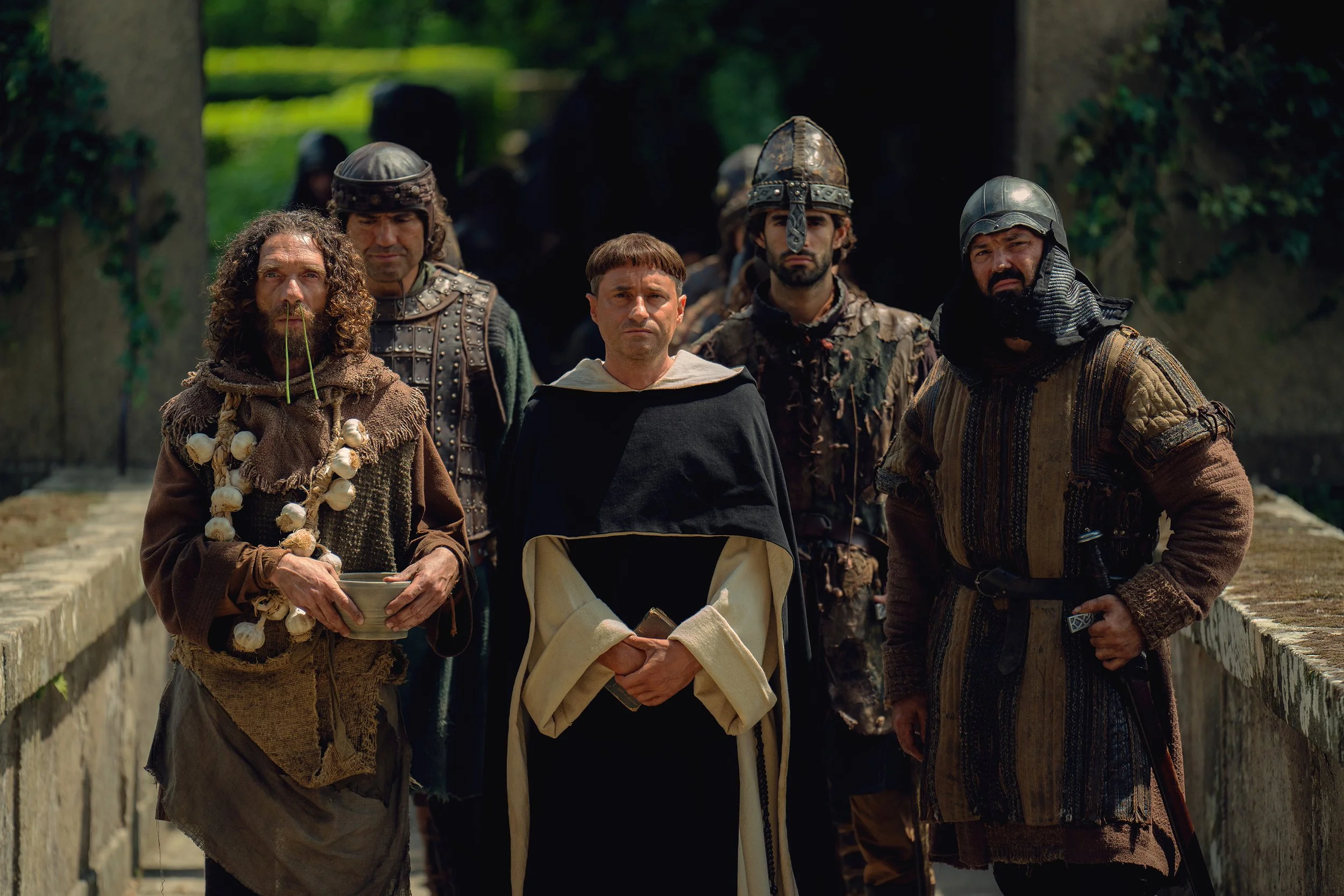
A rebel monk and his mercenary army stand guard. One of the men wears a necklace of garlic and has stuffed flowers up his nose to fend off the plague. (Netflix)
Conclusion: Rat Tails and Human Souls
Netflix’s show plays on the audience’s limited knowledge not just of medieval medicine but also of modern medicine, weaving together those two bodies of medical assumptions, creating a kinship of experience between the medieval plague survivors and modern Covid survivors. Such is the case with rats, which modern popular knowledge invariably associates with plague, so that audiences have come to expect abundant rats in any plague medievalism and creators have been happy to oblige. Sure enough, the opening titles of The Decameron emerge from an elaborate choreography of thousands of rats. But these are not the terrifying hordes of malevolent rats in Albert Camus’s The Plague (1949) or Asobo Studio’s A Plague Tale: Innocence, but a gathering of confused and curious rodents who explore, sniff, fuck, and die as a group, accompanied by a breathy pseudo-medieval chant (Ruth Barrett’s original soundtrack for the series is excellent). These rats unite as a sentient Rat King that forms various convulsing shapes indicative of themes in the series: a wine goblet, hands folded in prayer, a cross, and a skull. Yet the very first shape they make is not ‘medieval’ but modern and biomedical: a web of twitching and weaving lines, thick and thin, echoing videos of bacteria multiplying and moving under a microscope, reminding modern viewers that we (supposedly) understand the microbiological causes of plague better than our medieval ancestors.
But for all this focus on rats in the opening titles, they are surprisingly absent from the episodes themselves. They are not shown directly as the bearers of plague, but as a regular nuisance, as when the cook Stratilia captures one in the kitchen and burns it to death on a stove. The plague of Netflix’s Decameron is a human disease, caused and spread by human interactions, as well as God’s punishment on the world for humanity’s many sins (the obsession of the character Neifile). In this respect, the new Decameron is faithful to medieval views, as fourteenth-century observers of the plague focused on human bodies and their environment, and the relationship of body and soul, but not on the animals—rats and fleas—that we now recognize as the primary hosts and vectors of plague in relation to human populations.
The show’s creators interweave medieval and modern medical ideas, modern and medieval humor, to draw in viewers and make us feel more comfortable in a medieval setting. The plague doctor is not an object of fear, but a knee-shakingly handsome and complicated man (there are surely intentional echoes here of our handsome protector, “Daddy Fauci”), whose death provokes sadness and confusion among the characters and audience. I still don’t know why Dioneo had to die, but, if we read this plague tale as a parable for Covid, he reminds us of the many medical professionals who died, especially in 2020, trying to contain the new disease. The moments of historical accuracy in the show, especially concerning doctors and medical ideas, are not there simply for the sake of appearing more ‘correct,’ but to help viewers understand that our shared medical and existential crisis during the Covid pandemic bears comparison with the lived experience of the Black Death.
Author Bio:
Winston Black (he/him) is a historian of medieval medicine, Christianity, and medievalism. He holds the Gatto Chair of Christian Studies at St. Francis Xavier University in Nova Scotia, Canada. Black is the author or co-author of six books and many essays on medieval history and the history of medicine, including Beyond Cadfael: Medieval Medicine and Medical Medievalism (2023) with Lucy Barnhouse, and he served as a historical consultant on the award-winning 2022 medieval video game Pentiment. He is currently writing a monograph on the creation and use of a medical handbook in a twelfth-century monastic infirmary.
Notes:
[1] I echo here one of the foundational works in the study of medieval history and medievalism, Kathleen Biddick, The Shock of Medievalism (Durham, NC: Duke University Press, 1998).
[2] Shona Kelly Wray, ‘Boccaccio and the Doctors: Medicine and Compassion in the Face of Plague,’ Journal of Medieval History 30 (2004): 301-322.
[3] Lucy C. Barnhouse and Winston Black, ‘Beyond Cadfael: Identifying and Defining Medical Medievalism,’ in Beyond Cadfael: Medieval Medicine and Medical Medievalism, ed. Lucy C. Barnhouse and Winston Black (Budapest: Trivent, 2023), pp. 1-27, at p. 7.
[4] Winston Black, The Middle Ages: Facts and Fictions (Santa Barbara, CA: ABC-CLIO, 2019), pp. 213-240.
[5] April Harper, ‘Misdiagnosing Medieval Medicine,’ in The Middle Ages in Modern Culture: History and Authenticity in Contemporary Medievalism, ed. Karl C. Alvestad and Robert Houghton (London: Bloomsbury, 2021), pp. 58-73, at 63.
[6] Alaya Swann, ‘White Supremacy and Medievalism in Online Dungeons and Dragons Communities,’ History Workshop, 17 June 2019, https://www.historyworkshop.org.uk/anti-racism/white-supremacy-and-medievalism-in-online-dungeons-and-dragons-communities/.
[7] Robert Houghton and Karl C. Alvestad, ‘Introduction,’ The Middle Ages in Modern Culture, pp. 1-11.
[8] Katharine Park, ‘Medicine and Society in Medieval Europe, 500-1500,’ in Medicine and Society: Historical Essays, ed. Andrew Wear (Cambridge: Cambridge University Press, 1992), pp. 59-90, especially pp. 83-87 on medicine for the lower classes.
[9] Giovanni Boccaccio, The Decameron, trans. G.H. McWilliam. Second Edition (London: Penguin, 1995), p. 5.
[10] On regimens and other medieval medical genres, see Marilyn Nicoud, ‘The Western Medieval Medical Literature, its Books and Readership: A Complex Reality,’ Medicina nei secoli 36.1 (2024): 81-101.
[11] John Aberth, Doctoring the Black Death: Medieval Europe’s Medical Response to Plague (Lanham, MD: Rowman & Littlefield, 2021), pp. 165-172.