
Licisca(s) and the Transgressive Medieval in Adaptation
By Megan Gorsalitz
The COVID-19 pandemic sparked creativity in many people stuck at home, and this creativity brought people in the twenty-first century closer to people in the fourteenth century. Beginning in 2020, a number of interesting adaptations of Boccaccio’s fourteenth-century Decameron emerged. These adaptations were a direct result of the COVID-19 pandemic. Boccacio’s text, written between 1348 and 1352—in the wake of the Black Death in Florence—follows ten Florentine elites as they flee to countryside villas in order to escape the plague. For ten days, they tell each other stories to pass the time. Several adaptations of the Decameron, such as The New York Times’s Decameron Project (2020) and Harper Collins Italia’s Nuovo Decameron (2021), were collections of stories meant to mimic the ten elites’ stories in the source text. However, Netflix’s 2024 television series adaptation, The Decameron, focuses entirely on the frame narrative—the interpersonal relationships between the elites and their servants—rather than on the stories they are telling.
Many characters in the 2024 Decameron are also significantly altered in comparison to their fourteenth-century counterparts. In particular, Licisca goes from occupying only a few pages of Boccaccio’s text to being one of the 2024 version’s central characters—even featured heavily in the show’s marketing. While Licisca’s role in the Netflix adaptation is greatly increased, there are still clear resonances with Boccaccio’s original character. In each version, Licisca engages in processes of creative remaking that call class divisions into question. The parallels between the two Liciscas, along with the story’s pandemic setting, create a sense of similarity rather than difference between The Decameron’s original fourteenth-century context and the Netflix series’s 2024 context. This sense of similarity reduces the distance between present and past, allowing viewers to see themselves reflected in the medieval world on screen.
The first five days of Boccaccio’s Decameron emphasize the order of the countryside retreat in contrast to the chaos of the plagued Florence. Each day has a designated leader— ‘king’ or ‘queen’—who governs the group’s activities, which take place in manicured garden spaces. However, on Day Six, just before the first story of the day commences, this manufactured peace is interrupted by ‘a great commotion, issuing from the kitchens.’[1] The commotion is a disagreement between two servants, Licisca and Tindaro, who argue over whether a mutual friend was a virgin when she married. Licisca asserts she was not and only tricked her husband to make him think so. The argument itself is not the most interesting part of this interaction: what’s really interesting is Licisca’s behaviour. When Tindaro tries to speak she tells him ‘hold your tongue and let me tell the story,’[2] following this statement, ‘six times at least the queen told her to stop, but all to no avail: she was determined to have her say.’[3] After Licisca is finally banished back to the kitchens, Dioneo (Day Seven’s ‘king’) declares that the theme for the next day’s stories, inspired by Licisca, must be wives who play tricks on their husbands.
In her disruption of the retreat, Boccaccio’s Licisca engages with a creative textual remaking akin to adaptation. As Linda Hutcheon has argued, adaptation is both a product and a process that is characterized by repetition and variation.[4] This process involves, according to Thomas Leitch, critical reading and creative re-writing.[5] In Bocaccio’s story about nobles storytelling, at the moment that elite narration is primed to occur, Licisca inserts herself and demands to tell her own tale. In doing so, she repeats the story-within-a-story structure of The Decameron but introduces textual variation when she gives herself—a servant—a voice. She tries to creatively rewrite The Decameron in order to create a version of the text in which she also has the privilege to partake.
By adapting the structure of The Decameron to introduce class-based variation, Licisca destabilizes clear class divisions. This kind of instability is also characteristic of adaptation, which Rochelle Hurst asserts is binary-resistant:[6] the relationship between adaptations and their sources is reciprocal and destabilizing, with each adaptation becoming multiple narratives at once. On the most straightforward level, then, Licisca partakes in this kind of creative adaptation by resisting status binaries through the appropriation of an elite storytelling ritual. She breaks through class divisions by invading the nobles’ physical and aural space, inserting herself into their activities and demanding that her voice be heard. In doing so, she creates an unstable, layered narrative: even when she is banished back to the kitchens, the stories for the next day are all themed around her interruption. She continues to haunt the text, inverting the class hierarchy by exerting influence over the elites who are supposed to have power over her and by insisting her voice is just as valuable as theirs. Ultimately, Licisca’s creative adaptation of the text in which she exists calls into question the apparent power of the nobles in charge of the retreat; their supposed order can be disrupted and appropriated by a member of their serving staff, undermining the validity of their higher position on the social hierarchy.
Licisca’s creative disruptiveness carries over into the 2024 Decameron, refashioned for contemporary audiences. In and of itself, the premise of Boccaccio’s Decameron provides an easy gateway for audiences living in the aftermath of the COVID-19 pandemic to connect with the story: it’s a text rooted in plague. Showrunner Kathleen Jordan has discussed feeling inspired by Boccaccio’s text while quarantining from the coronavirus;[7] The Decameron (2024) is set during the Black Death, but it’s about COVID-19. Namely, the show, because of the particularly close attention it pays to its servant characters, is about problems of wealth inequality, which were exacerbated by COVID-19. Jordan cites her class commentary as inspired by the general public’s online reactions to celebrities during the pandemic, saying ‘there were these pop culture moments of sending up the wealthy for being tone deaf about the time that we were living in.’[8] The connection between the Black Death and the COVID-19 pandemic thus primes contemporary audiences to relate to the 2024 Decameron’s portrayal of servants like Licisca (Tanya Reynolds).
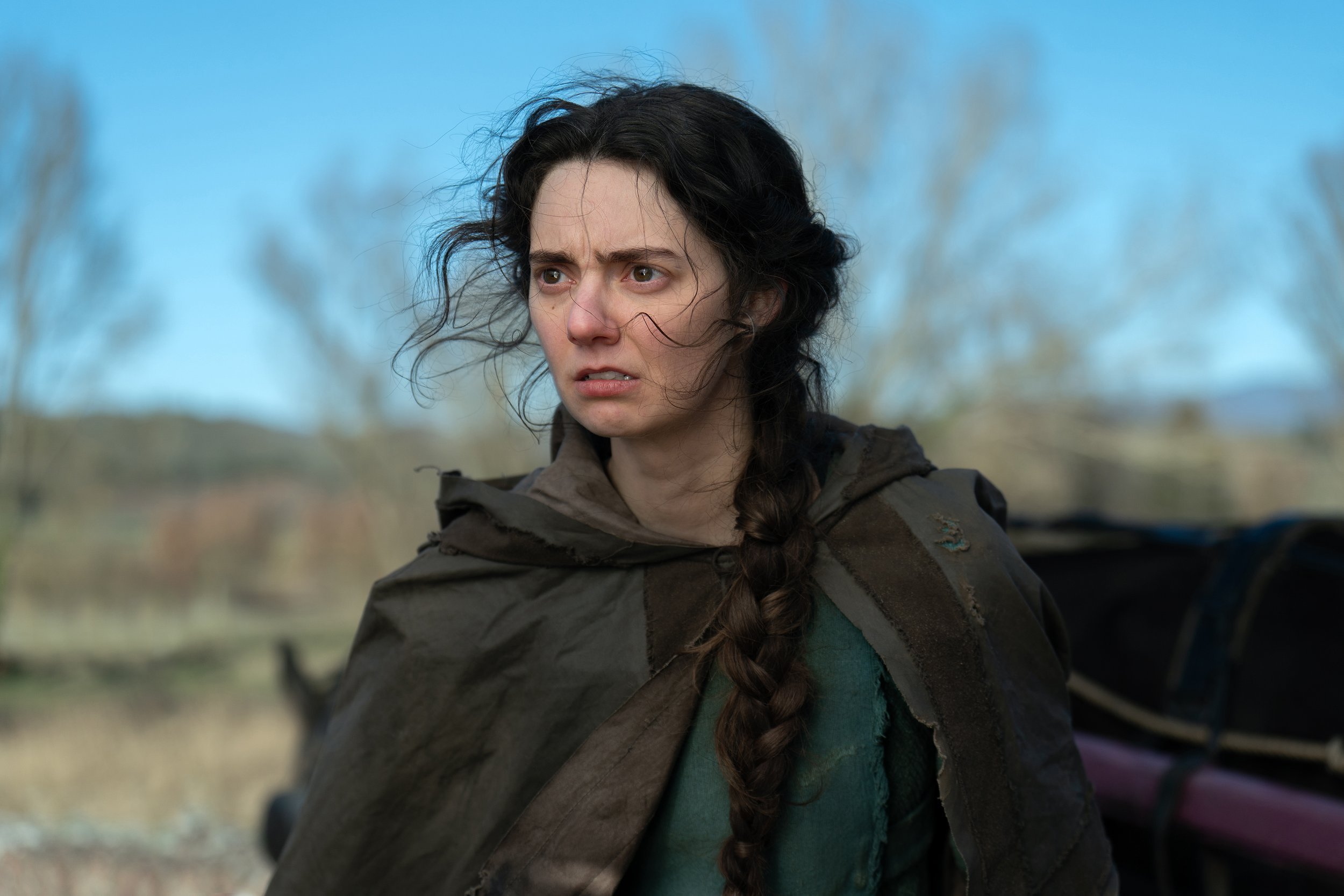
Licisca (Tanya Reynolds) in her servant role at the beginning of the show; her hair is in a single braid, with no adornments, and she stands in a simple cloak and dress (Netflix)
The first episode of The Decameron opens with a montage of the main cast of nobility—Pampinea (Zosia Mamet), Panfilo (Karan Gill), Neifile (Lou Gala), Filomena (Jessica Plummer), and Tindaro (Douggie McMeekin)—voicing their desires to flee Florence and save themselves while surrounded by people suffering from plague. The show then cuts to Licisca watching the disposal of bodies and expressing sympathy for the deceased and their families. Licisca’s empathetic reaction immediately contrasts her with the selfish nobles, making her into an everywoman. Here, she is like the average viewer was during the COVID-19 pandemic: experiencing tragedy and trying to understand the weight of it. Her relatability, then, allows the audience to become invested in her character and to continue rooting for her when she steals her ‘mistress,’ Filomena’s, identity and partakes in the countryside retreat, giddily indulging in fine food and clothing. As the series progresses, Licisca’s identity theft becomes a fundamental self-transformation. She asserts to Panfilo: ‘I am no longer a servant, not to anyone.’[9] However, she does not simply become a noble either. Even when it is revealed that Eduardo (a nobleman) was Licisca’s father, she refuses to accept that she has any kind of inherent high status.
The 2024 Licisca’s identity transformation parallels the textual transformation of Boccaccio’s Licisca. Where Boccaccio’s Licisca attempts to creatively rewrite the text in which she exists, Jordan’s Licisca creatively adapts herself. She begins, like Boccaccio’s Licisca, by inserting herself into the nobles’ spaces and rituals. However, this Licisca does so in a more literal way: disguising herself in Filomena’s clothes and tricking the others into letting her partake. This already amounts to a class transgression like that of the original Licisca. By being easily able to slip into the role of a noble lady, the 2024 Licisca reveals the lack of any real, inherent distinctions between nobles and non-nobles. However, Licisca’s most provocative class transgressions come with her eventual refusal of her genuine blood nobility. In doing so, the 2024 Licisca, again like Bocaccio’s Licisca, destabilizes binaries. She rejects a simple understanding of her own class status: she is neither a servant nor a noble; she is just Licisca. When she remakes her identity as noble only to reject her blood nobility later on, she places herself somewhere outside of easily definable social classes. Licisca’s creative remaking of her own identity thus transgresses class boundaries to expose social class itself as an artificial construct.
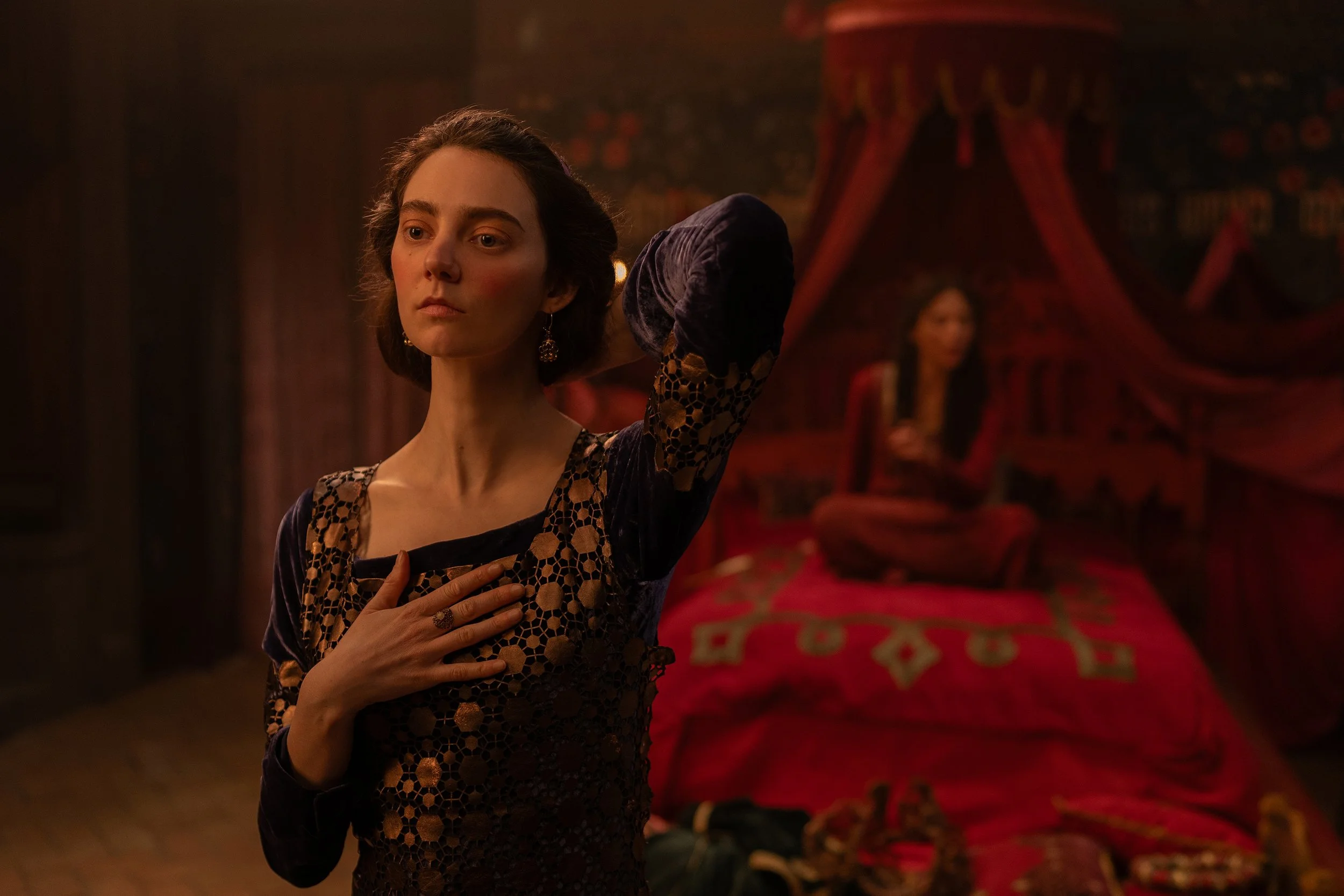
Licisca, having temporarily assumed the identity of Filomena (Jessica Plummer), stands in fine clothing and wearing jewelry, arranging her hair (Netflix)
Licisca’s creative remaking of her own identity in the 2024 Decameron reflects the series’ general creative remaking of the medieval period as a whole. Her self-transformation is built upon a foundation of the most basic knowledge of medieval class divisions: that some people are born servants and some born noble. The series then creatively and anachronistically adapts these assumptions by combining them with historically improbable disguise and the eventual reveal of Licisca’s true father. Licisca’s initial disguise is presented as a game of dress-up that represents, for the contemporary audience, a kind of universal fantasy: to be rich and able to indulge. This fantasy is especially relatable to the post-COVID audience, who, facing financial struggles due to the pandemic, are generally more aware of wealth inequality. The final reveal of Licisca’s noble blood and her rejection of any clearly-defined social status, then, further exacerbates problems of wealth inequality by revealing the arbitrary nature of class divisions. The Black Death is remade to reflect COVID-19, with Licisca’s character arc playing out contemporary class inequality issues in medieval dressing.
When Licisca is adapted in the 2024 Decameron, she goes from being medieval to being a part of medievalism. Michael Alexander emphasizes the creativity of medievalism when he calls it ‘the imaginative adoption of medieval ideals and forms.’[10] In essence, medievalism is the creative reimagining and remaking of all things medieval. As a process of artistic remaking, medievalism is remarkably like adaptation; it can even be considered an adaptation of the medieval past. Also, like adaptation, medievalism resists binaries. In recreating the medieval period for contemporary purposes, medievalism makes time non-linear. Rather than there being a clear division between past and present, medievalism is characterized by the ‘co-presence of past, present, and future.’[11] It makes the past present and the present past, blurring the boundaries between time periods. In the 2024 Decameron, the series uses its medieval setting to deal with contemporary social issues, revealing the constructedness of the division between medieval and modern and prompting the audience to reconsider their relationship with the past.
The 2024 adaptation of The Decameron aligns a medieval pandemic with a contemporary one, allowing viewers to see contemporary social problems reflected in a medieval setting through the portrayal of a medieval servant. The connection between the medieval and the contemporary forged in the 2024 Decameron is further reinforced by the fact that the series is grounded in a fourteenth-century text. Boccaccio’s Licisca inserts herself into the narrative during the plague retreat, inverting the regular class structure by asserting influence over her social superiors. Netflix’s Licisca smashes through the class hierarchy completely by continually remaking her own social status until her class is undefinable. In both cases, the instability of a pandemic instigates Licisca’s creative remaking that subsequently highlights the arbitrary nature of class divisions. The parallel plagues and the parallel Liciscas reduce the conceptual distance between the medieval and the contemporary. The show’s medieval setting aligns problems of wealth inequality that have spanned centuries and thus increases the magnitude of these problems and makes the need for their resolution more urgent. The artificial construction of class differences emerges as a problem that is both age-old and immediate, reinforcing the need for the reduction of wealth inequality in the present day.
Author Bio:
Megan Gorsalitz (she/her) is a PhD Candidate in the Department of English at Queen’s University in Kingston, Ontario. She has a BA in English and Linguistics and an MA in English from the University of Saskatchewan. Her dissertation research focuses on literary representations of medieval working women and the connection between labour and textual creation.
Notes:
1 Giovanni Boccaccio, The Decameron, trans. G.H. McWilliam (New York: Penguin, 1995), p. 444.
2 Ibid, p. 445; emphasis mine.
3 Ibid, p. 445.
4 Linda Hutcheon, A Theory of Adaptation (London: Routledge, 2006), p. 22. https://doi-org.proxy.queensu.ca/10.4324/9780203095010 .
5 Thomas Leitch, Adaptation and its Discontents: from Gone with the Wind to The Passion of the Christ (Baltimore: Johns Hopkins UP, 2007), p. 16.
6 Rochelle Hurst, ‘Adaptation as Undeniable: Fidelity and Binarity from Bluestone to Derrida,’ in In/Fidelity: Essays on Film Adaptation, ed. David L. Kranz and Nancy C. Mellerski (Newcastle: Cambridge Scholars Publishing, 2008), p. 186.
7 Nicole Fell, ‘How “The Decameron” Showrunner Kathleen Jordan Found the Right Tone for the Plague-set Comedy,’ The Hollywood Reporter, July 29, 2024, https://www.hollywoodreporter.com/tv/tv-features/the-decameron-showrunner-kathleen-jordan-tone-netflix-1235957529/.
8 Norman Vanamee. ‘The Perfect Setting for a Wine-Fueled Sex Romp? How About Italy in the 1300s During an Outbreak of the Plague?’ Town and Country, 25 July 2024. https://www.townandcountrymag.com/leisure/arts-and-culture/a61698748/tony-hale-zosia-mamet-decameron-netflix-interview/.
9 Tanya Reynolds, actress, ‘The Beautiful, Not Infected Countryside,’ The Decameron, season 1, episode 1 (Netflix, 2024), 48 min., 22 sec.
10 Michael Alexander, Medievalism: The Middle Ages in Modern England, (New Haven: Yale UP, 2007), p. xxii.
11 Bettina Bildhauer, Filming the Middle Ages, (London: Reaktion, 2011), p. 27; See also: Carolyn Dinshaw, How Soon is Now?: Medieval Texts, Amateur Readers, and the Queerness of Time, (Durham: Duke UP, 2012).