
A House Turned Upside Down: Popular Medievalism, Queerness, and Deconstruction in Netflix’s The Decameron
By Dr. Hilary Rhodes
This article contains spoilers for the Netflix Decameron!
There’s no doubt of it: this is not your college professor’s Boccaccio. In fact, the 2024 Netflix series sets out to create a TV version of The Decameron only in the loosest possible sense, borrowing some (but not all) of the character names, the basic conceit of ten young men and women taking refuge from the Black Death in a fourteenth-century Florence countryside estate, and a few throwaway references to the original tales, but not much else. Instead, like much other medieval-themed media, its primary intent is to pointedly satirize the present through a pop-culture version of the past, especially in the wake of the COVID-19 pandemic and its dislocations and displacements. While our own lockdown might not have been (quite) as traumatic as its premodern predecessor, the series is well aware of this context and the way in which it offers renewed relevance to a mordantly funny story of social struggle and class conflict in the middle of a deadly plague which nobody in power seems able—or willing—to do anything about. The result, as New York Times film critic James Poniewozik puts it, is an ‘apocalyptic medieval soap-com: “Succession” crossed with “The Walking Dead”.’
This cavalier treatment may irritate medieval-literature scholars or those weary of fast-and-loose Hollywood adaptations, but it opens a useful opportunity to analyze the series as its own entity, and in a way that does not require any prior knowledge of the source material. Nonetheless, the TV version does meaningfully draw on the original text and generate dynamic challenges and collaborations in ways that are initially less obvious to a general audience, but that appear upon closer analysis. One of its most interesting treatments is that of its queer narratives and characters, and how these actions and desires function as both a repressive and revelatory force. While these are just one of the Black Death’s epochal upheavals of marriage and gender, heteronormative heterosexuality, class and nobility, and other central social hierarchies, they are sometimes the most powerful of all, and are importantly connected to all of these themes. In a fragile environment where the rules of society are revealed to be constructed and flimsy, utterly unable to hold back the devastating tide, there’s no reason not to do whatever one wants. But for the hapless denizens of the Netflix Decameron, this liberation plays out both for better and worse—and sometimes fatally.
This article examines the television series through two queer analytical frameworks: first, the usual application of the word ‘queer’ to mean same-gender attraction and relationships, and second, a broader approach rooted in queer theory. This intersection has recently emerged as a fruitful venue for new scholarship in medieval studies. Charlie Samuelson has applied queer theory to medieval French literature, while Alicia Spencer-Hall and Blake Gutt’s edited collection reads medieval hagiography through a trans and genderqueer lens. While the TV Decameron is a modern text, it nonetheless serves as a further example of this kind of project, where its medieval origins and tropes gain an enhanced resonance through the excavation of its queer themes. The TV series explicitly depicts both male-male and female-female same-gender relationships, but its disruption of core social structures, such as monogamous heteronormative marriage, the household and family, race and class, and even the original author of Boccaccio, goes much deeper. This is where queer theory, which moves beyond just sex and gender and posits a more expansive ‘queering’ of cultural and epistemological systems, becomes especially relevant.
The queerness of this text is not artificially imposed by modern TV writers, or the present analysis. Boccaccio’s original text deliberately plays with the gender-subversive implications of its setting, and the way in which
the plague serves as a justification for the formation of the mixed-sex brigata at a time of strife and for the group’s decision to abandon [Florence] for the surrounding countryside, thereby finding themselves in gardens which recall the culture of courtly love […] Boccaccio allows the narrators, and indeed himself as author, the freedom to express ideas not commonly discussed or accepted in the society of his time.
As such, the original narrative places the Decameron characters in a milieu where transgressive subjects can be openly invoked in ways that are taboo elsewhere. Boccaccio’s Decameron has also been interpreted through a queer lens, especially in regard to Day 5 Story 10 and its arguably queer and polyamorous characters: ‘the tale of Pietro di Vinciolo, his wife, and their lover […] [whose] queer elements are included intentionally in the story due to its changes from the source text, The Golden Ass.’ Therefore, while the TV series’ queer stories are made manifest, instead of merely latent, and directly involve the main cast, they build on themes already present in the medieval text. This challenges the common stereotype of queerness as only modern, anachronistic, or included in period pieces merely to fit the demands of ‘wokeness,’ and the conservative insistence that queerness could never authentically exist in premodern source material otherwise.
The TV series’ ten main characters—Licisca, Filomena, Misia, Pampinea, Panfilo, Neifile, Tindaro, Dioneo, Sirisco, and Stratilia—all reflect or exemplify some form of social or narrative disruption, but a theme of queerness, here defined as the intentional upending of conventional social and sexual norms, runs through them all. Mistreated servant Licisca (Tanya Reynolds) takes advantage of a fight on the road to leave her obnoxious mistress Filomena (Jessica Plummer) for dead and assume her identity, posing as a noblewoman. When Filomena turns up at the estate, very much not dead and hungry for revenge, circumstances force her to unwillingly uphold the masquerade, acting as her servant’s servant. Filomena and Licisca continue to struggle over which of them is entitled to the presumption of nobility, who should defer to the other, and whose identity is more stable. As they switch back and forth several times over the course of the series’ eight episodes, the question of identity is thrown for a further loop with a late-stage revelation that the girls are actually half-sisters. Their father kept the secret from Licisca, obliging her to remain as a servant in the family home where she should have been a mistress all along, and Filomena’s effort to forcibly remove them from this environment, disease-ridden in more ways than one, is reinterpreted as a clumsy gesture of sisterly solidarity, freeing them both from the shackles of patriarchal repression. Reluctantly, Licisca also comes to see it as such.
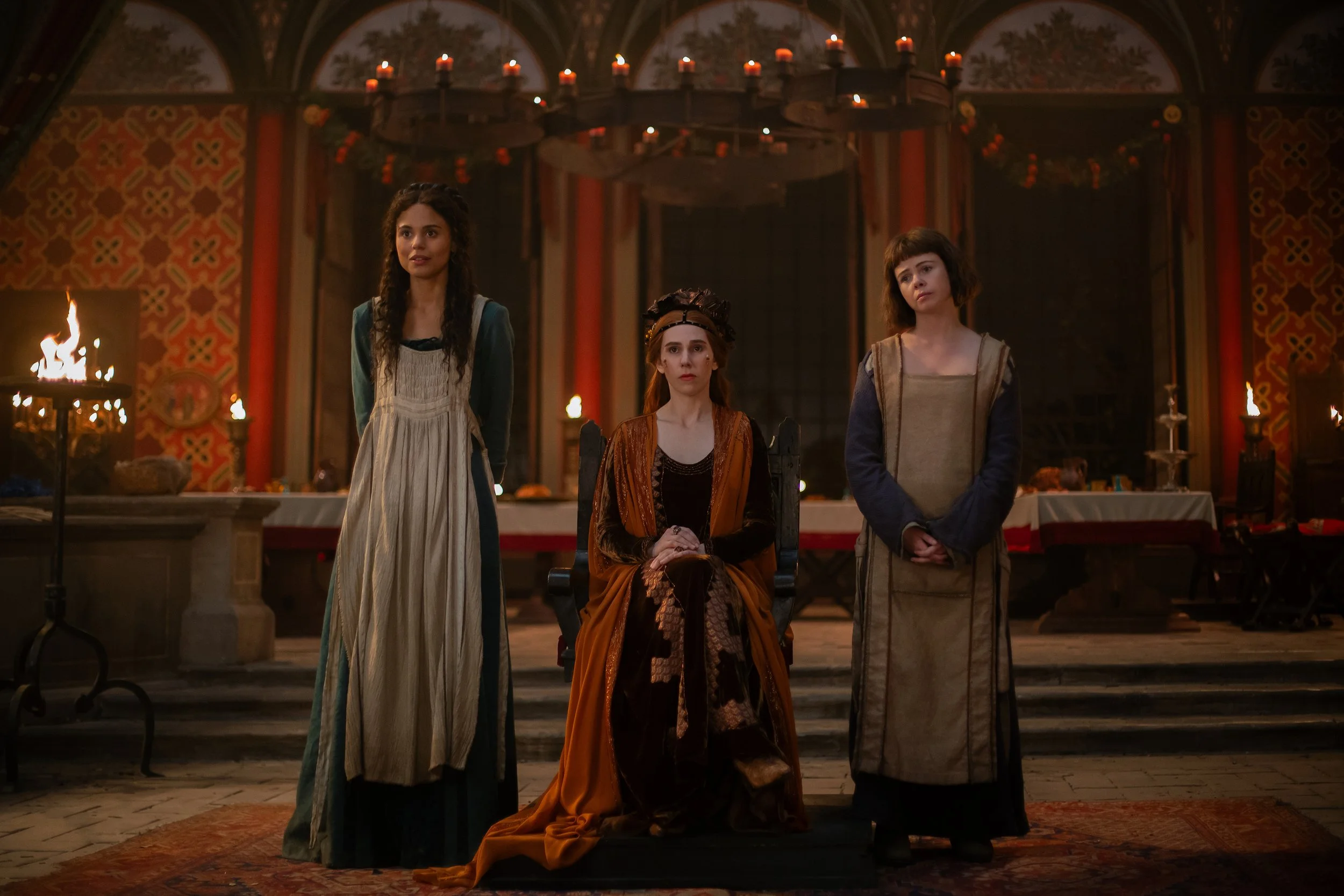
Filomena and Misia flank Pampinea who sits in fine clothes and accessories, while the other two women stand in servant’s garb (Netflix)
Furthermore, Filomena’s path to liberation involves a specifically queer element. She forms an alliance with lady’s maid Misia (Saoirse-Monica Jackson) to teach her the ropes of servant life, an attachment which eventually turns explicitly sexual: their liaison is shown on-screen and at length in episode 7. Misia has previously attempted to smuggle her female companion (and implied lover) to the relative safety of the estate, but failed as her lover did not survive the journey. Misia is also too-obsessed with her vain and capricious mistress Pampinea (Zosia Mamet), remaining lovingly faithful even as Pampinea’s delusions of grandeur and overbearing behavior increasingly irritate the other guests. Pampinea originally traveled to the estate in order to marry its owner Leonardo, who died of the plague before her arrival, a fact the scheming steward Sirisco (Tony Hale) struggles to keep secret. When she finds out, Pampinea insists on proceeding with a fake marriage anyway—calling herself Leonardo’s wife, claiming the prerogatives of the lady of the house, and striking up a brief and ill-fated affair with Sirisco, who is thus temporarily usurping the deceased Leonardo’s identity as husband and master. Pampinea even briefly claims to be pregnant with Leonardo-Sirisco’s child, but when Leonardo’s death becomes known to the others, this lie is found out. Yet rather than backing down, Pampinea decides to take ever-more-extreme measures. She even finally loses Misia’s loyalty – with fiery and fatal consequences.
The show’s queer-coded disruption of heteronormative marriage, procreative expectations, and class boundaries leaves the customary configuration of a medieval noble household in tatters, and when the systemic deceit is exposed, it all collapses on itself. It is worth noting that this modern portrayal of Pampinea as a shrill and screeching shrew concerned only with her own position is considerably more misogynistic than Boccaccio’s comparatively nuanced depiction, or what Valerio Ferme calls ‘Pampinea’s ‘honorable’ leadership in the Decameron.’ While the Netflix adaptation does not style itself as a thematically or literarily faithful rendition by any means, Pampinea’s characterization represents one more case of modern misogyny used to ‘authenticate’ a medieval text that is in fact, quite a bit more complicated. Indeed, F. Regina Psaki has examined how modern editing of medieval texts, including the arguably genderqueer Le Roman de Silence, tend to impose much more overt or explicit misogyny than the original, simply due to our common perception of the Middle Ages as excessively and unrelentingly misogynist in all times and places. This overcorrection goes double for queer-coded texts and subjects.
The tension within a queerly disordered marriage also manifests in the relationship of husband Panfilo (Karan Gill) and wife Neifile (Lou Gala), but its resolution is quite different. Panfilo attempts to keep his sexual attraction to men a secret from his excessively devout wife, who fears that her own desire for men who are not her husband will compromise her immortal soul. They separately express lust for handsome doctor Dioneo (Amar Chadha-Patel), who is fooling his gullible master Tindaro (Douggie McMeekin) with quack treatments for imagined diseases. In a montage where other characters engage in sexual liaisons inside the manor, Panfilo indulges in a one-night stand with a visiting male messenger. This coupling takes place in the stables, outside the main domestic-heteronormative household space, with a partner who is transitory and impermanent by nature. Matters are further plunged into discord by the arrival of the late Leonardo’s loutish cousin Ruggiero (Fares Fares), who wages a battle for control of the villa with its existing occupants. Giving into her extramarital desire, Neifile sleeps with Ruggiero and is then infected with the plague, introduced to the manor by Ruggiero’s ruffian entourage. She has already put her health in danger with increasingly dramatic stunts, such as throwing herself down a well, to get the apparently absent Almighty to pay attention to her, and this would seem to vindicate His dislike—or at least, serve as divine punishment for the couple’s mutual infidelity.
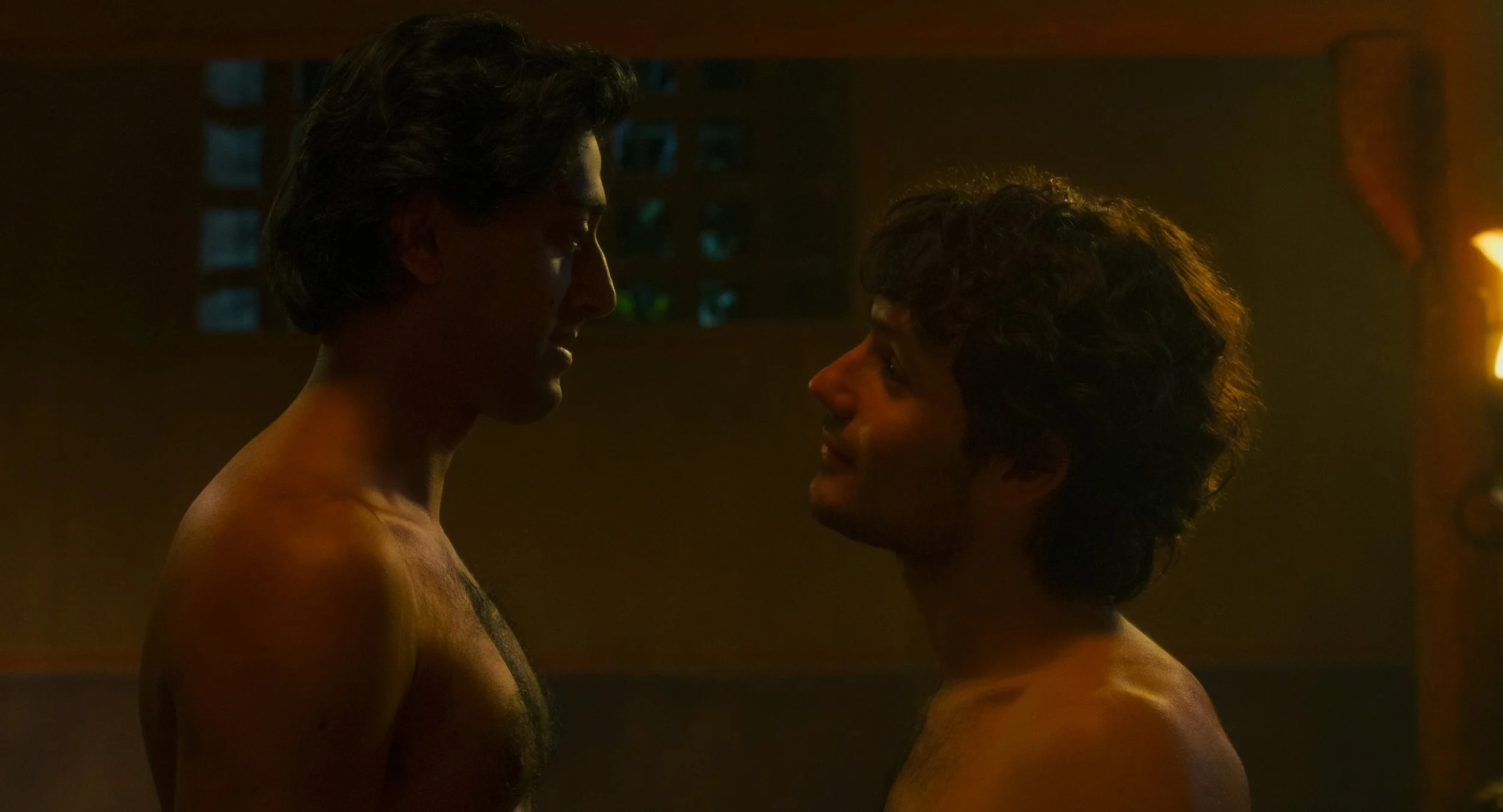
Panfilo indulges in a one-night stand with a visiting male messenger (Netflix)
However, Panfilo then seeks to take control of the narrative and rewrite it to—if not necessarily a happier—at least a more subversive ending over which they both exert more agency. As Neifile lies mortally ill, he comes clean to her with his queer desires and apologizes for his inability to be a satisfactory husband, especially sexually. This deathbed confession, instead of driving the couple apart, brings them closer; Neifile forgives him for his transgressions and admits to her own aberrant desires, and the two of them tearfully affirm that they are each other’s best friends before she passes away. Amid the raunchy and chaotic disorder of the adaptation, and the bawdy broad-stroke depiction of its sexual themes, this is a surprisingly poignant and heartfelt note, and represents the ability of honestly admitted queerness to function as a healing and unifying force, rather than as just a disruptor and divider when it is repressed or ignored. When Licisca and Filomena’s misadventures bring a pack of angry peasants to the manor, eager to break in and forcibly partake of the privileged life they imagine to be occurring inside, Panfilo carries Neifile’s body out to confront them and is shot with many arrows. He dies next to her in an unmistakable evocation of Saint Sebastian, the arrow-pierced martyr commonly used in queer Catholic analysis and iconography.
Meanwhile Dioneo, the object of Panfilo and Neifile’s unconsummated lust, is also subject to a rocky road. When clever villa maidservant Stratilia (Leila Farzad) works out that he is deliberately poisoning his hypochondriac master Tindaro, Dioneo is forced to come up with a new plan on the fly, but the chaos of Ruggiero’s attempted takeover catches up with him. He is the first main character to die, even before Neifile, which is a shockingly pointed choice. The character of Dioneo is often identified as Boccaccio’s authorial stand-in, portrayed as the wittiest of the ten tale-tellers in the original Decameron and able to select topics as he pleases, often to directly deconstruct presumed authorities, previous tropes, or narrative prerogatives. As David Wallace puts it, ‘All tales told by Dioneo are, accordingly, comically critical of any authority that takes itself too seriously. Dioneo exploits his privilege of speaking last to ironize, subvert, or disperse the theme that has supposedly unified the day’s storytelling.’ When the television Dioneo becomes the first to die, the message is clear: both a literal ‘death of the author’ and an additional upending of the Decameron narrative itself, a double destabilization, where obviously he will now not be the last one to speak. By employing the text’s own topsy-turvy logic and disdain for authority to legitimize its drastic changes, including the outright killing of the original author, the series is nonetheless still operating within the established, and queered, parameters of its source.
Indeed, while none of Boccaccio’s narrators die on the page, the only TV characters to make it out alive are Sirisco, Misia, Filomena, Licisca, Stratilia, and her son Jacopo—who was fathered by Leonardo and is thus the estate’s lawful heir, regardless of Pampinea’s desperate manipulations and Ruggiero’s violent thuggery. While the Decameron actors are visibly diverse and hail from various national and ethnic backgrounds, the casting of Jacopo as a young Black boy also adds an implicit social commentary: the actual heir is a racialized and lower-class minority being prevented from realizing his rightful privileges by the blundering and self-interested maneuvers of a thoroughly mocked and discredited elite. This is a message meant for the Decameron’s twenty-first century viewers, but as noted, this is the function of medieval media: by nature, it always speaks primarily to the modern.
Overall, the narrative disruptions of the Netflix Decameron cohere around two major areas: social and sexual. The first concerns the many ways in which servants and masters change places, both voluntarily and involuntarily, and the constructed hierarchies that unfairly legitimate the domination of one over the other. By revealing the nobles’ falsity and foibles, and the ways in which their privileged positions are artificial, relative, and prone to be lost through their own mistakes and misjudgments, the Decameron television series does follow in the thematic steps of its source material, even if its way of going about it is markedly different. Its ultimate message is also considerably darker than the original, which can arguably be read as one of the most ‘cheerful and life-affirming’ narratives in medieval literature. The TV adaptation’s cynicism opens a dialectic conversation with the original text’s optimism; though each version uses different strategies and styles, they both attempt to confront the overwhelming tragedy of a pandemic with gallows humor, social satire, and individual resilience. This provides another way to consider their intertextual poetics, disruptions, and responses.
However, the adaptation’s sexual politics have been the primary focus of this piece, as analyzed through a multi-layered queer-theory reading. For better and worse, it enables the most powerful subversions of social norms, personal behavior, and narrative stereotypes, and directly impacts on both those characters who survive the events and those who do not. It is to be feared but also in some sense welcomed, precisely for that uniquely transformative power. In episode 4, when Ruggiero leads the manor guests into the late Leonardo’s private study, they are both shocked and slightly envious at the wealth of pornography, visually explicit murals, sex toys (including large dildoes) and other debauchery thus revealed. Licisca, still trapped in her increasingly precarious masquerade as Filomena, can’t help but wonder what it’s like to be ‘that free,’ living a life where one’s true self is not hidden and indeed regularly indulged, regardless of how startling it is to so-called polite society. Of course, the irony is that the study has been hidden, sealed off since Leonardo’s death and never intended to be associated with his public image, but just like the queer secrets of the rest of the Netflix Decameron, it has finally come to light.
Author Bio:
Hilary Rhodes (she/they) earned their PhD at the Institute for Medieval Studies, University of Leeds, in 2019. She currently works at the University of Denver and can be contacted at Hilary.Rhodes@du.edu.