
Sirocco
By Dr. Kavita Mudan Finn
There are two contexts for this story.
The immediate context was the 2009 Yuletide Fanfiction Exchange, where I had been given a prompt focused on the character of Palomides in the Arthurian legend:
Any kind of Palomides fic would be spectacular—I like a good, plotty gen fic, but I’m also both slash-friendly and het-friendly. Include whichever other characters you like. I am a SUCKER for good humor fic, but I also like well-constructed and nuanced character studies. Feel free to choose whatever source material suits you best; if you’d rather write T.H. White’s Palomides calling himself ‘yours truly’ and dressing up as a Questing Beast, that would be a joy, but if you’d prefer the version who shows up in the Tristan-and-Iseult legend as the perpetual also-ran, that’s cool, too. If you want to play with his religious affiliation, though, I do ask that you be respectful to his identity as [...] a Muslim—in some versions, he converts to Christianity, and I’m cool with it if you include that aspect, but I’d prefer that it be respectfully treated.
While I also love T.H. White’s whimsical take on the character, in autumn of 2009 when I was working on the original version of this story, I was also preparing to defend my doctoral thesis, and had Thomas Malory on the brain. So, Malory became my source canon, and I ended up doing a deep dive into ‘The Book of Syr Trystram of Lyonesse’, which—let me be clear—is possibly the weirdest section of the Morte D’arthur, and is often cut from abridged versions. I, however, have a perverse fondness for it, primarily because of how much it features Sir Palomydes, a Muslim knight of the Round Table who, I argued more recently in an article in Arthuriana, Malory doesn’t know what to do with.
Note: All modernizations in the main text are my own. I also want to acknowledge my original recipient, Gil, who gave me such a lovely prompt, as well as Geraldine Heng, whose feedback allowed me to make several significant improvements for this revision/expansion.
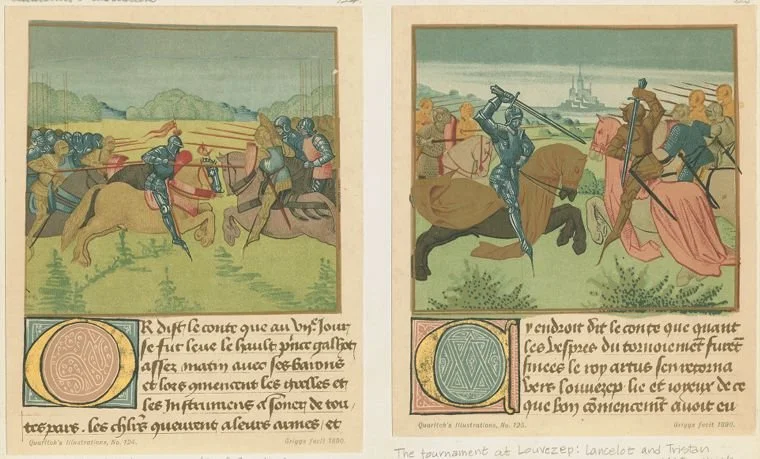
The Miriam and Ira D. Wallach Division of Art, Prints and Photographs: Picture Collection, The New York Public Library. ‘Illustrations of Palamedes in the tournament of Soreloys and Lancelot and Tristan in the tournament at Louvezep, from the Roman de Tristan.’ New York Public Library Digital Collections.
***
Sirocco
There were still nights when he dreamt of the desert.
The air tasted different, leached of all suggestion of moisture, and the sunlight seemed to hum about his skin. An entire world painted in shades of gold and white, shifting and whirling as the wind shaped the sand in its image. Memory, fast-fading, of his father’s palace, wrought in white marble inlaid with jewels, the feel of silken rugs beneath bare feet and the scent of cedar and frankincense in the air. Syllables of a language he was gradually forgetting, echoes of prayer he remembered only because, for a full sixteen of his twenty-two years, they had formed the very centre of his being.
He would awaken from these dreams, throat parched, and eyes blurred with tears—such a waste of water, his father used to say. Not anymore, not in England, where there was water in abundance. He could not imagine what his father would make of that. In some ways, it was the essence of Paradise, where the world was a garden, always green and growing.
And in others...
From the courtyard below, he could hear a group of monks as they went about their morning prayers, the rise and fall of their voices both like and unlike the imams in their minarets. From the knot garden beyond, the laughter of the Queen and her ladies sparkled bell-like in the sunlit air. Of course, King Asclabor had known of these things, though he had never spoken of them to Palomides. At least not during those days of his childhood from which he remembered his father, before he departed for Rome and the world beyond, a world where there were no deserts.
It was inevitable, Palomides’ mother[1] had often remarked, that her three sons would follow their father to those alien shores that seemed as distant as the very ends of the earth. But by the time Palomides had crossed land and sea and presented himself before the mighty King Arthur, his father had long since departed this life.
That Palomides would take up his father’s position appeared equally inevitable, and the arrival of his brothers—now calling themselves Safir and Segwirades[2] to better appeal to Christian tongues—confirmed it.[3]
That had been four years ago, though it seemed far longer. Four years of tournaments, battles, the inevitable skirmishes with knights who failed to yield the road, four years of hating Sir Tristram of Lyonesse for everything he was that Palomides was not.
He could almost taste sand in his mouth. Disgusted, he spat onto the rushes, but the texture lingered on his tongue.
This shall be your charge. First, upon pain of your life, that ye forsake my lady Iseult. Also this twelvemonth and a day that ye bare no armour nor harness of war. Now promise me this, or thou shalt die.[4]
That twelvemonth had come and gone, and he had kept his word, shameful as the promise had been. The first charge, however, had been impossible. Tristram of all men had to have known when he demanded it, and it was for that injustice that Palomides vowed to himself that he would be avenged.
The other knight’s curious absence from Surluce had been immensely gratifying, as had his willingness to allow Palomides to claim the battle of the Red City thereafter. And now, at Lonezep,[5] it appeared they were fighting as comrades, clad in green for Iseult, and Palomides had forced himself to swallow the inevitable conclusion that Tristram would, as always, win the day and yet again win their invisibly shared lady’s heart. If it hadn’t been for his prowess in the field and the lists, Palomides was certain the other’s allure would have faded long before. And yet it hadn’t, least of all in Iseult’s eyes. Those eyes—green, like the Gardens of Paradise—that had only ever regarded him with icy disdain.
But love disdained, as he knew well, only flourished all the more. Of that, his ancestors had written screeds, transforming love into a thread of light drawn mercilessly behind the lover’s needle.[6] Had Palomides any ear for their poetry—what he’d once possessed had drained away as he stopped hearing his mother tongue—he would have poured out his heart in ink as Tristram did in music. All he had now was his strength and quickness, his ability to twist a sword at just the right confluence of angles to rip another man’s life from this earth and carry him forth to whichever afterlife beckoned him.
And it was those talents that just might, for the first time, win him the renown he had been pursuing all these years, that seemed to hover just beyond the reach of his fingertips. He had come close, so painfully close, at Surluce, but for Lancelot (and who could blame Lancelot?) and Lamerok, with whom he’d fought so long and so hard and fallen only by losing his balance beneath a barrage of sword-blows.
There had, of course, been one other battle at Surluce, of which Palomides was not disposed to think, except—Fie on thee. Do thy worst.[7]—that he could not help himself. He had not known Corsabryne[8] well, although the other knight that shared his heritage had been brought to his attention before now. He had, in his more bitter reflections, wondered if the encounter had been staged for the court’s amusement, the nameless damsel having disappeared once her request had been fulfilled.[9] Perhaps after five days of watching Christian men beat one another to a pulp, the spectacle might have seemed a pleasant diversion. To them, we are only Saracens,[10] every one of us bred and born of lies. One fewer damned soul in the world would surely trouble none of them.
It was unfair, Palomides knew. Arthur had always been good to him, as he had to his father, had treated him more or less like the rest of the knights. But as he’d stood over the kneeling Corsabryne and thrown aside his helmet, there had been genuine pleading in his voice when he asked the other to yield.
He still remembered the dead man’s eyes, staring from his severed head in silent accusation. You would turn on your own kind now? Have you become such a whore, pledging your sword to the highest bidder with no thought for your soul? Indeed, it had been his soul that concerned Lord Galehault and even Queen Guenevere, who had watched with cool curiosity as the lord of the tourney requested that Palomides be baptised.
Palomides could not recall his answer, some witty jape about winning seven true battles for Jesu Christ’s sake[11] before he could possibly accept such an honour. He recalled the Queen’s gaze, however, unnervingly steady as if she saw through his humour to what roiled within.
Why it troubled him so, and troubled him still, he couldn’t have said. His father had converted while in service of King Pellinore, and his brothers had turned to the Christ within several years of their arrival in Camelot. Only Palomides had kept to himself, speaking nothing of faith but only of loyalty, of knightly virtue. I promise all knights will set the more by you.[12] Recalling Lord Galehault’s words, he closed his eyes. Surely it was not so simple. In my heart I am christened, and christened will I be.[13] Only when his heart was not so consumed, his world contracted to the Queen of Cornwall’s gaze. Only when he had put aside envy for Tristram, could love him as both Christ and the Prophet had exhorted their followers.
Only when he no longer dreamt of the desert and the stories written in the sands.
It had been his one link to Iseult, the single reason she had tolerated his presence for those few blessed months. He had spun stories to her as had Scheherazade to her Sultan[14] and lived for the glint of laughter in those glorious eyes, the low, enthralled voice begging for just one more, please, or I shall die from not knowing. And he would oblige, though his own throat grew hoarse and his body wearied.
At least until Tristram had lured her from his side with jongleurs’ airs and cansos extolling her perfections, and she had tired of hearing of other women, however brave and clever.[15]
‘Sir?’ His squire’s voice awakened him from reverie. ‘Shall you wish to be armed now, sir?’
‘Of course,’ he said, offering the boy a smile. ‘Wait in the tent. I will not tarry long.’
The sun shone upon the lists like a benison, catching the glitter of cloth-of-gold and jewels in the ladies’ gallery. Spectators lined the battlements above and clustered in the windows, some pointing as he came into view. What they whispered, he could not have guessed.
He found the note as soon as he entered his tent, scrawled in Tristram’s near-illegible hand. In honour of the Red City and the vows of friendship sworn after at Joyous Gard, we fight for the glory of our fair lady Iseult.
To read the very name sent pain lancing through his heart. There were to be no more stories for Iseult—when he’d set eyes upon her again at Joyous Gard, the castle the perfect setting for her jewel-like beauty, every word in Palomides’ mind had dissolved to sand.[16]
But there was no time for that now.
He armed in silence, his thoughts turned to the day ahead. As his squire eased the green silk cotte over his armour, it occurred to Palomides that, for the second day in a row, he was anonymous. A smile broke across his face and he ruffled the boy’s hair briefly before pulling his helmet over his head and departing the tent.
On the previous day, Tristram had been the unquestioned champion, and Palomides had accepted his place in the other’s shadow, if only grudgingly. Today, however, the King himself appeared on the field to challenge them, with Lancelot and two others at his side. In the first turn, Palomides found himself flying sideways as Sir Bleoberis’ lance made a sudden twist downward and caught his shield at the hip.
When he dragged his body back upright, he saw that all four green shapes had been unhorsed, including Tristram—it had to have been Lancelot; even the King could not have thrown Tristram aside so easily—and, unworthy as it was, it made his shame more bearable. The first to regain his mount was, unsurprisingly, Tristram, who dealt the King a hearty blow to the helmet, knocking him to the ground, before losing himself in the press of knights who had joined the mêlée.
Palomides seized the opportunity and lunged forth, sword flashing, to plant himself between the King and the nearest horse. That the King was a mighty swordsman in his own right, all the world knew, but Palomides could not help but think it an unkingly act to throw oneself into a tourney and risk losing to a mere knight. Even still, he knew King Arthur would not thank any knight who allowed him to win for his title alone.
A flash of red and white caught the corner of his eye, and he saw a knight in red array leading his own horse toward him. Tossing the man a grateful salute, Palomides leapt into the saddle and swung the mount around to drive the King back toward his knights.
It was at that moment that the high, clear sound of a woman’s laughter rang out above the crowd.[17] Palomides looked up at the now-familiar window, through which he could see the swirl of green silk, and his heart soared. The treacherous thought flickered that perhaps she had only mistook him for Tristram, but that mattered not at all.
The mêlée, though it must have consisted of at least fifty knights all told, had faded to a blur beyond the length of the spear he’d just retrieved from the ground. Palomides smiled, narrowed his eyes, and charged.
They fell before him, clearing his path as if he were the sirocco itself, in its deadly dance across the desert. Echoing the ghost of Iseult’s laughter that still sang within his skull, he too laughed in purest, wicked delight.
The dust—he nearly thought it sand, as if he’d created it anew here on the dark English soil--began to clear from his vision, and he realised he was alone at the centre of the tiltyard, his blade slipping from his fingers to hit the ground.
There was a dull roar somewhere in the back of his head that he suddenly realised was coming from the crowds, the overflowing galleries a haze of waving scarves. He looked up at the window again, and though he could not see her, he knew she was there, a second sun glittering amidst the heavenly spheres.
He pulled off his helmet and knelt before the King, glorying in the sudden laughter as his liege lord recognised him. ‘Why, Palomides, what do you in this array?’
‘I am not myself, my lord king,’ replied Palomides, resisting the allure of the open window behind him. ‘I hope you will forgive me.’
‘I will do more than that, Palomides. You are this day’s champion!’ Raising him to his feet, the King embraced him.
‘An it please the day’s champion to accept one final challenge—’ Something shattered at the corners of Palomides’ vision as a familiar voice boomed across the tiltyard, ‘—as the King’s Champion, I do hereby offer it.’
Lancelot.
I seek refuge in the Lord of the daybreak.[18] The crowds were shouting their approval like hounds baying for the kill. From the evil of whatever He has created, and from the evil of the night when it grows dark. Would they have cried out so, Palomides wondered darkly, had he been Tristram?[19] And from the evil of an envier when they envy.
King Arthur’s smile held something of wickedness in it as he watched the greatest of his knights advance, astride a smoke-grey stallion. Even a king could not be above all frays, and Palomides had, if not unhorsed him, at least held him at bay while his own horse was stolen.
He knelt again before the King and murmured his acceptance, unable to look his lord in the eye. If it had been Tristram, if he had encountered him but moments before when the haze of sun and imagined sand were still upon him...
As he turned, however, Palomides froze in place, horror and hope warring within his breast. There, just below Lancelot’s pommel, one of the straps that held his saddle in place had frayed to the point of snapping. One glancing blow—
My Lord, I seek refuge in You from the temptations of the devils.[20]
It was the rankest, most underhanded, unchivalrous action he could possibly take. But he would win. To defeat Sir Lancelot du Lac on the field was worthy of Tristram himself. Palomides cast his eyes to the window once again, seeking desperately for the telltale flash of green. If she saw...
If she saw. What could she see from so far above?
Hating Lancelot with every last fibre of his being, Palomides slung himself back into the saddle. This was not a battle, he could not justify a false victory, and yet. Who would say that it was anything other than an accident? Who could say otherwise? He had been taught to judge an opponent’s weakness--they had all been trained thus. And what was a loose saddle if not a glaring weakness, begging to be adventured?[21]
A blur of grey, Lancelot charged. Palomides urged his horse forward, holding his sword aloft. In a moment of awful clarity, he watched as the blade swung downward, slicing through the cracked leather with all the precision of the scimitar he only barely recalled his father wielding.
Lancelot fell.
Shouts of outrage intermixed with the roar of the crowd, and Palomides immediately knew he had chosen poorly.[22] He barely had time to turn at the sound of hoofbeats when a spear took him in the chest, sending him crashing to the ground.
Within seconds, Lancelot was upon him, his sword at Palomides’ throat. ‘Know you well what you have done this day, the greatest despite ever done unto me in tournament or joust, and I will be avenged.’[23]
‘Forgive me,’ he heard himself whisper. ‘I could not withstand you, and I had done so very much this day that well I knew I could never in all my life repeat it. Have mercy, I beg you. An you take this from me now, you take from me the greatest day of my life, the greatest I ever shall have.’[24] Even now, his eyes strayed to the window, this time hoping against all hope that it was empty. ‘Please. For pity’s sake.’
Lancelot followed his gaze and, after a moment’s consideration, smiled wryly. ‘I believe I know the lady for whom you pine, Palomides.’ The sword remained at his throat, though the King’s Champion pulled him half-upright. ‘An were my own lady here, I should not pity you, but if I understand nothing else, I do understand love. Only beware that Sir Tristram learn not of your affections, or you will live to repent it.’[25]
‘I am yours to command, Sir Lancelot. I will take arms against you no more.’ He blinked away foolish tears, a waste of water, his father’s voice echoed somewhere lost in the darkness, so many leagues and years away from the dusty tiltyard on which he now lay, watching the greatest knight in Christendom retrieve his destroyed saddle.
Palomides threw one final glance at the darkness where Iseult no longer watched, and made his own quiet retreat, green spattered not with gold but with white. There was no place for sand in Britain, and the whisper of stories died on the wind.
He is the Most Merciful of the merciful.[26] May He forgive me. For I cannot forget.
Author Bio:
Dr. Kavita Mudan Finn (she/her) is an independent scholar who has published widely on medieval and early modern literature, Shakespeare, popular medievalism, and fan/reception studies. Since completing her PhD in 2010, she taught literature, history, and gender studies at a range of universities, most recently in the Literature Section at MIT in 2019-2020. She works as a freelance editor and indexer, and is writing a biography of the fifteenth-century English queen Elizabeth Woodville when not managing a two-child, two-dog chaos train in the woods.
Notes:
[1] About halfway through ‘The Book of Sir Trystram of Lyonesse’ is a description of a lady in a castle, who asks to see ‘that jantyll knyght, my dere sonne Sir Palomydes’. Her message to him goes astray, and it is never specified if she and Palomydes ever meet again. Thomas Malory, Le Morte D’arthur, ed. P.J.C. Field, vol. 1 (Cambridge, UK: D.S. Brewer, 2013), 466.14-15.
[2] These are Anglicised versions of Arabic names. While they may not map onto specific people, we can see similar instances in the use of ‘Sephardin’ to refer to Saif ad-Din, the brother of ‘Saladin’ (Salah ad-Din Yusuf ibn Ayyub), or referring to the twelfth-century Andalusi polymath Ibn Rushd as Averroes.
[3] Malory, Le Morte D’arthur, 605.24-27: ‘my name ys Sir Palomydes, sunne and ayre unto kynge Asclabor, and Sir Saphir and Sir Segwarydes ar my too brethirne. And wyte thou well, as for myselff, I was never crystynde, but my too brethirne ar truly crystynde’. Asclabor is only mentioned in passing, but Saphir and Segwarydes appear throughout Le Morte D’arthur, and the reader is reminded multiple times that they have been christened and Palomydes has not.
[4] Malory, Le Morte D’arthur, 305.12-16.
[5] Surluce, the Red City, and Lonezep are all locations of tournaments described in ‘The Book of Sir Trystram’, some in more detail than others.
[6] This refers to a specific medieval poem written in Arabic, but I am embarrassed to admit that I cannot remember the poet or the title.
[7] Malory, Le Morte D’arthur, 526.33.
[8] The only other named Muslim knight in Malory’s text, Corsabryne appears exactly once, during this single combat with Palomydes. Again, we have no indication of the original from which this Anglicised name derives.
[9] She is described as ‘doughtir unto Kynge Baudas’, and complains that Corsabryne is pursuing her without her consent. And, having heard that ‘Syr Palomydes ded muche for damesels’, she ‘prayde hym to fyght with Sir Corsabroyne for her love, and he shode have her and all her londis’ (Malory, Le Morte D’arthur, 527.12, 19-21). However, after the fight concludes, she is never mentioned again.
[10] For an important corrective to the use of this pejorative term in medieval studies, see Shokoofeh Rajabzadeh, ‘The Depoliticized Saracen and Muslim erasure’, Literature Compass (2019), https:/doi.org/10.1111/lic3.12548.
[11] Malory, Le Morte D’arthur, 527.13-16.
[12] Malory, Le Morte D’arthur, 527.9-10.
[13] Malory, Le Morte D’arthur, 527.11-12.
[14] The stories in the Thousand & One Nights are much older and have analogues all over South and Central Asia, but the earliest Arabic reference to the frame story of Scheherazade is from the tenth century, where it is described as a Persian book called Hezār Afsān [The Thousand Stories].
[15] One constant element in all the versions of Tristan and Isolde is that Tristan (or Tristram, as Malory calls him) is a talented singer and harper. A canso is what troubadours called their compositions in Occitan, which often focused on descriptions of a woman’s beauty.
[16] Malory, Le Morte D’arthur, 570:20-21: ‘And whan Sir Palomydes saw La Beall Isode he was so ravysshed that he myght unnethe speke.’
[17] Malory, Le Morte D’arthur, 580.34-581.5: ‘Sir Palomydes aspyed how she lawghed. And therewyth he toke suche a rejoysynge that he smote downe, what wyth his speare and wyth hys swerde, all that ever he mette, for thorow the syght of her he was so enamered in her love that he semed at that tyme that and both Sir Trystram and Sir Launcelot had bene both ayenste hym they sholde have wonne no worshyp of hym’.
[18] All of the italicised text in this paragraph comes from the Qur’an, specifically Surah Al-Falaq (113:1-5), trans. Dr. Mustafa Khattab. I want to thank Geraldine Heng for catching this set of inconsistencies.
[19] This is one of the central arguments of my article in Arthuriana—that Palomydes fulfils the oaths of knighthood as well as if not better than Tristram does, but is never given the same credit or benefit of the doubt, because he is a brown-skinned Muslim man.
[20] Surah Al-Mu’minun 23:97, trans. Khattab.
[21] In Malory’s text, Palomydes kills Lancelot’s horse (582.1-4), which is a far greater transgression than cutting his saddle girth, but that seemed unnecessarily violent.
[22] Malory, Le Morte D’arthur, 582.6-10: ‘Ryght so there were many knyghtes wrrothe wyth Sir Palomydes bycause he had done that dede, and helde there ayenste hit, and seyde hyt was unknyghtly done in a turnemente to kylle an hose wylfully, othir ellys that hit had bene done in playne batayle lyff for lyff’.
[23] Malory, Le Morte D’arthur, 582.19-20.
[24] Malory, Le Morte D’arthur, 582.24-30.
[25] Malory, Le Morte D’arthur, 582.32-583.2.
[26] Surah Yusuf 12:92, trans. Khattab.