
Medieval Murder: Blurring the Lines between History, True Crime, and Social Media
By Hannah Purtymun
Social media comes in many forms: tweets, posts, blogs, podcasts, newsletters, and more. Over the course of the last decade, the lines between certain elements of social media and public history have begun to blur. Medieval history, in particular, could be considered a rather niche interest, but through the use of social media, historians and history enthusiasts have begun to widen their circle and expand the reach of their research, while also making it more accessible to a non-academic audience. One of the ways to make this leap from academic history to public history is through the rising public interest in true crime. For example, my master’s dissertation was entitled ‘Crime and Punishment: Homicide in Early Anglo-Saxon England.’ In order to stay involved with historical research, while also being on the fringe of academia as an academic librarian, I began a blog and Instagram account extrapolating on that dissertation called Medieval Murder. Due to the pandemic, Medieval Murder became a podcast that has now been going for the last five years, has over 60 episodes and has regular listeners all over the world. The following will explore the rise in true crimes’ popularity, the blurring lines between public history and social media, and how this all lead to Medieval Murder.
So where does the concept of ‘true crime’ originate? After the invention of the printing press in the fifteenth century, accessible reading materials became more readily available to the general population. But it wasn’t until the middle of the sixteenth century that printers in Germany and England began producing broadsheets, pamphlets, and newspapers that reported on criminal trials, executions, and the stories of the crimes themselves.[1][2] They also began printing more accessible ‘ballads’ that recounted the crimes and were posted across city centers. One of the biggest, ‘true crime’ stories in history also became the obsession of Victorian London, and is still talked about even today﹘the story of Jack the Ripper, the serial killer that brutally murdered working women in the London’s Whitechapel area. This obsession with ‘true crime’ is not just a modern phenomenon, but a historical one as well.
While podcasting and social media itself are relatively new inventions, the sensationalization of crime is not. According to Professor Emerita of history Joy Wiltenburg, ‘While sexual scandals and other shocking events have become staples of modern sensationalism, its chief focus has always been crime, especially the most bloody and horrifying of murders.’[3] For example, it is well known that public executions throughout the medieval and early modern periods were well attended as a way for the political and religious spheres to influence the public away from crime and sin. Assistant Professor of English Jennifer Lodine-Chaffey describes this political machination or ‘policy of terror’ as she explains ‘...a crowd of witnesses needed to be present to understand the terror of the procedure and verify its truth, thus becoming agents of the monarch.’[4] As ‘agents of the monarch,’ those who attended the execution would naturally spread the word of they had seen, often including the gruesome and terrifying details, which would hopefully ward others away from committing the same crimes that had led others to the gallows. However, public executions were also attended as a form of macabre entertainment. Public executions were reserved for the worst criminals, those who had committed murder, treason, heresy, etc. Just like today, people were fascinated by those who would go to such extreme lengths of crime and sin and wanted to see both the execution and the person being executed.
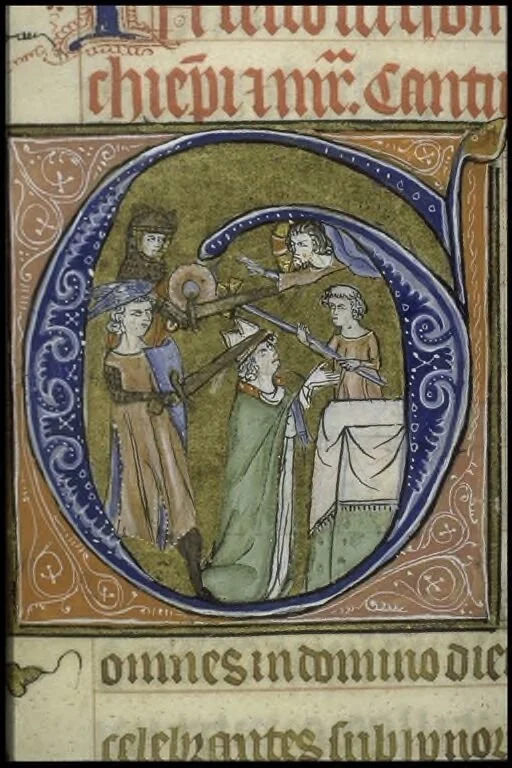
Bouclier Epée Mitre Thomas Becket (saint ; 1120-1170), Bibliothèque nationale de France, Public domain, via Wikimedia Commons, https://commons.wikimedia.org/wiki/File:Meurtre_de_saint_Thomas_Beckett._-_btv1b105749771_(2_of_3).jpg.
The term ‘podcasting’ was coined in 2004 by Ben Hammersly;[5] however, it wasn’t until 2014 that the first sensational true crime podcast, Serial, was launched. The podcast investigated the murder of Hae Min Lee, a high school senior in Baltimore, from fifteen years prior and seemed to launch the current popular phenomenon known as ‘true crime,’ that has become prominent in podcasts, documentaries, and books. Serial developed a huge following, not only because of the content of the podcast but because of the growing popularity of social media and podcasting. Since Serial came onto the scene there has been a growing number of true crime podcasts that follow both historical and current crimes. The difference between these two genres ﹘ historical true crime, (prior to the 20th century) and current true crime (after the onset of the 20th century) ﹘ is small but still significant. For example, ‘By repeatedly publicizing stories and images, true crime programs can infringe upon the privacy and emotional well-being of crime victims and survivors, particularly when their stories are shared without their consent or without appropriate sensitivity.’[6] These worries are justified, as current true crime, including podcasts, documentaries, and online speculation, often harms those involved due to speculation or the exploitation of their trauma. For example, the 2022 Netflix series Dahmer – Monster: The Jeffrey Dahmer Story has been criticized for not consulting with the victim’s families and for profiting off the trauma of others. Historical true crime, especially from the medieval and early modern periods, is less likely to indirectly harm anyone involved in the actual event itself because no one is alive who was either involved in the event itself or a member of the victim’s family.
Medieval history is often times seen as purely an academic topic. To be a medieval historian, you are expected study medieval history, get doctorate in medieval history, publish in peer-reviewed journals, and become a professor; all the while, there are not enough research or teaching posts in the field for everyone whose wishes to be a medieval historian in academia. That is where public history and social media come into play.
I received my MSc in Medieval History from the University of Edinburgh in 2019 with the intention of returning to academia within a year or two to pursue a PhD in history. However, personal circumstances, as well as a world-wide pandemic, prevented this from happening. Instead, I joined the workforce but continued to wish I could be a historian. Unfortunately, without being affiliated with a university, I wasn’t sure how to go about ‘being a historian’ until I found an online community of medieval historians on both Twitter (now X) and Instagram. The two communities were vastly different. #MedievalTwitter was largely a community of researchers, professors, and graduate students who would live tweet conferences, discuss books and articles, or just communicate their love of history. The history community on Instagram was full of an eclectic combination of public historians, museum curators, bloggers, podcasts and book reviews, and more. Some researchers had PhDs, some did not; some went to graduate school, some did not; some had published books, some had published blogs. The one thing everyone had in common was a love of history and sharing it with others. Instagram had a greater number of people interested in medieval history than other social media at the time and because of this the community felt more accessible and welcoming to content and conversation.
So, in 2021, I decided to continue the research that I had undertaken during my master’s dissertation about murder in early medieval England, but in a way that was more accessible to me as an independent researcher, to the public, and to my family, specifically my father, who wanted to be involved. So, the Medieval Murder podcast, Instagram, and occasional blog, was born. The podcast features true medieval history stories about murders involving everyday people and royals, historical sagas and folk tales, and interviews with other historians and history-enthusiasts alike. Crime in the medieval period was rampant and so there is no end to the stories and lessons we can learn from them.
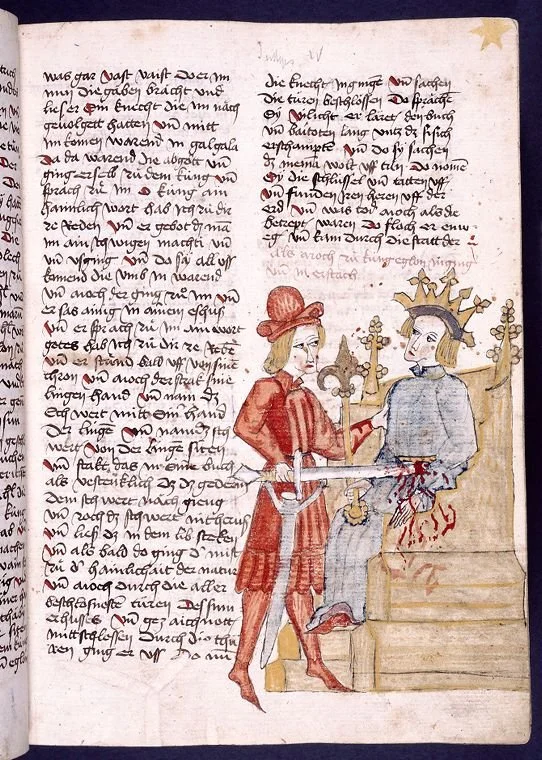
Manuscripts and Archives Division, The New York Public Library, ‘Text with rubric and placemarkers; miniature (in one column) of the murder of a king, f. 69r,’ New York Public Library Digital Collections, https://digitalcollections.nypl.org/items/2bc7d570-c5cc-012f-8fb6-58d385a7bc34 (accessed April 10, 2026).
When we first started the Medieval Murder podcast, we didn’t necessarily know what we were doing. I knew how to do historical research, my father knew about modern day criminal justice and had a passion for history, but neither of us knew how to go about producing a podcast. But we hit the ground running. We started (and have continued) by researching things we’re interested in. Our first episode was ‘The Many Murders Surrounding Mary Queen of Scots’ and our first episode series (which ended up going on for over a year) was on Egil Skallagrimmson in the Sagas of the Icelanders. One of our more recent episodes that I very much enjoyed researching was on the Peasant’s Revolt of 1381, as it provided more insight into medieval governance and the results of tyranny. For those that aren’t familiar, the Peasant’s Revolt happened in the aftermath of the Black Death when England, and Europe in general, was already struggling economically and the government implemented additional taxes. This understandably did not go over well with the English people and an uprising formed against the government. While the podcast is meant to be entertaining, we do try to bring in educational aspect of public history and relate the events of the past to current events. We each spend several weeks researching as much as we can (library access is incredibly helpful) and then on Sunday mornings my father and I record from our respective houses across the country. Slowly over the years, podcast production has gotten easier, we’ve hit a rhythm and we’ve learned a lot in the process. A good microphone is important, but having a sound-insulated room is more important. Editing myself has been the biggest challenge so far because it can be time consuming, and there are times when I’ve missed weird sounds in the background and have had to go back and edit weeks later after a listener (my wife) has noticed and let us know. Once of the easiest things so far has actually been that as our podcast has gotten more listens, all of our guests have come to us and we have been lucky enough to interview great people, read good books, and have interesting conversations.
Medieval Murder has been going for five years now and we have kept a following even with inconsistent output, initial low-quality recordings, and the limited amount of outreach of a father-daughter duo. The fact that the Medieval Murder Podcast has had over fifteen thousand downloads in more than one hundred countries is a testament to the power of public history, the true crime medium, and the way social media can be used as a tool for engagement, education, and community.
Author Bio:
Hannah Purtymun is a Discovery Librarian at Drexel University Libraries and a medieval historian interested in book history, legal history, and religious studies. She holds an MA in Library and Information Science from the University of Iowa and an MSc in Medieval History from the University of Edinburgh. Hannah has previously published peer-reviewed publications including her article ‘Crime and Sin in Early Medieval England”, as well as magazine articles aimed at the general public including her article ‘Letters and Sanctity: the Canonization of the Last Sainted King.’ She is also the co-host of the Medieval Murder Podcast.
NOTES:
[1] Joy Wiltenburg, “True Crime: The Origins of Modern Sensationalism,” The American Historical Review 109.5 (2004): 1379.
[2] Pamela Burger, “The Bloody History of the True Crime Genre,” JSTOR Daily. (2016).
[3] Joy Wiltenburg, “True Crime: Origins of Modern Sensationalism,” 1379.
[4] Jennifer Lodine-Chaffey, A Weak Woman in a Strong Battle : Women and Public Execution in Early Modern England (Tuscaloosa: University Alabama Press, 2022), p. 19.
[5] Lindsey A. Sherrill, “The ‘Serial Effect’ and the True Crime Podcast Ecosystem,” Journalism Practice 16.7 (2022): 1474.
[6] Christine Linke and Lisa Brune, “Intimate Yet Exploitative: Representations of Gender-Based Violence in Platformed True Crime Narratives,” Media and Communication 13.3 (2025).
.jpg)