Chappell, Chaucer, and the Structural Instability of Fame
By Amy Ayotte-Juarez
In September of 2024, global pop icon Chappell Roan performed her hit song ‘Good Luck, Babe’ at the MTV Video Music Awards.[1] Before this performance, Roan walked the black carpet, dressed in her first of three medieval-inspired looks for the night: standing on an antique rug unfurled by her own knight-attendant, she wore a sheer, maroon dress with a green velvet robe, armored fingernails, and a sword as her accessory of choice. While posing for photos, the popstar was caught in a tense exchange with paparazzi who were heckling her. After growing frustrated with Roan’s poses on the carpet, one photographer shouted ‘I’m not gonna shut the f**k up, she needs to stop’ while the popstar’s back was turned away from the cameras. With one armor-adorned finger pointed directly at the paparazzo, Chappell whipped around, retorting, ‘You shut the f**k up. Don’t. Not me, bitch.’ Because of instances like these, in which Roan is forced to defend herself against intrusive fans and media, she has received backlash from online critics who consider her ungrateful, even when she makes clear that she is complaining about being abused, not complaining about her success. Her VMA exchange is a case-in-point: the photographer, his words, and actions become a metonym for the abuses that can come with fame, requiring Chappell to defend herself not only against aggressive media but also against accusations of ingratitude. Her response on the carpet is, I argue, one demonstration of the reclamatory power found in medieval imagery: emboldened by the medieval-inspired garb adorning her body, Roan accessed a kind of knightly persona to protect herself from the dangers of public spectacle.[2] Through her on-carpet interactions, Roan actively challenged traditional caricatures of women as damsels in distress, instead demanding to be seen simply as a person worthy of respect. This moment reflects a larger pattern across Roan’s VMA performance where she adopts the agency of a medieval knight and subverts traditional expectations of what it means to be famous.
It is noteworthy that Roan draws from medieval imagery at the height of her own negotiation with stardom since the concept of fame, or fama, was also a particular concern in the minds of many medieval authors. One prominent example is that of the poet Geoffrey Chaucer whose poem The House of Fame (c. 1380) offers a commentary on the nature of fame and its discontents. In this poem, a figure named Geffrey navigates to the dream-like world where the House of Fame resides, visiting places like the Temple of Glass and the House of Rumor on his escapade through a wondrous vision of what glory and popularity may or may not have to offer. Geffrey not only contemplates the woes of fame but also meets the allegorical goddess of Fame herself who shows him that renown is both capricious and unforgiving; he watches as she rewards wicked deeds with praise while condemning the deserving to oblivion based simply on a whim. Like Geffrey’s journey, Chappell’s VMA experience invites a similar contemplation of the troubling world of celebrity culture. After traversing the abuses of stardom on the black carpet, she embodies one version of the goddess Fame who reveals the unforgiving reality of chasing after something–or someone–that will never reciprocate appropriate feelings of personal or public admiration. This essay reads Roan’s performance and her experiences with celebrity culture alongside Chaucer’s poem, suggesting that both popstar and poet similarly critique the fickle, volatile, and uncontrolled nature of fame. Ultimately, I argue that Roan’s use of the medieval aesthetic becomes a recuperative mechanism through which to confront the harmful realities of 21st-century stardom where the boundary between public and private is blurred by social media and parasocial fixation.
After her altercation with the photographer, Roan took the stage to perform ‘Good Luck, Babe’ set against a castle backdrop. Clad in a suit of armor and matching chainmail, she stands before an ensemble of backup dancers, dressed as thanes in service to their liege, Roan, whom some on the Internet emphatically nicknamed ‘Roan of Arc.’[3] Though she is positioned in front of the castle, Roan remains trapped behind the bars of its prison-like gate. Upon stepping through this gate, she turns around and shoots a flaming arrow from a crossbow, setting the structure behind her ablaze.[4] By using popular medieval tropes like the castle, armor, and crossbow, Roan constructs a striking tension between herself as a modern celebrity and the medieval inspired environment she traverses on stage.[5] As icons of the Middle Ages, castles acted as physical sites of notoriety and renown, and could represent high status and martial order. Designed to fortify and protect their inhabitants, they were structures that housed wealthy and politically powerful elites. With tall curtain walls for protection, turrets for firing weapons, and large metal gates (called portcullises) for securing entrances, castles were monuments of safety for those entitled to protection and imposing statements of security against outsiders. Indeed, as Abigail Wheatley notes, the architecture of such stately buildings communicated ‘ideas of defence, of power, and lordship’ by connecting the occupant’s identity to a physically dominating structure worthy of public regard.[6] For this reason, the medieval castle operated as a symbol of architectural visibility, with an appearance that could dominate skylines and broadcast its owner’s legacy across time and space. Rather than protecting her own castle as a cultural elite, Roan initiates its demise. In setting ablaze a structure with this symbolic magnitude, she defies the role of obedient pop-princess and refigures her agency as a defense against the industry’s destructive traditions. Through her actions on stage, Roan rejects the castle as a secure fortification for the rich and powerful and instead declares it a site of public resistance.
It is striking that Roan arms herself with a weapon–the flaming crossbow–that exposes the fragility of a building assumed to be impenetrable. The protagonist of Chaucer’s poem, Geffrey, has a similar experience when he comes upon one allegorical structure, a castle called the House of Fame, and ponders its feeble design. Geffrey wonders ‘what congeled matere’ [what congealed matter] the castle’s foundation is made of: only after closer inspection does he learn that it stands on ‘A roche of yse, and not of stel’ [A rock of ice, and not of steel].[7] Engraved on one side of this foundation are names of famous folk, but many of the letters have ‘molte[d] awey with hete’ [melted away with heat] making their identities unrecognizable.[8] The other half of the icy rock also includes names of ancient authorities, with every letter intact, that have been ‘conserved with the shade’ of the castle.[9] Though magnificent on its surface, the House of Fame is a deceptive monument with a structure prone to melting under the slightest heat or external pressure. When she sets the VMA castle ablaze, Chappell literalizes this Chaucerian critique: unlike Geffrey, who passively observes the fragile building, Roan actively incinerates it. In doing so, she exposes how fame rests on a foundation that appears glamorous, and impregnable, but is feeble at its core. When read alongside Chaucer’s poem, Chappell’s act of arson is a moment of recognition that the on-stage castle cannot shelter her from fame’s eroding power. Instead, she chooses to destroy the structure and its symbolic legacy, refusing to accept the imposing forces of traditional stardom and all that accompanies it.
As she moves through the barred entry onto center stage, Roan frees herself from the physical and metaphorical shackles of a building that, I argue, functions as a monument to the dominating realities of fame. This move is especially poignant in the larger context of her personal feelings about the nature of stardom. In a story published by The Face only five days after this performance, Roan remarked that ‘fame is just abusive,’ likening it to a violent ‘ex-husband.’ In a separate interview with The Guardian that detailed the photographer incident, she also noted that she is ‘very turned off by the celebrity of it all’ because of her unwillingness to adhere to the respectability politics expected of popular figures. In fact, Roan is vocally reluctant to provide fan service to intrusive and often harmful audiences. In an Instagram post from August 2024, Roan expressed that the ‘predatory’ and ‘creepy’ behavior she faces from followers, including ‘being touched and being followed,’ is unacceptable. Her articulations of the violent nature of celebrity culture feel like a modern proxy for Chaucer’s presentation of fame’s cruelties. In The House of Fame, Geffrey-the-dreamer encounters the goddess Fame who decides, with no clear rationale, to grant—or deny—the requests of those seeking renown. Her power is most visceral when she unleashes her wrath on one group of petitioners. She orders her henchman, Aeolus, to blow his trumpet of condemnation which creates a sound that Geffrey describes as ringing ‘thrughout every regioun’ [throughout every region] moving ‘As swifte as pelet out of gonne / Whan fyr is in the poudre ronne’ [As swift as a pellet out of a gun / When fire lights the gunpowder].[10] As Seeta Chaganti observes, the goddess ‘is not only arbitrary but also violent in her decisions about whose histories should be remembered and whose forgotten.’ Fame’s command represents the volatile force that is reputation: it requires only a single spark, a small ‘fyr’ [fire] to the gunpowder, to trigger a destructive and expansive blast. When she shoots at her castle with a burning arrow, Roan refuses the violent strike of public scrutiny. Rapid, intense, and fast-moving, Chappell’s ‘fyr’ enables her to fight back against the harmful sounds of rumor and speculation that have shaped many public opinions about her.
Roan’s VMA experience and her public discussions of stardom demonstrate how fame today is largely mediated by public perception and media—as in her interaction with the aggressive photographer. The voices that carry news and the stories that spread, whether true or false, determine one’s place in the world of renown. Social media, for instance, amplifies and distorts reality, shaping the way that artists are seen or remembered. For example, shortly after her VMA performance, Roan’s own TikTok post went viral, addressing critics who misconstrued her political stance on LGBTQIA+ rights. She cited specific snippets of her interview with The Guardian that were taken out of context, urging viewers to question those who hold political power and encouraging them to verify that information is ‘even true’ before forming judgments. Despite the clarity of her words in the original interview, Roan highlighted how her vocal advocacy for trans rights had been strategically omitted from narratives being spun online. When these distorted stories continued to circulate, Roan returned to social media to address concerns from those who were further ‘skewing’ her comments. Roan’s struggle to reclaim her narrative serves as a modern proxy for the Chaucerian view that fame is often determined by external perception rather than by actual deeds.
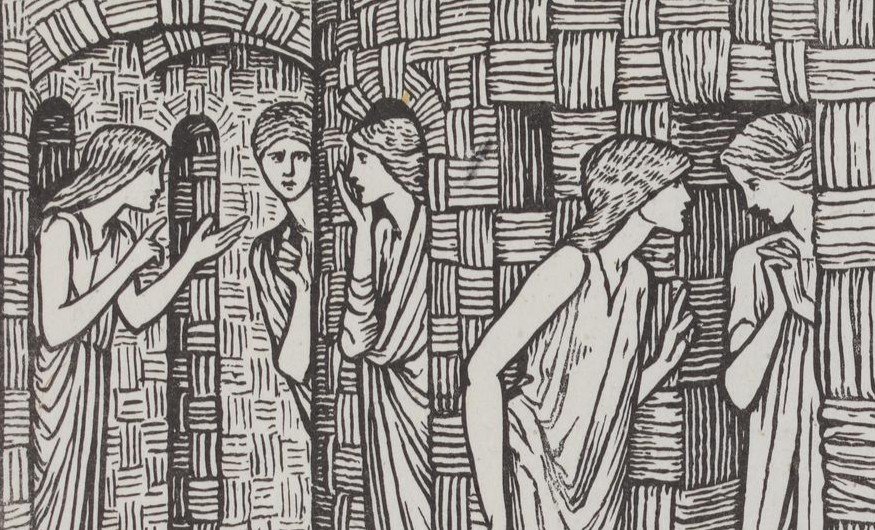
Proof of an illustration designed by Burne-Jones for the Kelmscott ‘Chaucer’: p.467, ‘The House of Fame,’ Liber III, with a cloaked man looking on women emerge from the frames within the woven structure. 1896 Wood-engraving on India paper.
Like Roan, Geffrey-the-dreamer witnesses how rumors and slander take shape through distorted storytelling. Inside the House of Rumor, he sees how one person tells a version of a story to another, watching the narrative transform as it moves from person to person and from ear to ear until, eventually, it escapes, rapidly fleeing in a frenzy towards the figure of Fame who ultimately decides its fate. Geffrey is stunned by this process; he says it is a ‘wonder’ that when someone ‘had herd a thing’ [had heard a thing] he goes to ‘tellen anon-ryght / The same that to him was told’ [tell another person / The same that to him was told].[11] It should be no coincidence to Geffrey that this is how rumors form, given how the space functions: the House of Rumor, made up of loose twigs, spins uncontrollably, physically representing the spiraling of language as it shifts from fact to fiction in the form of whispers and rumors. In this context, rumors rise rapidly to fame/Fame regardless of their validity, and their ascent demonstrates just how little agency individuals have over their personal stories.
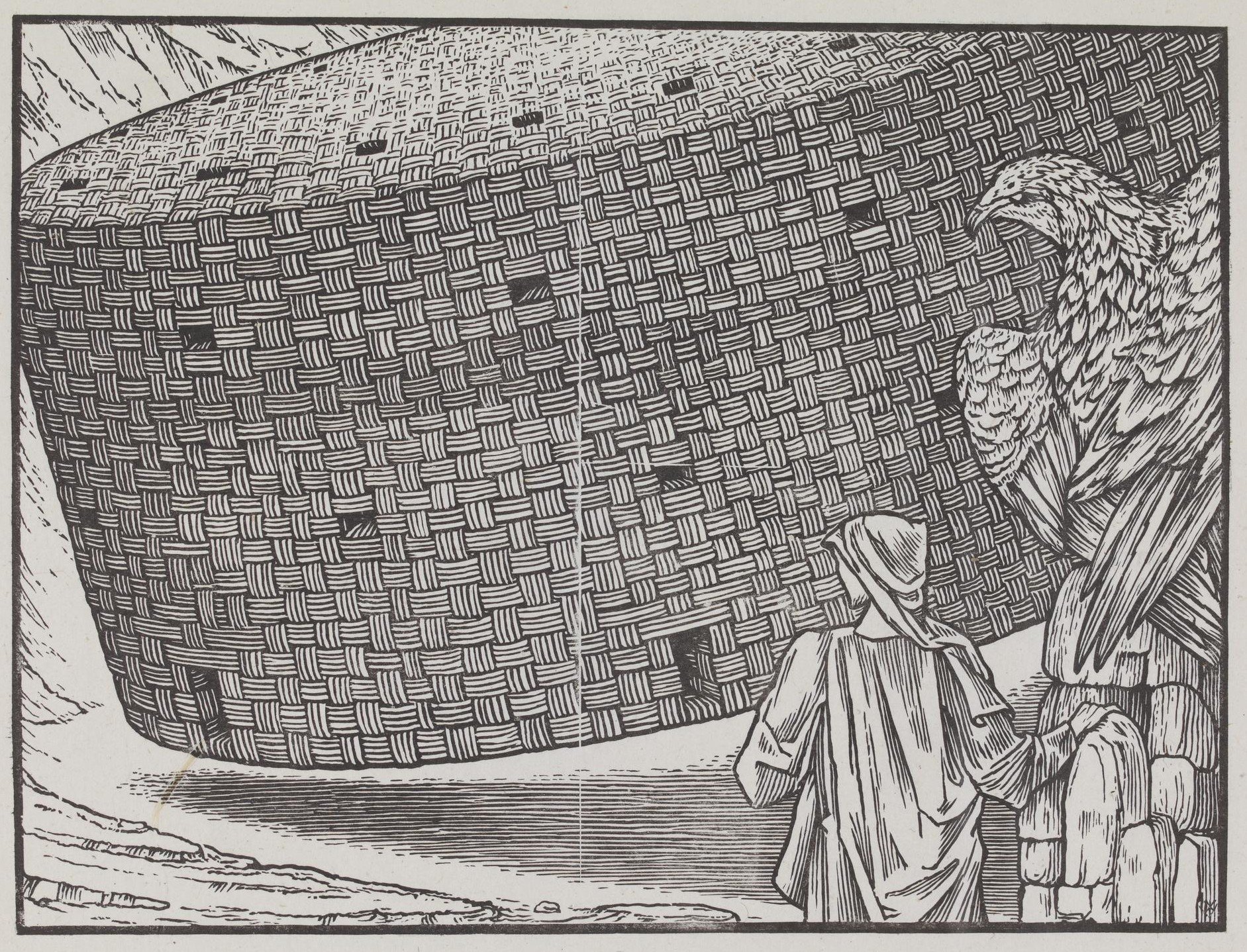
Proof of an illustration designed by Burne-Jones for the Kelmscott ‘Chaucer’: p.466, ‘The House of Fame,’ Liber III, with a cloaked man with an eagle beside him look on as a giant woven structure alights on the ground. 1896. Wood-engraving on India paper.
Chappell and Chaucer seem to share a concern about how rumors distort the way we perceive and are perceived by others. Strikingly, they also share strategies for reckoning with this harsh reality: both popstar and poet project their fame onto avatars who bear the weight of its complexities. For Kayleigh Rose Amstutz, the drag persona of Chappell Roan functions as a performance identity. When on stage during the VMAs, she embodies this popstar persona while also playing the role of a medieval knight. All at once, Roan exists as a triply caricatured version of herself: a drag queen who is also a popstar who is also a knight. This figure, who denies fame, embraces it, and refigures it on stage, creates distance between Amstutz’ private identity and Roan’s public image, enabling the latter to carry the burden of the public’s gaze. Geoffrey-the-poet similarly utilizes the voice of Geffrey-the-dreamer to contemplate the desires that accompany cultural memory, literary tradition, and history writing, all elements that become synonymous with Chaucer as the ‘Father’ of the English language. Geffrey’s observational role in The House of Fame creates a safe distance for Chaucer’s authorial critique of fame and protects him from expectations of literary greatness. Ultimately, Chaucer and Amstutz recognize image management as a legitimate form of personal protection against the volatile nature of public celebrity.
If the personal cost is so high, what value is there in fame? The medieval idea of fama, which denotes both talk about a person and an individual’s representation, was often feared, but it was also valued as a tool for cultivating one’s reputation. As Thelma Fenster and Daniel Lord Smail show, ‘with its [various] cognates and derivatives,’ fama ‘acquired an impressively wide semantic range.’[12] For this reason, fama was as much a concept related to rumor and reputation as it was linked to memory, glory, and honor. In our digital world, fame is often linked to one’s ability to capitalize on virality. While this ability has launched the careers of countless online celebrities and social media stars, it simultaneously has platformed people and content that is harmful and misinformed. In fashioning the House of Fame, it seems Chaucer also wrestles with this conflict. The building, a structure made ‘Wythouten peces or joynynges,’ [Without pieces or joinings] is at once unsteady and simultaneously grounded in a rich tradition of artistic creation.[13] Pillars, which line the hall towards the seat of Fame herself, bear the visages of authors whose histories and stories are, Geffrey notes, ‘hevy’ [heavy] to shoulder because ‘they were mad for gret noblesse’ [they were made for great excellence].[14] Perhaps it is for this reason that, Chaganti writes, Chaucer’s poem ‘encourages us to reject such memorials.’ If those who occupy our pillars are arbitrarily chosen, how do we appropriately redress them? Do we arm our pedestals with better figures, ones that are seemingly more ethical and more representative of our so-called forward-thinking beliefs? Chaganti believes we should avoid rectifying the foundation or the figure who rests atop it; instead, she argues, it is the ‘act’ of destroying both the pedestals and the statues that is ‘the legacy.’ As I see it, Roan’s performance is itself an act of destruction and a denial of fame’s expectations, showing that value is determined not by simply adhering to cultural norms or viral popularity, but by the authenticity and integrity of those we choose to elevate.
Author Bio:
Amy Ayotte-Juarez is a Visiting Assistant Professor of English at Union College. She holds a PhD in English from the University of California, Riverside. Her research explores the relationship between bodily and built form in medieval literature and culture. Her research has been supported by the Medieval Academy of America, the Richard III Society, and the International Center of Medieval Art. Her work is forthcoming in Florilegium.
Bibliography:
Delia Cai, ‘The femininomenonal ascent of Chappell Roan,’ The Face, September 16, 2024, https://theface.com/music/chappell-roan-pop-music-famous-interview-good-luck-babe, (accessed May 1, 2025).
Seeta Chaganti, ‘B-Sides: Chaucer’s “The House of Fame,”’ Public Books, February 14, 2019, https://www.publicbooks.org/b-sides-chaucers-the-house-of-fame/, (accessed May 1, 2025).
@chappellroan, ‘Untitled,’ TikTok, September 24, 2024, https://www.tiktok.com/@chappellroan/video/7418361967166950699?lang=en, (accessed May 1, 2025).
@chappellroan, ‘Untitled,’ TikTok, September 25, 2024, https://www.tiktok.com/@chappellroan/video/7418582700141055278, (accessed May 1, 2025).
‘Chappell Roan confronts a photographer at 2024 VMAs carpet,’ Associated Press, September 11, 2024, YouTube, 0 mins., 43 sec., https://www.youtube.com/watch?v=1ww74TfkbFs, (accessed May 1, 2025).
Geoffrey Chaucer, The House of Fame, Riverside Chaucer, 3rd ed., ed. Larry D. Benson (Boston: Houghton Mifflin, 1987).
Thelma Fenster and Daniel Lord Smail, Fama: The Politics of Talk and Reputation in Medieval Europe (Cornell University Press, 2003).
Chappell Roan, ‘“Good Luck, Babe!” (Live From The 2024 MTV VMAs),’ September 24, 2024, YouTube, 4 min., 9 sec. https://www.youtube.com/watch?v=6ENzV125lWc, (accessed May 1, 2026), (accessed May 1, 2025).
Chappell Roan [@chappellroan], ‘“I turned off comments because I’m not looking for anyone’s response,”’ Instagram, August 23, 2024, https://www.instagram.com/p/C_CGxsrP4Bc/?igsh=MXRiZnZxeXNhcmJzdQ%3D%3D&img_index=4, (accessed May 22, 2026).
Kate Solomon, ‘“Fame is like going through puberty”: Chappell Roan on sexuality, superstardom and the joy of drag,’ The Guardian, September 20, 2024. https://www.theguardian.com/music/2024/sep/20/fame-is-like-going-through-puberty-chappell-roan-on-sexuality-superstardom-and-the-joy-of-drag, (accessed May 1, 2025).
Abigail Wheatley, The Idea of the Castle in Medieval England (York: York Medieval Press, 2004).
Megan L. Cook, ‘(Chappell) Roan d’Arc: Some thoughts on camp medievalism,’ Modern Medieval newsletter, ed. David M. Perry and Matthew Gabriele, September 13, 2024, (accessed May 1, 2026).
NOTES:
[1] I would like to thank Chelsea Keane and Chelsea Silva for their invaluable feedback on multiple drafts of this article. I would also like to thank the anonymous peer reviewers for their generous and incisive comments. Lastly, I’d like to thank Brittany Claytor for her attentiveness during the editorial process.
[2] In her interview with The Guardian about the VMAs performance, Roan commented that the idea of embodying a knight was one she’d had for ‘so long’ because it was ‘what [she] would have wanted as [the] 11-year-old boy version of [herself].’ I interpret her on-carpet interactions and the artistic choices of her performance under the framework of this sentiment.
[3] Chappell Roan, ‘“Good luck, Babe!” (Live From The 2024 MTV VMAs),’ YouTube video, 4:09, September 24, 2024, from Chappell Roan, https://www.youtube.com/watch?v=6ENzV125lWc, (accessed May 8, 2026), 00:01-00:21.
[4] Chappell Roan, ‘“Good luck, Babe!”’ 00:22-00:40.
[5] For discussion of Roan’s use of medievalism here and elsewhere, see Megan L. Cook, ‘(Chappell) Roan d’Arc: Some thoughts on camp medievalism,’ guest-post for Modern Medieval newsletter, David M. Perry and Matthew Gabriele, September 13, 2024.
[6] Abigail Wheatley, The Idea of the Castle in Medieval England (York: York Medieval Press, 2004), p. 2.
[7] Geoffrey Chaucer, The House of Fame, The Riverside Chaucer, ed. Larry D. Benson (Boston: Houghton Mifflin Company, 1987), p. 361, Book III, lines 1126, 1130.
[8] Geoffrey Chaucer, The House of Fame, p. 362, Book III, line 1149.
[9] Geoffrey Chaucer, The House of Fame, p. 362, Book III, line 1160.
[10] Geoffrey Chaucer, The House of Fame, p. 367, Book III, lines 1641, 1643-44.
[11] Geoffrey Chaucer, The House of Fame, p. 372, Book III, lines 2059-60, 2062-63.
[12] Thelma Fenster and Daniel Lord Smail, ‘Introduction,’ Fama: The Politics of Talk and Reputation in Medieval Europe (Cornell University Press, 2003) pp. 1-2.
[13] Geoffrey Chaucer, The House of Fame, p. 362, Book III, line 1187.
[14] Geoffrey Chaucer, The House of Fame, p. 365, Book III, lines 1473, 1424.