Exploring Medieval & Modern Experiences of Migration, and Why it Matters Now More than Ever
By Kirsty Bolton & Teresa Pilgrim
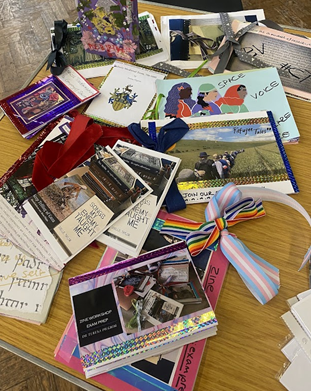
A selection of Teresa’s zines on display in our workshops
A bote he fonde by the brymme
And a fayr lady therynne,
That was ryght wo-bygone.
… … … … … … … … … …
Up he toke that fayre ladye
And the yonge chylde her by,
And hom he gan hem lede.
(Emaré, ll. 694-96, 706-08)
Community is essential to human experience in medieval romance texts of the fourteenth century. Women in Emaré, the Man of Law’s Tale, Octavian, and Sir Eglamour of Artois (to name but a few) are set adrift in rudderless boats and find sanctuary in foreign lands; their survival is dependent on the community that they find. In thinking about connections between medieval and modern experiences of identity and belonging, there is much to explore in the ethos of mutuality that refugee communities are bringing back to a modern British culture that has moved so far away from medieval concepts of social responsibility. Our specialism in medieval literature led us to draw connections between medieval and modern experiences of and mindsets concerning migration.
Mainstream modern British life, which has become increasingly reliant on home-working and on-line social interactions, seems to have lost a focus on community. The rash of St. George’s flags adorning lampposts and bridges purport to be about community pride, but instead speak of anti-immigrant sentiment and the breakdown of inclusivity, charity, and welcome. Research suggests that increasing life expectancies and declining social capital in Western societies has led to Britain becoming, according to the Office for National Statistics, ‘the loneliness capital of Europe.’[1] The welcome of sanctuary and safety is markedly absent from our current moment in the UK. We set out to explore these important concepts through a series of zine workshops, drawing on Teresa’s lived experience, with a women’s group of migrants at the Oxford-based charity, Refugee Resource.
As part of her research project on ‘Intersectional Identities and Migration by Sea in Medieval Romance’ at the University of Oxford, Kirsty explores similarities between medieval and contemporary experiences of migration and belonging.[2] The medieval texts that she studies show characters leaving or being forced from their homes and forging new identities in new communities. Some of the texts that she works with include Emaré, Bevis of Hampton, Sir Tristrem, Sir Eglamour of Artois, Guy of Warwick, Octavian, and Chaucer’s Man of Law’s Tale. Chaucer’s Man of Law’s Tale exhibits complex attitudes to immigration that still persist today. When Custance is sent from Rome to Syria to marry the Sultan there, his mother fears that Custance will convert the Sultan and, subsequently, the whole of Syria to Christianity. She executes a coup in order to maintain the religious purity of her land, killing all of Custance’s attendants and sending her back out to sea. When Custance washes up on the shores of Northumbria, she is taken in by the king, Alla, marrying him and converting his kingdom to Christianity through her virtuous example. The Sultaness’s fears for her own people become the glory of the British people in Chaucer’s perspective, as he uses Custance as an origin myth for the Christian conversion of Britain. While there are many differences between the fourteenth and twenty-first centuries, people are still being forced into dangerous journeys to escape desperate situations. With Refugee Resource, Kirsty engaged Teresa to develop and deliver a series of zine workshops that help displaced people explore their experiences through a creative outlet.
Teresa began zine making as a creative way to respond to the legacy of conversion violence. Their research into queer identities focuses on the ways in which we are exiled from our bodies, environments, and texts as a result of historical gender and identity-based violence. Their creative practice provides empowerment by way of embodied resistance and reconnection through our shared stories. Teresa works on conversion violence in early historical texts, examining how divisive rhetoric is used in increasingly harmful ways against people based on their identity, and the ways in which this damaging weaponization of language still perpetuates violence today. Their work challenges this dehumanising rhetoric to transform how people understand the historical past, but more importantly, to transform how people think about themselves in the aftermath of such harms today. In their own creative work with zines in several different contexts of survivor networks, they look at how we can rewrite how the body and our identity are interpreted or wilfully misrepresented by others. The creative practise can therefore be deeply transformative, for both the creator of the zine and the archive of lived experiences they create. Our interactions can change the way we and others think because they capture a myriad of different experiences.
Kirsty encountered Teresa’s transformative, embodied zine-making process at conferences where their zines are part of the writing process and also given out as creative-critical research outputs. She also attended a zine workshop Teresa facilitated on behalf of Refugee Tales, held in partnership with the Centre for the History of People, Place and Community at the Institute of Historical Research and the Refugee Law Initiative in the School of Advanced Study.[3] Therefore, when Kirsty approached Teresa about providing workshops for Refugee Resource, they were happy to accept. Prompted by the initial themes Kirsty suggested for their project, Teresa set to work creating a series of mutually enjoyable and beneficial activities grounded in our shared lived experiences of journeying, belonging, and hope. The immediate positive response of the women’s feedback to the organizer meant that they were invited back to provide two further workshops and this number subsequently grew the current ongoing series of ten workshops.
Refugee Resource is an Oxford-based charity that provides counselling, education, and community to refugees, asylum-seekers, and migrants. Mentors provide English language training and introduce them to the practicalities of living in Oxford, offering connection and a sense of belonging. One of the charity’s most important provisions is counselling, acknowledging the trauma and emotional distress of not only the journeys undertaken, but the process of seeking asylum in the UK. As part of Kirsty’s research focuses on women characters set adrift in medieval narratives, she saw potential connections with Refugee Resource’s weekly women group. This group comprised displaced women from countries such as Afghanistan, Sudan, Syria, and Palestine who are building lives and connections in Oxford. The echoes of such experiences across the centuries spoke to Kirsty and Teresa of how belonging is central to the human condition.
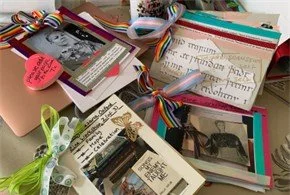
A selection of Teresa's zines[4]
What is a Zine?
Zine is an abbreviation of magazine. Originally arising from a fanfiction context, the fanzine was introduced as a means to focus on or respond to something of great personal importance. The Oxford English Dictionary describes the zine as ‘a fanzine or other magazine produced non-professionally for a relatively small audience.’ [5]As a legitimate, creative, critical form that circumvents the need for external editing or permissions, zines provide important creative and social freedoms, especially for marginalised communities.
Two great examples of zine archives are, first, that held in the Glasgow Women's Library, which is a specifically feminist space reflecting various forms of activism. This collection of zines dates from the early 1990s to the present day and covers a range of topics, including, ‘feminism, politics, culture, literature, sexuality, mental health and body image.’ Second is the work of Jonah Coman, whose pocket miscellany zines are available in the British Library. These informative teaching aids are curated by Jonah, with links to the medieval manuscripts that they examine. This extensive range of zines discuss the important topics of race, gender and sexuality, and, deservedly, received the British Library Labs Award for Teaching and Learning. Additionally, you can also read about Teresa's zine practice here.
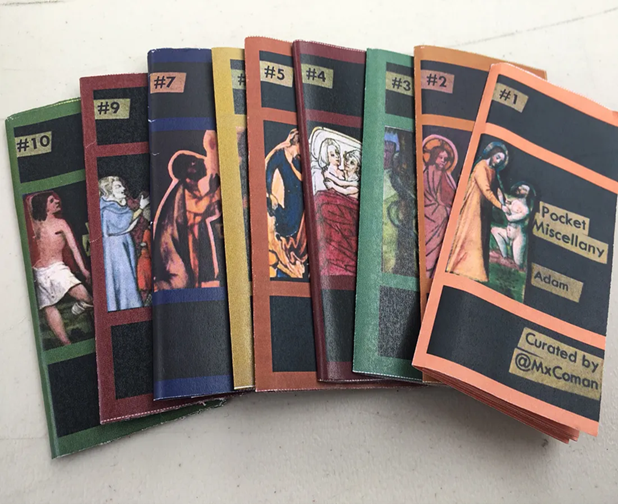
Jonah Coman’s zine miscellany. Photo credit: Ana Hine.
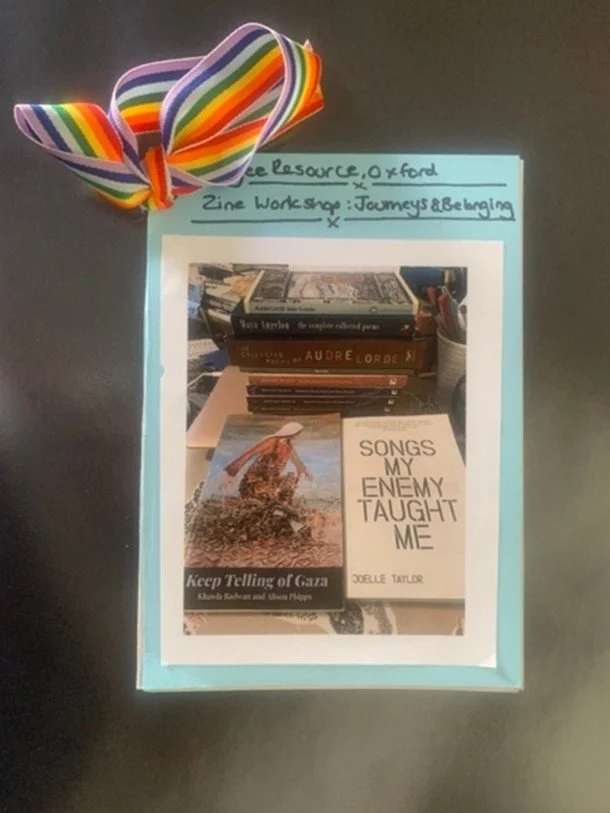
Zine created by Teresa, including the loose script of their introduction and prompts for workshop 1, with extracts of historical and contemporary migration stories, intersectional feminisms and poetry.
First Workshop: Journeys & Belonging
The zine format supports communication across languages and experiences. Assisting with translation was a large component of the workshops, which ties in with Teresa’s work on policy for providing interpreters, and the translation services undertaken by Refugee Tales. This is something that Teresa adjusted seamlessly in this workshop and in subsequent ones, amending the tone of the introduction and the materials that we provide. For instance, in this workshop, we used the folded zine format, which some of the women found a bit confusing. They opened them up and made more of a collage. In the second workshop, we instead provided colourful card and ribbon and showed the women how to make bigger format zines that could be bound together. These were really popular, allowing the women to focus on bright, bold imagery. Their pages reminded Kirsty of tapestries; a craft of women across time and place that is used to tell stories and pass information:
she sewed sylke werk yn bour,
And tawghte her sone nortowre
(Emaré, ll. 730-31)
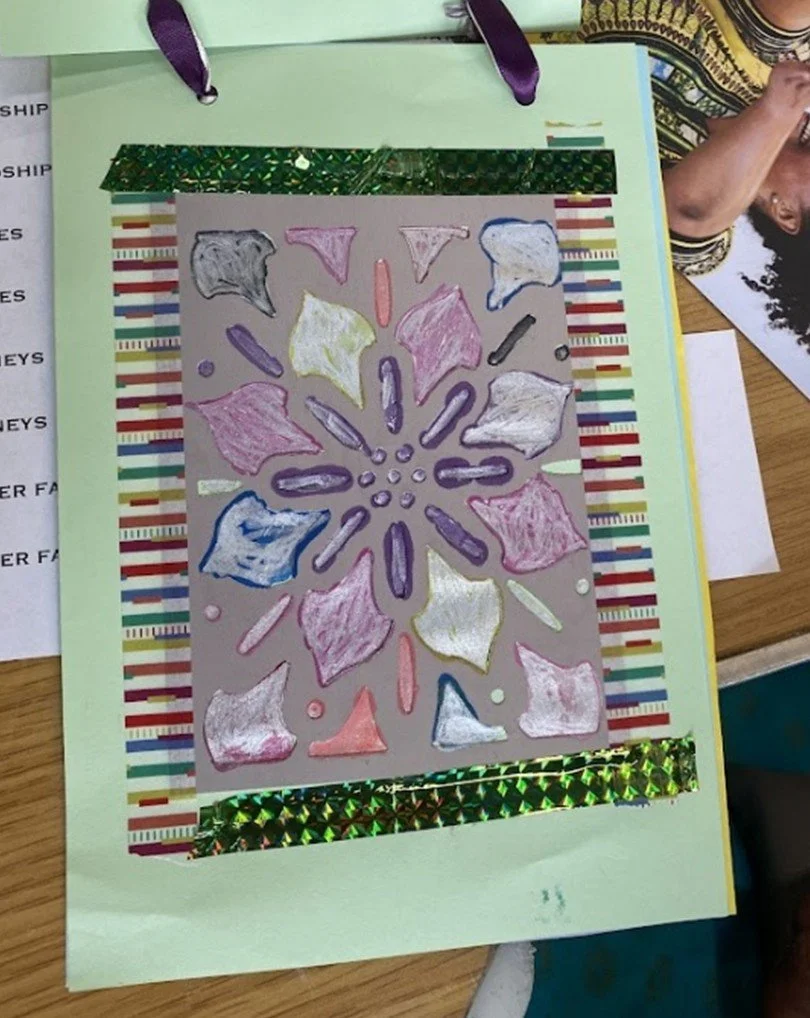
A zine page reminiscent of Afghan tapestries
We talked to the women about how long they’d been in Oxford. One, Rehana, had been there 20 years and reported feeling very connected to the city. Her zine was about her garden, which became a recurring theme for her over the workshops. A few of the women were reticent about their English language skills, asking the coordinator, who ran the group for Refugee Resource, to translate for them, using translation apps, and asking us for words in English. We gladly helped but also explained that these zines were for them and that it wasn’t essential that Teresa and Kirsty could read them. We wanted the women to feel comfortable expressing themselves in their own languages, which were largely Arabic, Farsi, and Persian. We worked hard to strike a balance in our communication with the group, acknowledging that some of the women had limited English without patronizing their contributions to the group and the activity. Small courtesies, such as letting them finish a sentence or thought without jumping in allowed them to maintain control and dignity as they communicated.
‘The Refugee’s Tale as Told to Patience Agbabi,’ produced by Refugees Tales, was particularly pertinent to one participant, Amine.[6] She had not come across zine making before and it was wonderful to introduce her to the format and then see her create a stunning zine with a parallel translation of Arabic and English. The story of Farida,[7] told to Patience was an important connection - a way into Amine's participation in the group. She wrote a passage about gathering to break the fast with Iftar after fasting fifteen hours a day during Ramadan. Clearly, this was an important connection, as the tale begins with Farida speaking about food being a shared component of our lives. Amine asked Teresa to check her translation into English; Teresa thanked her for her beautiful parallel translation but also felt it was important to say that her language, her mother tongue, was enough - no further translation was required unless she would like to do so. As someone who works on translation in old languages in their research, as well as working on policy for providing good interpreter provisions for refugees and immigrants, Teresa was struck with how vital this conversation was. Trust was involved on both sides. Language was not a barrier.
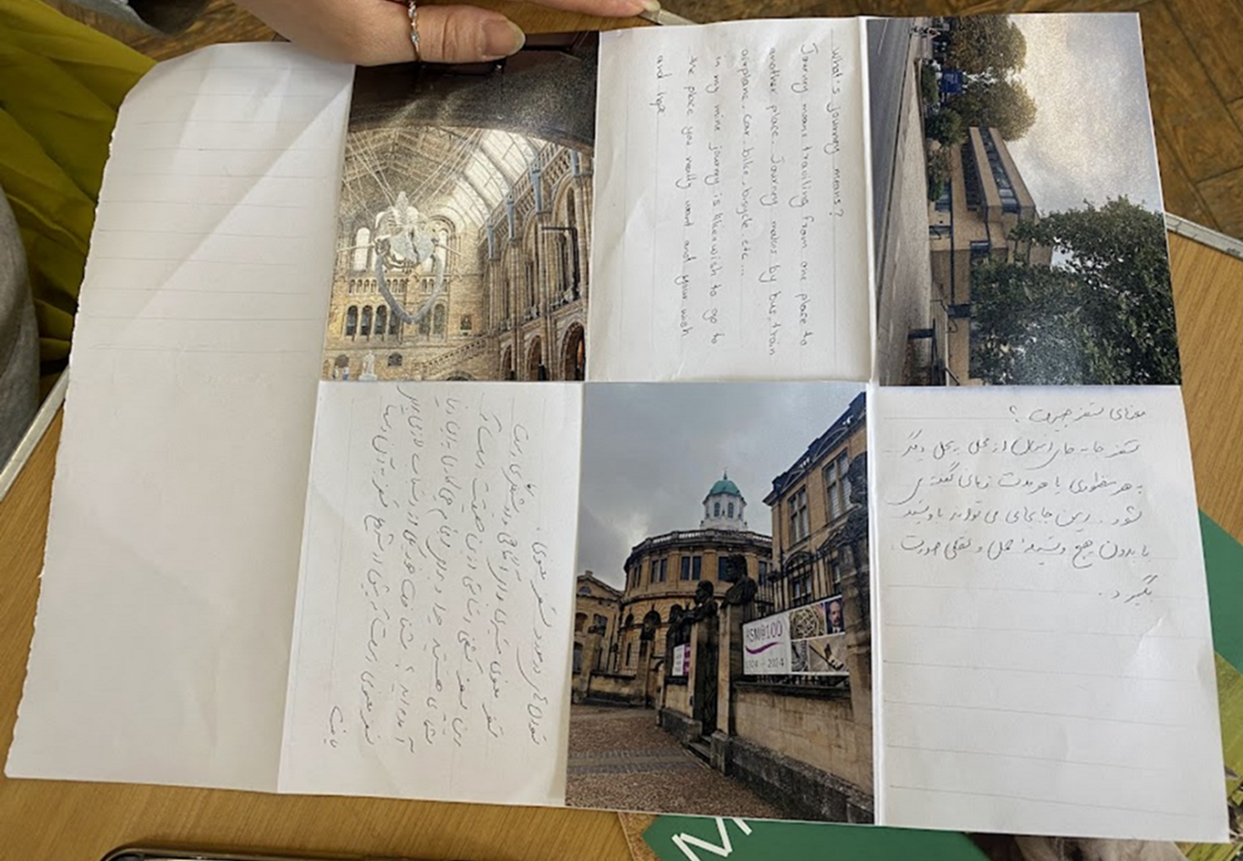
A zine written in Persian and English
Second Workshop: Family, Hope, Celebration
Our next workshop focused on themes which, after Eid and Easter, looked to family, hope, and celebration. We referred to Refugee Tales and activist poetry centering women’s experiences of violence and collaborative thinking towards hope. Teresa reached out to colleagues at Refugee Tales, and the editors and poets at Sidhe Press, whose Keep Telling of Gaza and previous anthologies Teresa used to speak to the themes of this and the previous workshop. We invited everyone to contribute words, simple phrases, or poetry in parallel translations which reflected what these terms meant to them and that they might also like to share with the women’s group, who are mostly from Afghanistan and Syria, but also Palestine and Sudan. Our texts included poetry in Persian and Arabic and a selection of phrases in Urdu and other languages.
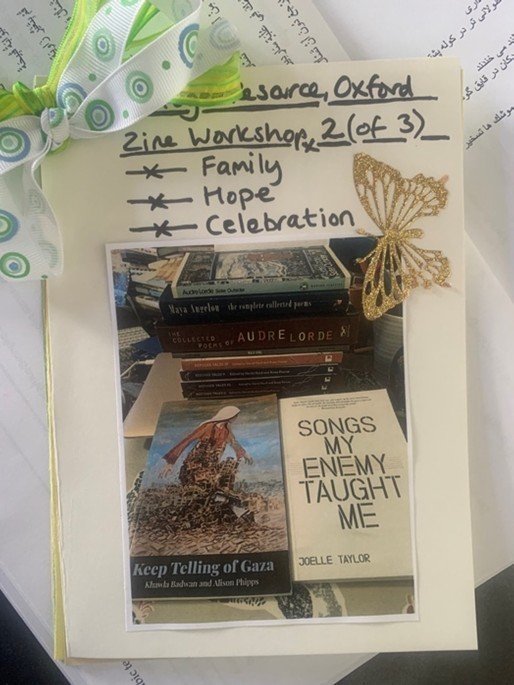
Teresa’s planning zine for workshop 2
We were so struck with how two women from Afghanistan who wrote about their journeys really benefited from the exercise. One wrote painstakingly throughout the session about her journey from her homeland and was comfortable to ask Teresa for translation of certain words that were important for her to use, for example, ‘dangerous’, ‘bomb’, ‘explosion.’ In this respect, the workshop prompts and our assistance provided a safe space and vocabulary to share the story of her perilous journey, which is how she described it in her zine. Another participant showed great comprehension and self-awareness in exercising her choice. Again, another sign of growing trust in and a feeling of safety in our workshop. She wrote: I am a person who belongs to Afghanistan. Which we experience very negatively by the name of ‘journeys’. But I don't want to remember anything which is not good. Now I'm a thinking about holidays. She chose a beautiful sea image to place on one page, and her text was displayed on the next. To acknowledge the journey in this context is very important and again this opportunity was afforded by the workshop as a space of meaningful connection.
She dryveth forth into oure occian
Thurghout oure wilde see, til atte laste
…
This woful womman broghte he to the londe.
(Man of Law’s Tale, ll. 505-06, 522)
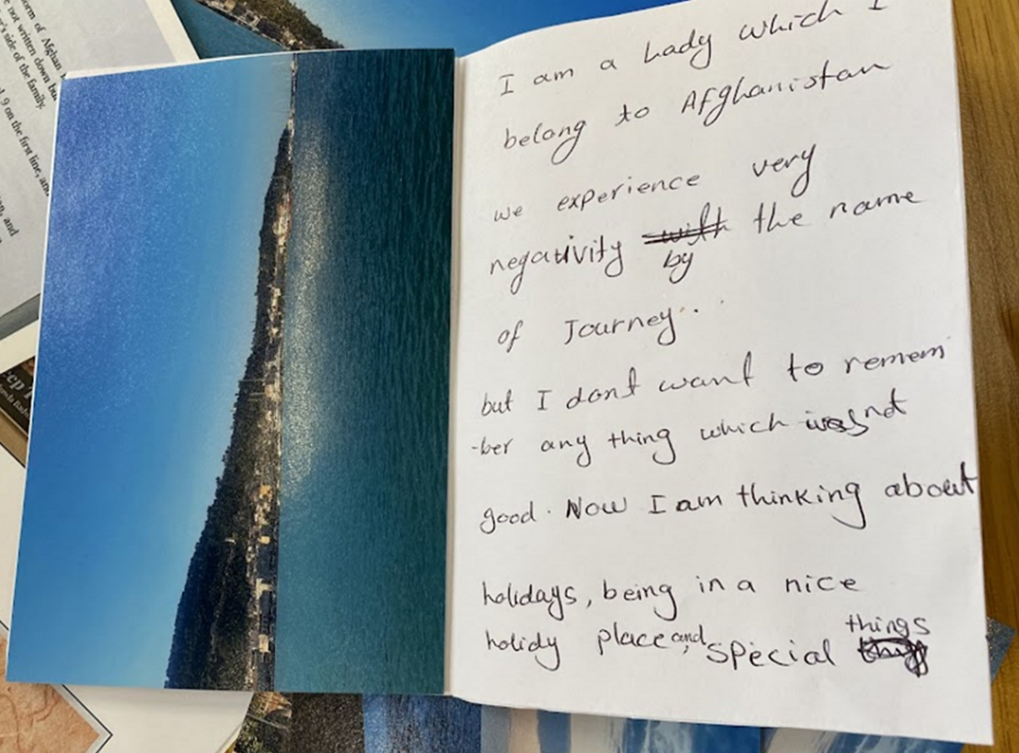
A zine page describing a migrant journey from Afghanistan, with a photo of the sea
The small number of participants in this workshop produced an intimate feeling, allowing the women to sit together and share materials, chat, and ask each other and us for ideas and words. It was reminiscent of medieval ‘god-sibs’ gossips (2.a A close friend, companion, pal; patron, benefactor; (b) as item of direct address), a community of women who support and guide each other through life. There were three women who were clearly having a wonderful time together. They expressed how this activity, away from their families and the multiple chores and expectations placed on them as women and mothers, was just so lovely. One of them had loved art at school but had not had any further opportunity to pursue it until the workshops. She was already looking forward the next one. It struck Teresa how little has changed in the expectations being made of these women by their families, irrespective of where in the world they are living. The hostility of forced displacement only adds to their burden, and it was joyous to see the fun they were having.
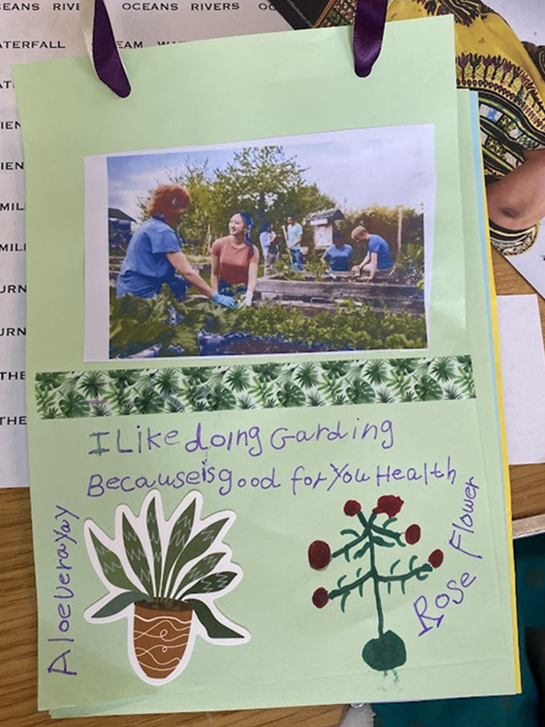
A zine describing the creator's love of gardening
Third Workshop: Connections, Community
The theme of our third workshop was connections: human connections, friendships, families, as well as more literal connections or steps on a journey. We thought through our connections to the world with medieval and modern poetry, letters, and saints’ lives. We were using both types of zine formats and to set the scene Teresa spoke of families, pilgrimage, St Mary of Egypt, and the conflicted perspectives of womanhood translated and interpreted through Greek, Latin, and Old English. They read from Walk Song, which is the Prologue to each volume of Refugee Tales, changing the pronouns to feminine to reflect the women’s group:[8]
But this prologue is not a poem
It is an act of introduction
Bathed every veyne in swich liquor
And all the introduction can do
Is set the tone
Albeit the tone is everything
And the tone is welcoming
And the tone is celebratory
And the tone is courteous
And the tone is real
And every step sets out a demand
And every demand is urgent
And what we call for
Is an end
To this inhuman discourse.
And so we stop this night
and the Host steps up
And [s]he says
Listen to this story
Whan that Aprile with [her] his shouers soote
And the room goes quiet
And a voice starts up
And then the language
Alters
Sweet
Tender
Perced to the roote.
Teresa read from Sappho and Adrienne Rich, a letter from Joan of Arc, and a few lines from Mary of Egypt. They also created a stock of words to be used in collage effects in the zines. There were also generously shared poems in parallel translations from Sidhe Press and colleagues from Refugee Tales shared words or phrases that captured what connections meant to them. It was rich and generative session. Once again, volumes of Refugee Tales, Keep Telling of Gaza, and Songs My Enemies Taught Me were a key part of the materials.
Lubna chose a striking image of a group of women in hijabs looking upwards. She told us that she thought that they were looking at the moon. Aisha[9] mentioned that the image spoke to her of female empowerment, of women holding their heads up high. Lubna decided to incorporate both of these ideas into her zine page, which became a beautiful, defiant artwork. The casual collaboration between the two women was an example of the community and connections created by the group, illustrated by the opportunity that the image gave them to explore the importance of women’s friendships. These connections often go unsaid, ignored by a society that does not value them. Lubna’s image perfectly captured the small act of defiance of women raising their faces as one.
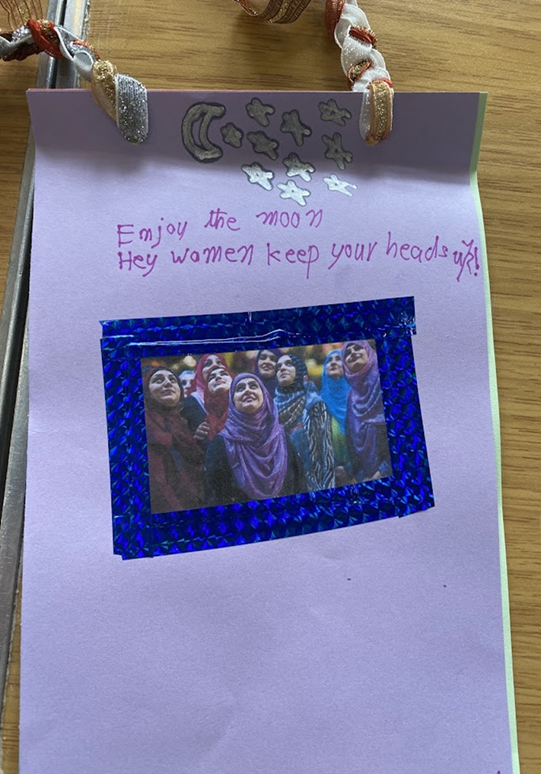
A zine page evoking female empowerment with an image of women looking upwards
The stories of Custance, Emaré, and other medieval mothers might only be read by a select few, but their journeys resonant across centuries and oceans. Our workshops exploring women’s experiences of displacement and rebuilding meaningful connections show the benefits of creative-critical practice in contributing to an archive of current lived experienced of migration. Perhaps the example of medieval romances and their attitudes to immigration can help us to rethink the current moment, bringing into question the barriers and sanctions that we have placed unnecessarily on our shared humanity.
Author Bios:
Kirsty Bolton is a Leverhulme Early Career Fellow at the University of Oxford. Kirsty’s postdoctoral research project focuses on intersectional identities and migration by sea in Middle English romance. Her first monograph, Motherhood and its Spaces in Medieval Romance, has recently been published by Boydell and Brewer.
Teresa Pilgrim is an Independent Scholar and Creative Practitioner. Teresa is a medievalist and transfeminist scholar, currently writing a monograph, Early Histories of Female Masculinities & Queer Identities, 700-1000, for the Medieval Institute Press and De Gruyter’s New Queer Medievalisms series. Teresa uses their own lived experience to combat anti-trans and anti-immigration ideologies. They work with Refugee Tales in a freelance research and voluntary capacity. Teresa facilitates creative-critical zine workshops in a variety of settings including pedagogy, outreach, activism and trauma-informed discussions.
Notes:
[1] Olivia Sagan and Eric Miller, eds. Narratives of Loneliness: Multidisciplinary Perspectives from the 21st Century (London: Taylor & Francis, 2017), p. 20.
[2] This project is funded by the Leverhulme Trust.
[3] Refugee Tales is the integral charity of Gatwick Detainee Welfare Group. They publish volumes of refugee’s stories, as told to the patrons of GDWG, many of whom are also well-known authors, and organise community walks to raise awareness of the impact of indefinite detention by walking together (based on the idea of Chaucer’s pilgrims) and sharing the lived experience of migrants.
[4] A selection of Teresa's zines: Join Our Conversation is a workshop facilitated on behalf of Refugee Tales in partnership with the Centre for the History of People, Place and Community, at the Institute of Historical Research and the Refugee Law Initiative. St Mary of Egypt: Trans Phenomenology, Intersectionality & Queer Lived Experience is Teresa’s British Academy Postdoctoral Fellowship application zine. Zine Workshop Exam Prep is a workshop facilitated for undergraduates studying Old English at University College, Oxford. Refugee Resource Zine Workshop 2 is a zine for the series of workshops Teresa is facilitating for Kirsty’s Leverhulme Project at Oxford. ‘My Queer Truth’ is a zine for my exhibition with Blossom LGBT for Pride.
[6] David Herd and Anna Pincus, eds., Refugee Tales, volume 1 (Manchester, UK: Comma Press, 2016), pp. 125-32.
[7] Not her real name.
[8] Herd and Pincus, eds., Refugee Tales, volume 4 (Manchester, UK: Comma Press, 2022), pp. 9-15 at pp. 14-15.
[9] This name has been changed for privacy.