From Round Table Tournaments to Renaissance Festivals: Arthuriana and the Hyperreal
By Theresa FitzPatrick
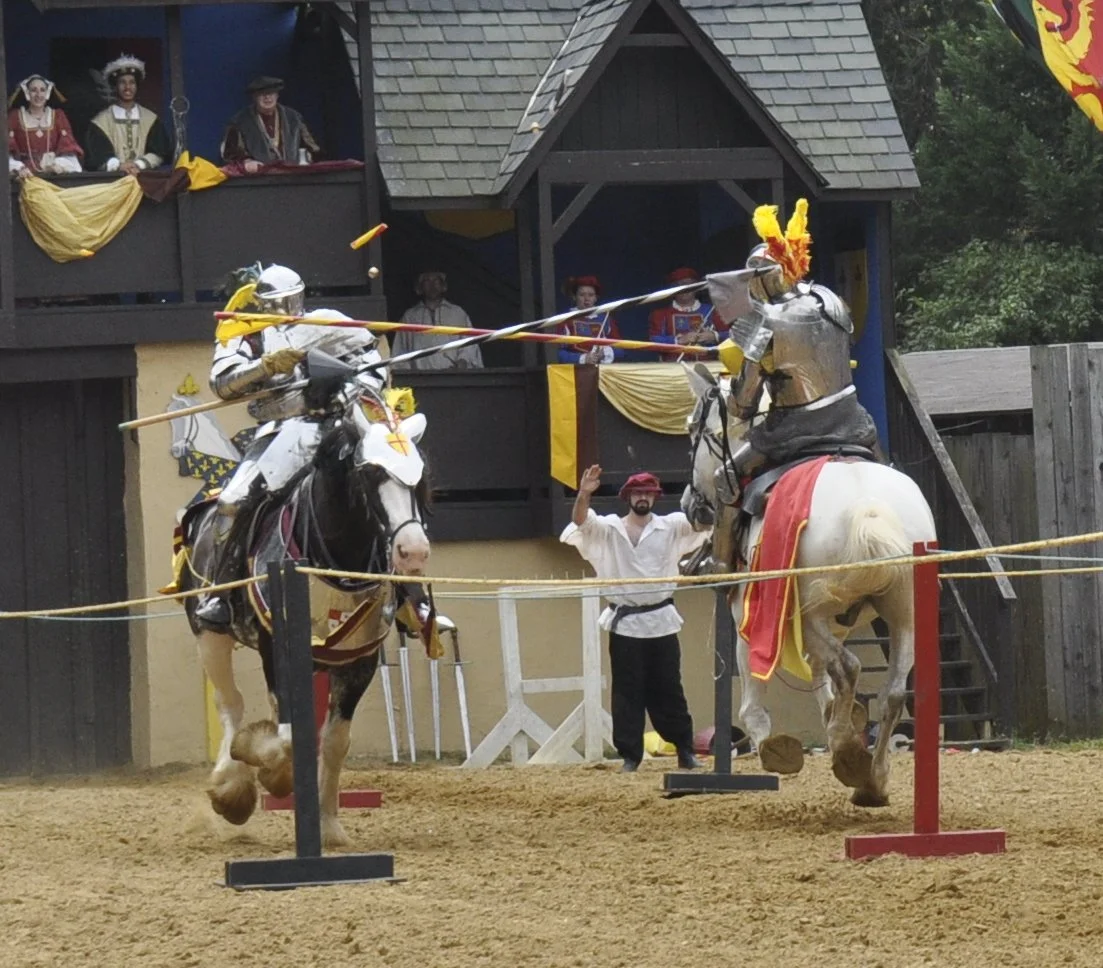
Photograph of a joust taking place at the Maryland Renaissance Festival
The first time I took my daughter to our local Renaissance Festival in Shakopee, Minnesota, a scene unfolded that imprinted itself firmly in my brain. Walking down the thoroughfare, we happened to encounter the King in all his finery, trailed by an entourage of dozens. My three-year-old, proudly dressed as Tinker Bell, stopped in her tracks, mouth agape, as the king waltzed straight up to us. He bowed, told her how lovely she looked, and gave her a golden coin. Playing along, I bowed and told her to do the same, which she did. After we parted, she asked me in a whisper, ‘Was that really the king???’
‘Yes!’ I answered. ‘Here at the festival, at least.’ What I didn’t realize until later was that she truly believed him to be THE KING of the world, and on the drive home, when she realized that she had been had, she was furious with me. I was playing a game. She was not. She had been lied to by someone she trusted, someone who thought she was foolish enough to believe. Something between us broke as the illusion shattered. The magic of an alternate world, much more vivid than preschool and baby brothers and parents forever telling her ‘no,’ turned out to be a cruel joke. She was not happy to remain secure in her fantasy. She wanted Truth, and I failed to give it to her. As a jaded adult, I had given up on Truth long ago, so much so that ‘being duped’ no longer hurt my feelings. It was exactly what I had paid $25 to experience. Reality is too distressingly banal, so, like many of the courtly characters in Sir Gawain and the Green Knight (as we will see), I would much rather make it a ‘Cristmas gomen’ [Christmas game] than think about it too much.
According to Umberto Eco, when the Arthurian film Excalibur came out in 1981, many Europeans and Americans alike took the movie to be a realistic rendering of life in the Middle Ages. Putting aside the focus on magic and sorcery, the raw violence of the images and the grittiness of life before modern conveniences led the public to embrace its verisimilitude as absolute.[1] At the root of this belief, Eco argues, was the collective wish for the Arthurian legend to be validated as a real period of history, a golden age, a touchpoint one can look to in order to ‘Make Camelot Great Again.’ While this wish gazes backward in time, it is also invested in the present; it belies a desire to bring the legend into the here and now. Like Eco, I contend that society wishes for Arthur’s England to be as historically believable as the Middle Ages themselves, to substantiate an ideological myth by glorifying the past. Eco posits that many of society’s most pressing contemporary worries—political division, technological advancement, religious strife, even human identity—can be directly traced back to the Middle Ages, a major turning point of history.[2] Therefore, our Game of Thrones-fueled obsession with it is understandable. Yet our grasp of the realities of this period is so far off that we are almost willing to believe magic was a perfectly normal part of medieval life.
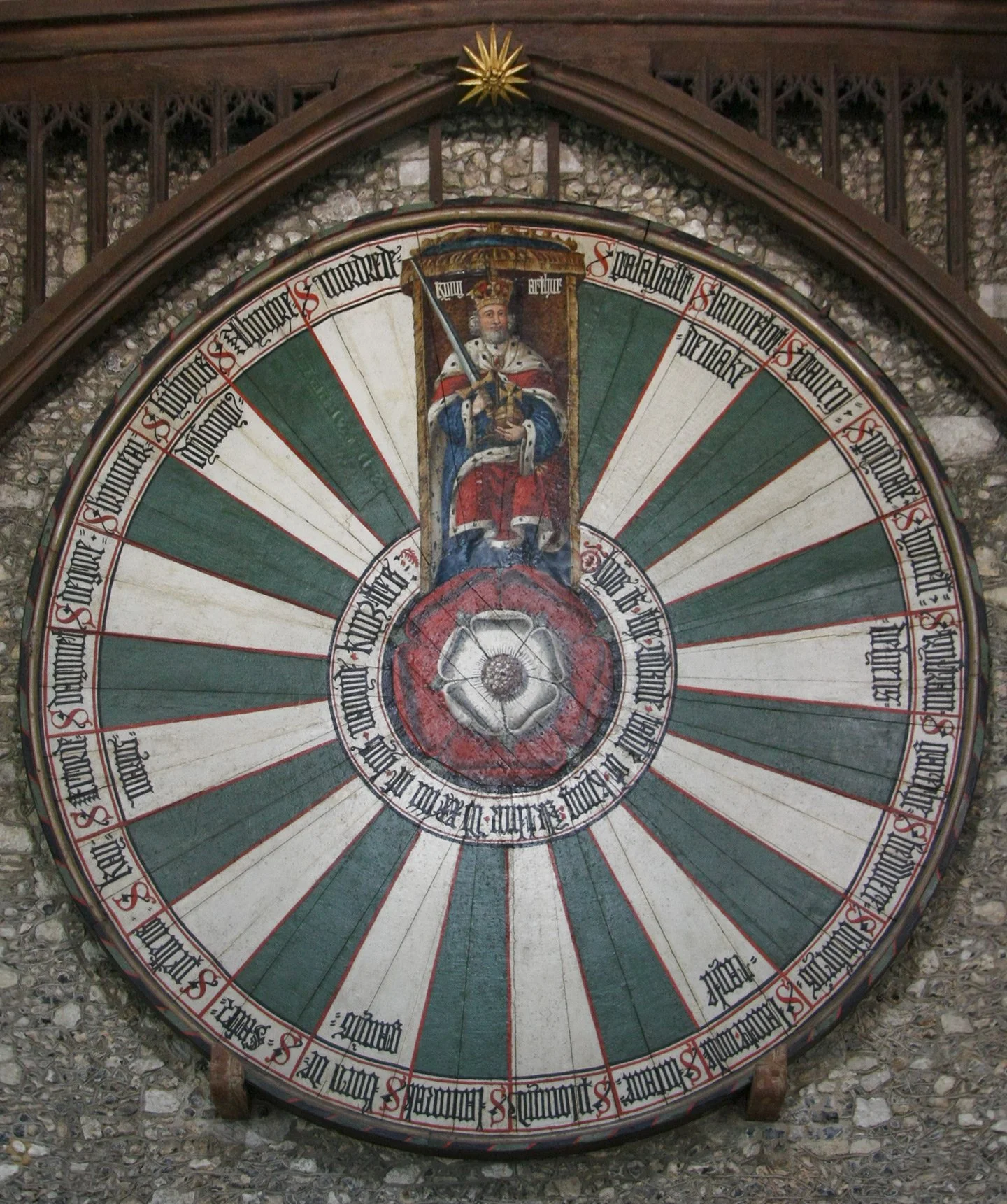
This tendency to conflate reality and myth is by no means restricted to modern society. Beginning in the thirteenth century, fewer than fifty years after the first mention of a ‘round table’ in Wace’s 1155 epic poem Roman de Brut, Round Table Tournaments became popular pastimes for wealthy European aristocrats. Here, ‘Arthurian devotees dressed in the appropriate costume to join in feasts, jousts, and dancing in imitation of the King and his knights. In some cases, the participants assumed the names and arms of Arthur’s knights, and more elaborate tournaments might even include a real castle built for the occasion.’[3] The Winchester Round Table, currently displayed in Winchester Castle’s great hall, is believed to have been commissioned for just such a tournament, possibly during the reign of Edward III (1327–1377), an Arthurian enthusiast, or even earlier by his grandfather, Edward I (1272-1307).[4] In 1522, in a powerful example of simulation, Henry VIII had the table repainted with a Tudor rose in its center and his own likeness where Arthur’s should be. Even actual kings had to measure up to the idea of Arthur, and the implication of assuming his place on the table was clear to anyone who saw it. The story, the image, is a template which leads the un-real to define—or even replace—the real.
This line of thinking also brings The Matrix franchise to mind. The framework for this real/un-real argument is the invention of the 20th-century postmodern theorist Jean Baudrillard. Lana and Lilly Wachowski, the creators and directors of The Matrix films, admit that Baudrillard’s ideas greatly influenced their work (NPR). They even included a brief glimpse of his foundational text Simulacra and Simulation in Neo’s apartment at the beginning of the first film and echoed a famous Baudrillarian line in Morpheus’s memeified greeting, ‘Welcome to the desert of the real.’
The central idea of Baudrillard’s theory is what he calls the ‘hyperreal.’ According to him, modern life has significantly blurred the line between real and un-real, particularly when it comes to how we use words and images. Words and images were once metaphors for the things they signified, but they no longer are. The word/image has now taken over for the thing itself and become the reality, which then shapes human belief and experience.
An example of this theory that works well for my students is the concept of ‘high school.’ As modern American children grow up, they are perpetually bombarded with images of what ‘high school’ is, particularly in shows like Saved by the Bell, High School Musical, or Sex Education. Often, the actors playing high school students are people in their 20s. There are swaths of available time for students to stand at their lockers and have long conversations. Students are often portrayed as stereotypes in order to move a plotline along. No one is ever on their phone. Obviously, my students understand that these are not realistic images of high school, but they often admit that, when they first experienced high school, it was a letdown. Their expectations had been set by years of high school simulation. Eventually, students start to behave in ways they think ‘real’ high school students should—a simulation of a simulation. This becomes reality. This is the hyperreal.
Baudrillard’s focus was on a specifically 20th-century phenomenon. He explicitly points to the time between the World Wars and the Cold War: ‘The great event of this period, the great trauma, is this decline in strong referentials, these death pangs of the real and of the rational that open onto a stage of simulation’ (43). After this trauma, for Baudrillard, history lost all sense of a definite referent and began instead to reproduce simulations of historical mythologies and present-day imaginings, realities which never really existed. I would contend, however, that Baudrillard’s hyperreal can be applied to a work produced long before this modern trauma, for people were already producing simulations of simulations and calling them ‘authentic’ well before modernity (e.g. thirteenth-century Round Table Tournaments). There are no clearer examples of this simulacrum—a copy without an original—than Arthur himself, the chivalric code, and the Golden Age of England.
The Arthurian work that best exemplifies the Baudrillardian hyperreal is Sir Gawain and the Green Knight, an anonymously authored quest poem from the fourteenth century, wherein the main character experiences a devastating epiphany akin to that of my daughter’s interaction with the King of the Renaissance Festival. The comparison between Arthur’s court (where the story begins and ends) and the realm of Lord Bertilak (where the adventure takes place) not only shows how the hyperreal is created and maintained, but also the consequences experienced when someone realizes they are the only ones invested in its reality. The story’s primary tool for exploring this comparison is the otherworld journey.
Common in medieval tales, the otherworld journey is one way the real/un-real binary is blurred and, in some cases, erased. The otherworld, according to James Mackillop’s Dictionary of Celtic Mythology, is ‘A realm beyond the senses, usually a delightful place, not knowable to ordinary mortals without an invitation from a denizen.’[5] In Celtic tradition, portals to the otherworld are all around. They can be a door that leads underneath a hill or involve crossing a rushing river or sailing a bit too far to the west. If a character finds themselves in the otherworld, time can move separately, rules of morality and propriety don’t necessarily operate in the same way, and things are not always as they seem.[6] Once the characters return home, if they ever do, they may right a wrong or see their world with new understanding.
Medieval otherworlds, Jeff Rider explains, ‘are the place where the acquisitive and utopian longings of their audiences found expression.’[7] Very often, they highlight a flaw in the real world that must be remedied. Readers can even see Arthurian tales themselves as otherworld journeys. Leaders are corrupt and greedy, but Arthur was a fair and honest king under whose rule the land and people flourished. War, poverty, and intolerance run rampant, but Arthur gave every knight an equal voice in decision-making and every citizen a champion to fight for them. Evil was easy to detect, and the valiant and brave were rewarded with favor. The fact that this was never the case—that Arthur’s realm is just as fictional as Narnia or Middle Earth—doesn’t stop us from using it as a template for societal success. Making the argument that current culture has fetishized a hyperreal Arthuriana in order to make sense of its current state is the easy part. Anyone who streams popular television series or attends a Renaissance Festival can see that. In Sir Gawain and the Green Knight, however, Arthur isn’t the ideal. Arthurian chivalry is not only called into question when juxtaposed with the otherworld, it is also exposed as a hyperreality. And the only one not in on the joke is Sir Gawain.
Taking part in a Renaissance Festival, or any other cosplay event, is equal parts good fun and harmless escapism. I am expected to believe that ice-cold Pepsi was sold on every medieval European street, that storm troopers and Klingons intermingled with common folk, and that whole turkey legs and corn on the cob were regular food staples. Of course this is absurd. My daughter’s reaction, however, was very real. This is the part that deserves attention. Both her anger and Gawain’s humiliation, detailed in the following article, highlight that the chivalric code, the Winchester Round Table, or any move to substantiate an ideological myth by glorifying the past does not go without human consequence.
Author Bio:
Theresa FitzPatrick (she/her) is an Associate Professor of English at Concordia University, St. Paul, where she teaches a variety of courses in English literature and literary theory. She holds a PhD in literature and criticism, and her primary research interests include medieval otherworld journeys, the real/unreal binary, and ways postmodern theory can enhance students' reading of older texts.
Bibliography
Jean Baudrillard, Simulacra and Simulation, trans. Sheila Faria Glaser (Ann Arbor: University of Michigan Press, 1994).
Umberto Eco, Travels in Hyperreality, trans. William Weaver (San Diego: Harcourt Brace Jovanovich, 1986).
Norris J. Lacy and Geoffrey Ashe, The Arthurian Handbook, 2nd edn. (London: Routledge, 2013).
James MacKillop, Dictionary of Celtic Mythology (Oxford: Oxford University Press, 1998).
Samir Patel, “Jean Baudrillard: The Mind Behind The Matrix,” NPR, March 7, 2007. https://www.npr.org/2007/03/07/7761639/jean-baudrillard-the-mind-behind-the-matrix.
Jeff Rider, “The Other Worlds of Romance,” in The Cambridge Companion to Medieval Romance, ed. Roberta L. Krueger (Cambridge: Cambridge University Press, 2000), pp. 115–31.
NOTES:
[1] Umberto Eco, Travels in Hyperreality, trans. William Weaver (San Diego: Harcourt Brace Jovanovich, 1986), 63.
[2] Eco, Travels in Hyperreality, 64–65.
[3] Norris J. Lacy and Geoffrey Ashe, The Arthurian Handbook, 2nd ed. (London: Routledge, 2013), 273.
[4] Lacy and Ashe, The Arthurian Handbook, 209.
[5] James MacKillop, Dictionary of Celtic Mythology (Oxford: Oxford University Press, 1998), 359.
[6] MacKillop, Dictionary of Celtic Mythology, 359–60.
[7] Jeff Rider, “The Other Worlds of Romance,” in The Cambridge Companion to Medieval Romance, ed. Roberta L. Krueger (Cambridge: Cambridge University Press, 2000), 122.