The So What
A public-facing, digital publication focusing on the ‘whys’ and ‘so whats’ of medieval studies and pedagogy.
Winner of The Council of Editors of Learned Journals (CELJ) 2025 Best Public Outreach Award
One of the hardest questions for academics to answer is why your argument, your writing, your interests matter. A question made harder still when your interests lie several centuries in the past. But, the Middle Ages continue to haunt our now, lingering in films and comics, beer names, the rise of the alt-right, and the search for the ever-elusive ‘holy grail’ of skincare. To explore that difficult “so what” question, the project asks why what medievalists do matters, what we can learn (for good or ill) from the Middle Ages, and why the study of what was remains so important for what is and for what can be. The definite article in our title signals our dedication to the ‘so what question,’ asking scholars and creatives to consider their work in a broader context for today’s public.
~~~
What does The So What (TSW) publish?
TSW pieces are peer-reviewed, open access works geared toward a broad audience. While our emphasis is on Arthurian material, we believe that more explicitly discussing the ‘so whats’ of medieval studies, including its connections to and appearances in more ‘modern’ and ‘contemporary’ culture is of great value to the field, to public discourse, and for promoting inquiry, equity, and justice. As such, we welcome proposals for pieces exploring the ‘so whats’ of medieval studies and medievalisms, as well as short, pedagogical and/or creative pieces.
Who can submit?
Both authors appearing in Arthuriana and those who do not have a forthcoming piece in the journal are welcome to submit to TSW. Types of submissions might include: short, accessible articles; detailed lesson or unit plans; annotated assignment sheets; and/or creative pieces in a variety of media, including audio/visual. The selection process will differ slightly, depending on whether the piece did or did not originate with an Arthuriana article (see our Submission Guide for more). Selection and editing will be anonymized, with review duties spread across members of our editorial team.
Reach out to us! Question? Comment? Correction? Please email our editors at thesowhatpub@gmail.com.
“I don't think things ought to be done because you are able to do them. I think they should be done because you ought to do them.”
- T.H. White, The Once and Future King

Editorial Team
Our Editorial Team is comprised of a sizeable group of established scholars, early career researchers (ECRs), contingent faculty, and independent scholars. All TSW submissions receive reports from two readers from our team, as well as proofs.
Editorial Team Rationale
Our team is large, allowing us to disperse duties, so that no one ends up overwhelmed. In addition, the mix of readers—including established scholars, ECRs, independent scholars, and contingent academics—provides a range of perspectives, as well as protected opportunities to and for those who are building careers and/or experiencing precarity.
Equity, Accessibility, Diversity, and Inclusion are deeply important to us; we welcome your feedback about ways we can improve or strengthen our efforts, particularly (though not exclusively) in those respects (you can contact us at thesowhatpub@gmail.com).
Editorial Team Members
Tarren Andrews, Amy Burge, Gabrielle M.W. Bychowski, Laura Chuhan Campbell, Seeta Chaganti, Brittany Claytor, Jonathan F. Correa-Reyes, Steffi Delcourt, Brenna Duperron, Nahir Otaño Gracia, Alison Gulley, Kevin Harty, Mairi Stirling Hill, Alex Kaufman, Tzu-Yu Liu, Sierra Lomuto, Molly Martin, Christy McCarter, Maud McInerney, Arielle C. McKee, Mariah Min, Ryan Naughton, Tory V. Pearman, Sara Petrosillo, Bradley Phillis, Christopher Queen, Logan Quigley, Robert Rouse, Sarah Salih, Richard Sévère, Margaret Sheble, Gale Sigal, Alexandra Sterling-Hellenbrand, Matthew Vernon, Usha Vishnuvajjala, Kevin Whetter, Adrian Whitacre, Clara Wild.
NB: to respect privacy, not all members are listed here, we are only providing the names of team members who wished to appear on our site.
Recent Issues & Articles

Concocting a Seat at the Round Table: Arthurian Legend, Historical Genealogy, and the Making of Empire in Tudor and Stuart England
What to the contemporary medieval scholar is the historical truth of King Arthur? For better or worse, this question has galvanized academics for generations. Much like the recurrent retellings of Arthurian romance across mass media, arguments over the titular king’s historical existence refuse to die, even as academic publishers have spilled barrels of ink in an attempt to lay it to rest.

From Chile to Camelot: Reception of the Arthurian Arc of Mampato and Ogú
Mampato and Ogú is a Chilean adventure and science fiction comic strip originally published in a children’s magazine of the same name. Since its third installment, cartoonist Themo Lobos assumed creative direction of the comic, adding the creative elements that came to define the series. Primarily aimed at a young readership, the premise of the series is that Mampato, a young boy in possession of a time traveling device, can travel to any time and place. One narrative arc follows the journey of Mampato and his prehistoric friend Ogú to Arthurian England. Interestingly, this storyline was first serialized in the years leading to the democratic election of Salvador Allende in 1970 and republished in a compiled format a few years later during Augusto Pinochet’s dictatorship.

Medievalism and (White) Nationalism: From Ossian to Today
At the January 6th attack on the U.S. Capitol, among various signs and symbols, one demonstrator held a poster that labeled Donald Trump ‘Braveheart’ and showed him screaming ‘Freedom!’ and brandishing a claymore sword in one hand and the severed head of Karl Marx in the other.[1] Earnest analysis of the poster renders something approaching farce: The poster equates Trump’s recent 2020 electoral defeat with the Wars of Scottish Independence; even more absurdly, it recasts a man who was exempted from military service in Vietnam due to ‘bone spurs’ as a military leader who literally was torn limb from limb for his commitment to Scottish freedom. Yet, the people circulating such pieces of propaganda are not concerned with accuracy or perceived histrionics, not when their strategies lie in emotionally and symbolically appealing to a political cause. Logic and particularities aside, according to this poster, we are meant to understand that Trump, like William Wallace, is a masculine, martial, and self-sacrificial icon and that we should support his equally noble (but nebulous and apparently anti-communist) cause of liberty. The past here is merely a vehicle for politics.

Unexpected Swords in the Stone
At Disneyland, if you are very lucky, a costumed actor dressed as Merlin might choose you from the crowd. After a few unlucky fathers get to try their strength on the iconic sword lodged into a glittering stone, a small child will inevitably have the proud moment of being worthy of this prize. The Disney movie and various children’s book adaptations, such as T.H. White’s Sword in the Stone, of the Arthurian legend, center this iconic moment. The epic pull of the sword from its stony sheath launches a young Arthur onto the throne, proving him the rightful and worthy king. The sword-in-the-stone scene is arguably one of the most celebrated and influential moments in Arthuriana, permeating throughout popular culture as a recognizable short-hand for heroism that has in many ways become surpassed its original sources. We find heroic characters throughout Hollywood test their mettle by pulling magical swords, hammers, and even tridents.
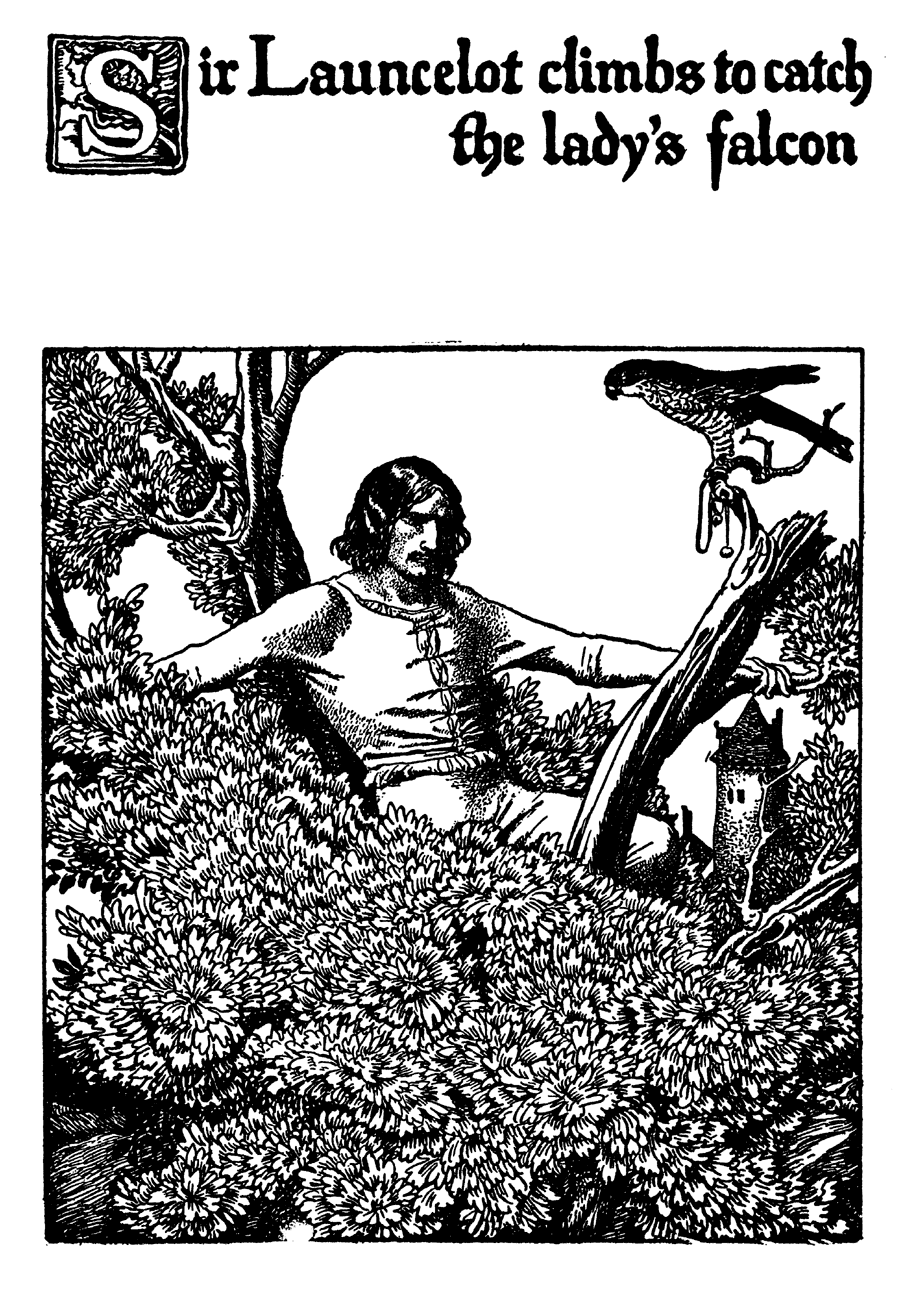
‘When she would have taken her flight, she hung by the legs fast’: Falconry and Bodily Autonomy
‘Falconry will break your heart in a hundred ways.’ During my time at a falconry apprentice seminar, the master falconer repeated this mantra through tears as she held the body of a small kestrel to her chest in a futile effort to revive it after it had been attacked by another falconry bird. The tender and fragile bond between falconer and hawk is hard to understand from the outside—it might look like a simple case of human superiority and especially male desire to control the wild. Yet the actual experience of spending so many hours in the company of birds produces men and women whose consciousness is subsumed by that of their avian partners. They see things from the perspective of the bird and bend their own minds and bodies to accommodate this other species.

Materials published in The So What can be distributed, remixed, adapted, and built upon for noncommercial purposes, so long as attribution is given to the creator.