The So What
A public-facing, digital publication focusing on the ‘whys’ and ‘so whats’ of medieval studies and pedagogy.
Winner of The Council of Editors of Learned Journals (CELJ) 2025 Best Public Outreach Award
One of the hardest questions for academics to answer is why your argument, your writing, your interests matter. A question made harder still when your interests lie several centuries in the past. But, the Middle Ages continue to haunt our now, lingering in films and comics, beer names, the rise of the alt-right, and the search for the ever-elusive ‘holy grail’ of skincare. To explore that difficult “so what” question, the project asks why what medievalists do matters, what we can learn (for good or ill) from the Middle Ages, and why the study of what was remains so important for what is and for what can be. The definite article in our title signals our dedication to the ‘so what question,’ asking scholars and creatives to consider their work in a broader context for today’s public.
~~~
What does The So What (TSW) publish?
TSW pieces are peer-reviewed, open access works geared toward a broad audience. While our emphasis is on Arthurian material, we believe that more explicitly discussing the ‘so whats’ of medieval studies, including its connections to and appearances in more ‘modern’ and ‘contemporary’ culture is of great value to the field, to public discourse, and for promoting inquiry, equity, and justice. As such, we welcome proposals for pieces exploring the ‘so whats’ of medieval studies and medievalisms, as well as short, pedagogical and/or creative pieces.
Who can submit?
Both authors appearing in Arthuriana and those who do not have a forthcoming piece in the journal are welcome to submit to TSW. Types of submissions might include: short, accessible articles; detailed lesson or unit plans; annotated assignment sheets; and/or creative pieces in a variety of media, including audio/visual. The selection process will differ slightly, depending on whether the piece did or did not originate with an Arthuriana article (see our Submission Guide for more). Selection and editing will be anonymized, with review duties spread across members of our editorial team.
Reach out to us! Question? Comment? Correction? Please email our editors at thesowhatpub@gmail.com.
“I don't think things ought to be done because you are able to do them. I think they should be done because you ought to do them.”
- T.H. White, The Once and Future King

Editorial Team
Our Editorial Team is comprised of a sizeable group of established scholars, early career researchers (ECRs), contingent faculty, and independent scholars. All TSW submissions receive reports from two readers from our team, as well as proofs.
Editorial Team Rationale
Our team is large, allowing us to disperse duties, so that no one ends up overwhelmed. In addition, the mix of readers—including established scholars, ECRs, independent scholars, and contingent academics—provides a range of perspectives, as well as protected opportunities to and for those who are building careers and/or experiencing precarity.
Equity, Accessibility, Diversity, and Inclusion are deeply important to us; we welcome your feedback about ways we can improve or strengthen our efforts, particularly (though not exclusively) in those respects (you can contact us at thesowhatpub@gmail.com).
Editorial Team Members
Tarren Andrews, Roland Betancourt, Gabrielle M.W. Bychowski, Laura Chuhan Campbell, Seeta Chaganti, Brittany Claytor, Jonathan F. Correa-Reyes, Steffi Delcourt, Brenna Duperron, Denva Gallant, Nahir Otaño Gracia, Alison Gulley, Kevin Harty, Mairi Stirling Hill, Jonathan Hsy, Alex Kaufman, Tzu-Yu Liu, Sierra Lomuto, Molly Martin, Christy McCarter, Maud McInerney, Arielle C. McKee, Mariah Min, Clint Morrison, Rachel Moss, Ryan Naughton, Tory V. Pearman, Sara Petrosillo, Bradley Phillis, Christopher Queen, Logan Quigley, Lynneth Miller Renberg, Christopher T. Richards, Robert Rouse, Sarah Salih, Richard Sévère, Margaret Sheble, Gale Sigal, Alexandra Sterling-Hellenbrand, Matthew Vernon, Usha Vishnuvajjala, Kevin Whetter, Adrian Whitacre, Clara Wild.
NB: to respect privacy, not all members are listed here, we are only providing the names of team members who wished to appear on our site.
Recent Issues & Articles
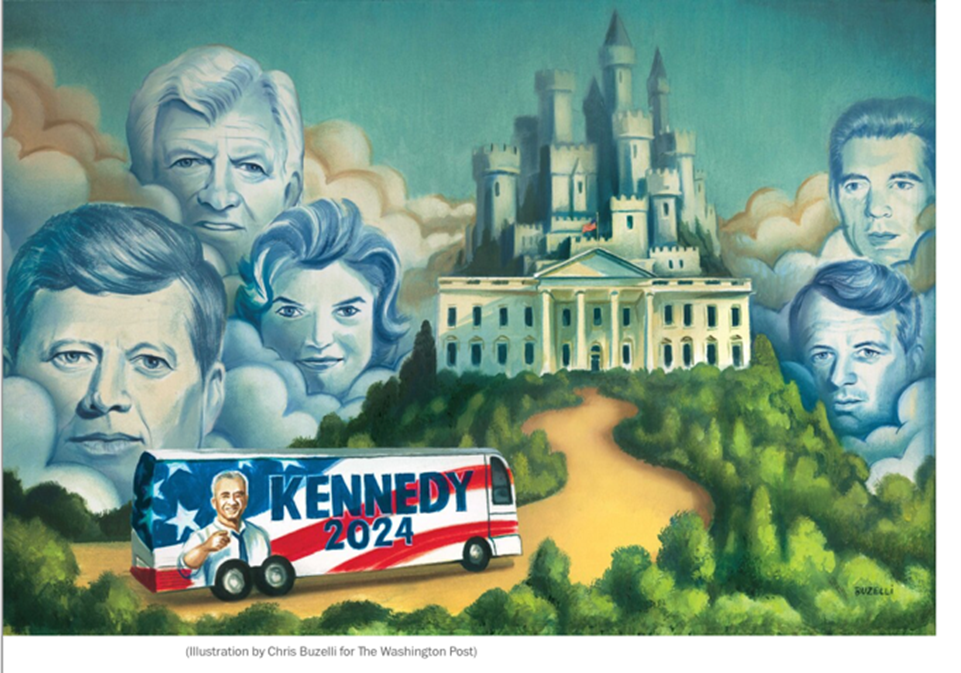
Donald Trump, Robert F. Kennedy Jr, and the Return of King Arthur
In 2021, I published an article in Arthuriana that mapped this facet of the QAnon conspiracy back to JKF’s assassination and discovered a distinctly medievalist bent to the discourse surrounding the Kennedys. I found that the myth of JFK faking his death and/or his return had been bolstered by framing JFK’s presidency as an idealistic ‘Camelot,’ drawing on the mythmaking around King Arthur as an imminently-returning saviour figure, traceable to the medieval works of Geoffrey of Monmouth, Chrétien de Troye, Layamon, Thomas Malory, and most overtly, Étienne de Rouen’s 12th century Draco Normannicus. The myth of JFK’s return, tied up with idealistic mythmaking around his presidency, flourished from the 1960s onwards and was buoyed by the ‘paranoid style’ of American politics…. It is clear that this medievalist myth continues to affect American politics, arising in the presidential bid of another Kennedy, Robert F. Kennedy Jr. (RFK Jr.). Throughout his campaign for president, RFK Jr. often took up the Camelot myth to present himself as the second coming of his much-revered uncle. He then suspended his presidential bid in August 2024, simultaneously throwing his support behind Trump, who in kind flagged his intention to nominate RFK Jr. as a member of his administration. Trump undoubtedly sought out RFK Jr.’s endorsement to amalgamate RFK Jr.’s voting base with his, but Trump’s desire to align himself with RFK Jr. was also perhaps driven by his desire to play into the QAnon myth of Trump’s powerful, at times supernatural, association with the Kennedy dynasty. Trump could not count on the ghost of JFK, but he could get the next best thing: an unprincipled and mercenary conspiracy theorist with the Kennedy name.

Materials published in The So What can be distributed, remixed, adapted, and built upon for noncommercial purposes, so long as attribution is given to the creator.