A Many-Headed Hydra: Early Modern Monstrosities and Demonstrations in Rare Books and Special Collections Outreach
By Eve Wolynes
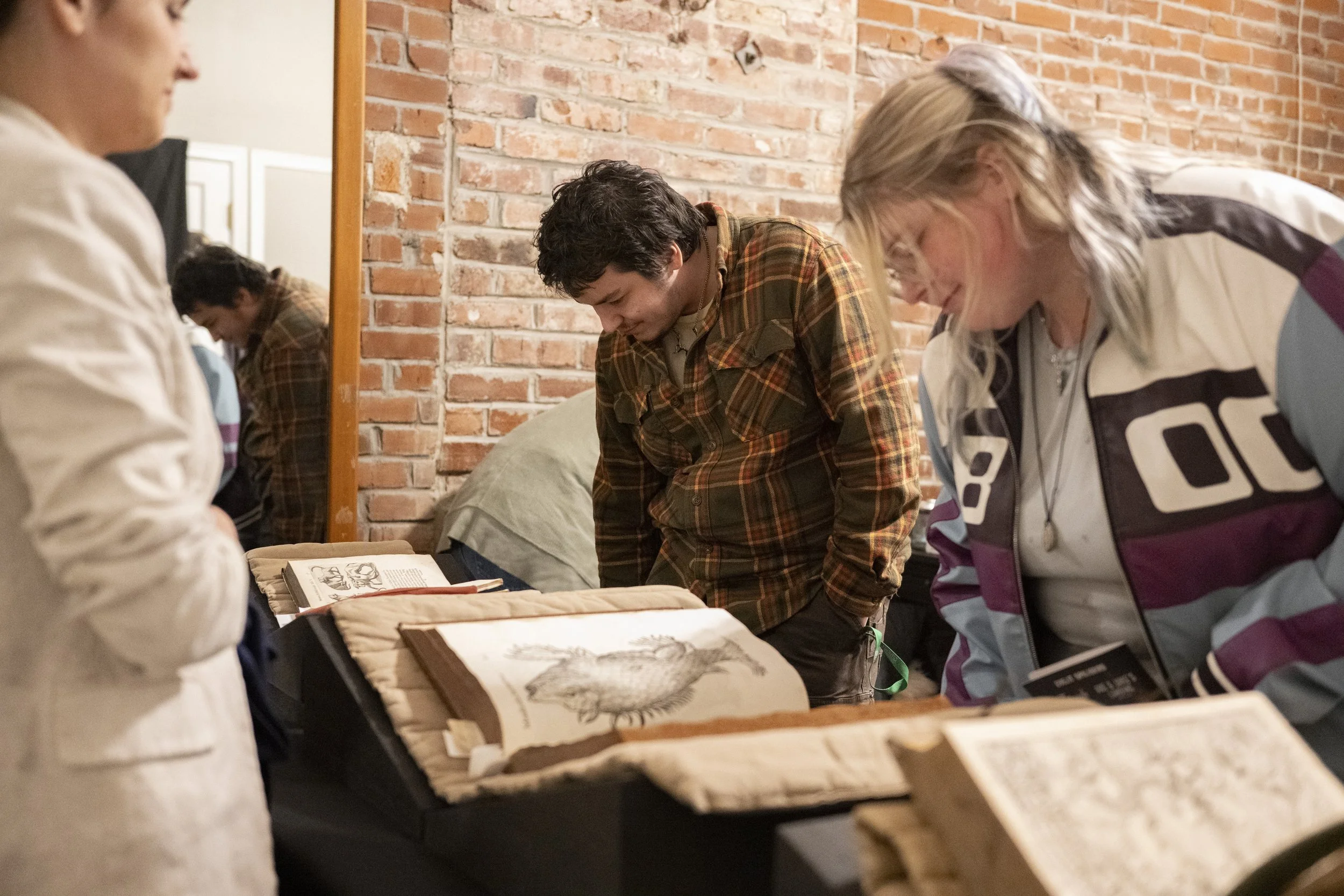
Visitors look at a displayed selection of printed libri monstrorum, or ‘Books of Monsters.’ Photo courtesy of Kevin McCarty, KU Libraries Office of Communication & Advancement
Monstrosities and Demonstrations. The parallel makes for more than simply a catchy title (though I can never resist a catchy title): the two words are closely related to one another. Monster was likely born from the Latin monstrare, ‘to show, reveal, or teach’ (though some sources also suggest monere, ‘to foretell, warn, admonish or presage’), the same root as ‘demonstrate.’ In the Middle Ages and the Early Modern era, people commonly thought of monsters as warnings of divine intent, as a demonstration of God’s will, and even as a manifestation of the playfulness of nature itself. Monsters were about showing and demonstrating morals and divine instructions, with all humans as the learning audience. Nowhere was this more evident than in Early Modern libri monstrorum, or ‘Books of Monsters,’ that used and explored monsters and monstrosities as everything from divine omens to scientific anomalies. If libraries with premodern collections embrace the very meanings of monstrosity and demonstration embodied by these books, we can transform ourselves, our authority, and our connections with the public through outreach that fosters dialogue and connects people directly with primary sources.
Public Humanities Special Collections outreach creates a connection between the ‘demonstration’ of our books and historical interpretations of monstrosities that made them emblems and symbols of divine will, nature, and their world. Our current approaches to Special Collections outreach increasingly mirror the transition in the Early Modern era to combine authority derived from personal experience grounded in sight, touch, and the senses, with the historical privileging of classical auctoritas [authority/authors]. Finding opportunities to create the ‘anatomical theatres’ of manuscripts and books by bringing them into the public will prove to be our best avenues for outreach.
In October of 2025, the University of Kansas (KU) held its biannual Haunting Humanities, a large-scale, free, and off-campus public outreach event attended by locals and students alike. The event exists in that ever-growing sphere of ‘public humanities’ that seeks to connect the research of scholars with broader communities. It is, in effect, a ‘So What’ concentrated into a single, four-hour event that shows why the work conducted ‘behind the scenes’ of an institution is interesting, exciting, and sometimes simply fun. In total, 765 attendees visited Haunting Humanities 2025, engaging with activities ranging from escape rooms, games, dance performances, digital tours, and arts and crafts, all themed around the research of local faculty and graduate students.
As part of this event, I helmed a team of librarians (and one intrepid student worker) to develop outreach centered around Early Modern libri monstrorum held in KU’s Kenneth Spencer Research Library’s Special Collections department. These books sought to classify, chronicle, and interpret ‘monsters’ in relation to the natural world, either as a part of it or as something unnatural or even supernatural. In doing so, they reveal historical attitudes towards ‘Otherness’ that traded in everything from orientalism to congenital birth defects. Our goal was not only to bring research and scholarship to a wider audience, but to bring the sources themselves outside the cloistered walls of our library. There, the books could spark their own dialogues and create connections with the public on a tangible level, allowing vistors to engage with the ‘monsters’ of the past through a variety of activities.
We titled our project, ‘Early Modern Monstrosities: A Many-Headed Hydra of Outreach Activities.’ It nearly fulfilled the nine-headed promise of its title. In addition to the curated showcase of materials from our collections, we offered button-making and coloring pages derived from illustrations from the displayed books, ‘Rate a Monster’ reviews, Monster Mad-Libs, Rare Book Bingo challenges, a write-up of secondary literature on monsters in Early Modern European culture, and two ‘Escape-Rooms-in-a-Box’ in which visitors could solve puzzles in a mystery narrative. Just a few shy of nine, but not too far off.
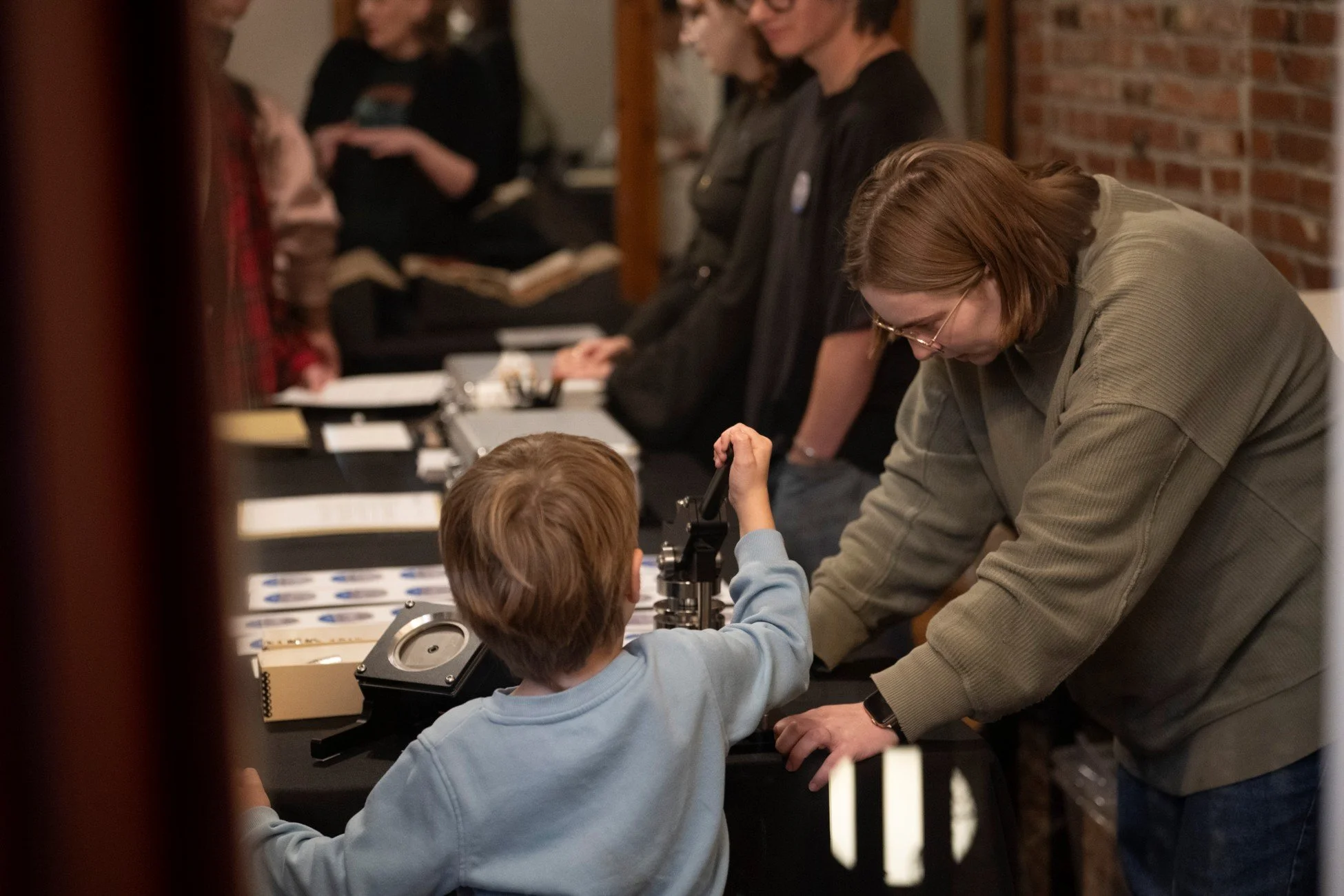
Children engaging in button-making. Photo courtesy of Kevin McCarty, KU Libraries Office of Communication & Advancement.
Our aim was to make an outreach event that offered something for everyone: ‘grab and go’ activities that people could take away from the event and do on their own, simple activities like the buttons for small children, and complex and challenging activities for older kids and adults who wanted to linger for fifteen to twenty minutes on something a little more intense. We asked people to lean into their critical thinking skills for what makes a monster good, scary, or simply monstrous.
And at its very heart stood the materials themselves. Visitors could elect to listen to a rambling lecture on the history of monstrosity from an attending curator (see also: me); question the materials and discuss them in-depth with said curator as an active participant; ignore me entirely and choose to read the exhibit labels instead (always an excellent option); or simply stare wondrously at the vivid, alien, and ancient woodcuts and copperplate engravings, flipping page to page until closing time, as more than one child chose to do. Everything according to their own wishes, in the ways that worked best for them, and at the depth of engagement they desired.
In curating our display, I selected four books that reflected different ways Early Modern intellectuals, theologians, and scientists mused and expounded on the idea of monstrosity and monstrousness:
Konrad Lycosthenes’ Prodigiorvm ac ostentorvm [Of Prodigies and Portents] (1557) collates a chronicle of portents and omens that foretold danger or drastic change, ranging from comets and natural disasters to the appearance of mythical creatures and monsters, as well as so-called ‘wonders’ and ‘monstrous’ births. (KSRL Call Number: Summerfield E392).
Joachim Camerarius’ Symbolorum et emblematum [Of Symbols and Emblems] (1590-1605) presents a collection of ‘emblems’: Pithy quotes or mottos paired with allegorical illustrations that instructed the reader on how to interpret both the image and the quote, in which monsters could be interpreted as symbols of moral lessons. (KSRL Call Number: Summerfield B1609).
Fortunio Liceti’s De monstrorum caussis, natura, et differentiis [On the causes, nature, and differences of monsters] (1633) represents the Early Modern treatment of ‘monstrosities’ as medical phenomena — what today we would most often understand as birth defects — exploring their forms and causes. (KSRL Call Number: Summerfield C802).
Ulisse Aldrovandi’s De Monstrorum Historia [A History of Monsters] (1642) takes a more scientific turn, as part of his fourteen-volume set of encyclopedias that aimed to construct a taxonomy of all creatures including ‘monsters’ as a part of the natural world. (KSRL Call Number: Ellis Aves E70).
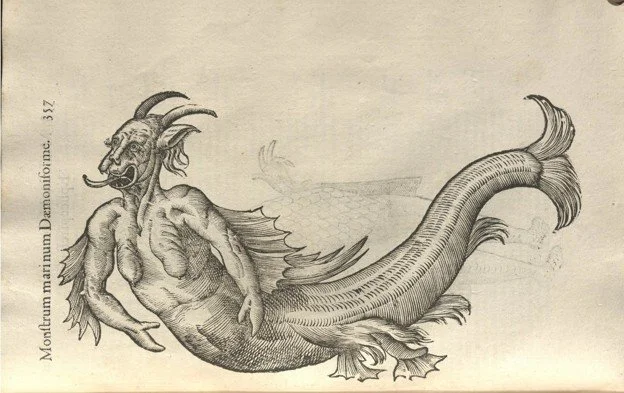
A ‘Demon-form marine monster’ from De Monstrorum Historia, p. 357
These books, in as much as four books selected from the inevitably narrow scope of a single Special Collections library can, represented four ways that Early Modern people thought about ‘monsters’ and ‘monstrosities’: as omens, as symbols, as part of a natural world, and as medical anomalies. Each text often intermingles these uses and perspectives. These approaches to monstrosities were, in the words of Hans Peter Broedel and Jana Byars, ‘perversely resistant to generalization,’ encapsulating the way their authors were ‘capable of viewing the world from a bewildering variety of contradictory perspectives.’[i] And yet, across all of these visions, understandings, and interpretations of monstrosity, there is a common and constant theme: the importance and value of witnessing, of showing and being shown, for the audience to learn and understand on a deeper level.
Beginning in fifteenth century, scientific communication and education privileged personal experience — or claims thereof — as an equal, complementary, and sometimes greater source of authority and trustworthiness than the historically privileged auctoritas, the authority of classical authors like Galen and Aristotle who derived their trustworthiness from prestige, reputation, and their very nature as classical authors.[ii] Witnessing, of seeing things personally, became an increasingly important tool for gaining readers’ trust and for learning and education in scientific communities. This is the era where we see the birth of instructional gardens, such as the Orto Botanico di Padova [Botanical Garden of Padua], which aimed to help students visually distinguish between species of plants for medicinal use, and the rise of public instruction on the human body via anatomical theaters.
Scientific learning and instruction were increasingly visible, tangible experiences. The wealthy collected oddities and exoticisms, everything from seeds and plants to taxidermied animals, as spectacles to flaunt their influence and intellectual authority through Wunderkammer [Wonder-rooms] and Cabinets of Curiosity. Ulisse Aldrovandi himself was one such avid collector, with some 4,760 plant specimens and, most famously, an alleged sea monster which he immortalized in his Encyclopedia Serpentum et draeonum historice.[iii]
Special Collections and Rare Books outreach in the vein of our Haunting Humanities event treads in the footsteps of this dramatic shift of scientific learning. We center the importance of witnessing, visually engaging with, touching, and reading primary source materials as a form of connection with a non-academic audience. Like Joachim Camerarius’ Symbolorum et emblematum, we treat primary source materials as emblematic monsters that reflect the values, minds, and thoughts of their creators that observers can contemplate and thereby gain greater wisdom. They meditate on images that reflect changing historical attitudes towards monstrosity that encompassed disabilities, foreign cultures, divine omens, and moral imperatives. In doing so, they are invited to ask themselves how we define monstrosity today, what forms of Otherness still invoke the horror and fascination that compelled people centuries past, and how we can dissect our own cultural anatomies under that same critical microscope.
The best part of any library, to my mind, is being able to actually touch the books. To read them, turn the pages, and experience shared sensations across centuries. Outreach events like these can marry together the mystical wonder of engaging with objects that are centuries-old and the demystification of Rare Books and Special Collections libraries. Getting to feel and manipulate books as objects makes them real to the senses beyond sight, and in doing so we make history feel closer and more tangible (on a literal level) for the public in an era when we feel increasingly removed from reality.
Rare Books and Special Collections departments are often thought of by the public as reclusive, cloistered places closed off to all but the elite and worthy academe, with their librarians and curators dour and stalwart guardians and gatekeepers against the hoi-polloi unworthy of such hallowed shelves. Even the most welcoming Special Collections is often labyrinthine, with opaque procedures and requirements that can be intimidating to all but the most experienced visitors — and sometimes even to us. Outreach events that bring materials into new environments convey the wonders of a tangible past to people for whom breaking those barriers would be unimaginable and unnavigable.
This shift of bringing materials out of a closed-off environment into public space mirrors the rise of public human dissection and the study of anatomy in Early Modern Europe. Medieval medicine, as with scientific learning, often relied upon classical authority, and especially the teachings of Galen, as a foundation of the field. Practical, anatomical dissection as a form of hands-on instruction had some persistence but remained rare. Frederick II mandated in 1231 that a cadaver be dissected for the education of surgeons once every five years, for example, and historical records from Italy document the practice in the thirteenth century. But beginning in the sixteenth century, public dissections, held for any and all to attend, became much more widespread. They existed in the liminal space between education and entertainment, ‘an almost gaudy civic spectacle,’ that emphasized the importance of experience and visual demonstration as a complementary form of medical instruction alongside classical authorities. Kenneth Spencer Research Library’s Early Modern Monstrosities outreach echoed those public dissections by taking the internal anatomy of our library, the books as our very heart, and carrying them outside the body of our library and into the public, as education, enlightenment, and entertainment for a wider audience.
Despite those historical shifts, many Early Modern attitudes towards monstrosity were inherited from the Middle Ages, layered with changing questions about the burden of morality, the natural world, and the heritability of monstrosity. The shared etymology of monster and demonstration is rooted in medieval language, no invention of the Early Modern era, and many of the books from our showcase drew directly from their medieval predecessors. Lycosthenes’ Prodigiorvm ac ostentorvm cobbled together monsters derived from classical authorities like Aristotle and Pliny the Elder alongside medieval sources including Petrarch, Govanni Villani and Matteo Palmieri. Indeed, quite a few large-scale exhibits have explored medieval monsters, as with the Getty’s Book of Beasts and the Morgan Library & Museum’s Medieval Monsters: Terrors, Aliens, Wonders.
Those changing historical attitudes mean that the materials themselves can drive different questions and change the shape of engagement in outreach. If Early Modern libri monstrorum lend themselves to the exploration of experience and authority in scientific learning, then medieval manuscripts demand and open opportunities for distinct approaches: the relationship between marginal voices and the center with monstrous marginalia, for example, or medieval and modern scribal and authorial cultures in constructing monsters through adaptation, interpretation, and reader reception.[iv] When we consider the past more than simply content for us to convey and instead use our sources as inspiration for how we convey that content, it enriches our outreach. We bring both our audiences and ourselves closer to experiencing history not only tangibly but through active participation in and contemplation of historical mentalities and behaviors.
With demonstrations and monstrosity, however, comes that beast of spectacle. Spectacle came into play across the sixteenth and seventeenth centuries with the skyrocketing popularity of lurid broadsides that trumpeted the news of everything from scandalous murders to ‘monstrous births.’ If we accept the importance of bringing Special Collections materials out into the world to center experience and instruction to wider audiences, we must also confront the risk of turning outreach and its subjects into little more than spectacle, sensationalizing sensitive and complex historical topics, especially when placing them in popular contexts.
When we engage in public outreach, we shift away from scholarly communication and into a new form of conversation. We are no longer the Ulisse Aldrovandis and Fortunio Licetis of the academy, seeking to discuss, categorize, and analyze the unknown, but instead communicating that knowledge to new communities. We risk becoming the lurid broadsides that reveled in shocking violence and the fascinating revulsion of abnormality, rather than the anatomical theaters that claimed instructional value alongside their entertainment. Monsters and Monstrosities, framed in the setting of the playful outreach of Haunting Humanities, tread that line carefully. Monsters embody the common, collective fears of societies: fear of the Other and the alien, fear of the inhuman, the unnatural, and the supernatural. Monsters in the Early Modern era weren’t always inherently terrifying or even negative (though they remained often so); they evoked a complex array of emotions. In the words of historians Katherine Park and Lorraine Datson, they conjured ‘horror, pleasure and repugnance,’ not always associated with ill omens but also positive portents.[v] The materials we showcased tell a complex story of historical perspectives that we risked flattening and trivializing when we placed them in a framework of the ‘horror’ of Haunting Humanities. In between the woodcuts of ‘A man with the eyes and neck of a crane,’ and a ‘marine monster with the likeness of a monk,’ in Aldrovandi’s Monstrorum Historia are illustrations of people with what we would now recognize as hypertrichosis, depictions of Chinese and Japanese people juxtaposed with cannibals. Liceti’s De monstrorum caussis perhaps best highlights the disjunction between our own understanding of the word monster and the pre-modern understanding of the word. His book sought to find explanations for ‘monstrous births’ that today we would understand as rare (and often fatal) congenital abnormalities; a distant cry from what we would consider ‘monstrous’ today. And yet, our own words and meanings today aren’t as divorced as perhaps we’d like to think: the study of birth defects lives on under the formal name ‘teratology,’ Greek for the study of monsters.
When we exhibit pre-modern depictions of monstrosity as part of a public humanities outreach event, we risk conflating the display of these definitions and understandings of monstrousness with their endorsement, especially when we place them in a context that presents the past as Haunting, a specter lingering into the present, positing these marginalized communities as horrifying or disturbing. Likewise, we risk sensationalizing serious, even harmful topics when we place them in a context of public outreach that’s framed as, in the words of KU News, ‘wicked fun’ that features ‘nightmarish stories, chilling factoids and joyful revelations’ — invoking that same complex array of horror, pleasure, and repugnance that Early Modern authors conveyed in their own works. That’s not a reason to avoid public outreach, to shy away from or whitewash these aspects of history when talking to broader audiences; it’s motivation to think carefully about how we present and discuss complex topics like the treatment of disabilities in the history of science and the invasive, looming shadow of the marginalized Other in otherwise playful conversations.
To deepen, rather than flatten, our portrayal of these conflicting depictions, I first built a reading list of secondary literature on monstrosity and disability, race, and otherness to help us ensure that we confronted the topics’ historical and modern complexities with visitors. We also integrated those articles into the Escape-Rooms-in-a-Box as clues so that they were introduced to both primary and secondary sources and learned to navigate their text and structure — following footnotes and cross-references — even if they were not engaging critically with its content. We made the same reading list available as a takeaway handout with citations and links to resources so that they could pursue those scholarly discussions on their own, reiterating our emphasis on giving people agency in how they engaged. Highlighting, rather than hiding, difficult conversations and equipping our audiences with avenues to explore independently, means attendees walk away with both a tangible experience of history, a more complex understanding of our own, modern perspectives of inhumanity and monstrosity, and preliminary tools to learn more.
In the end, I believe that our approach balanced the nuances of complex conversations about monstrosity, the human body, disability, and Otherness, together with the fascination and wonder of a tangible and visible demonstration of history through primary sources. It recreated the same interplay of authority, experience, and classical auctoritas that marked the shift in Early Modern scientific education. Visitors participated in their own, direct learning, but many still drew to the more traditional ‘authority’ of the curator, asking for the ‘correct’ interpretations, contexts, and analyses, only now in dialogue with a direct and personal experience of the primary sources on display. It at once challenged the traditional perception of rare books librarians as gatekeepers to primary sources and transformed lecture into dialogue, even as it bolstered that same authority as visitors relied on our expertise to guide them. Rather than making a broadside spectacle of our monstrous libri monstrorum, this approach recreated the balance of learning and education of the anatomical theaters that enabled surgeons and the public alike to understand the human body with greater detail than Galenic learning previously allowed.
Rare Books libraries and Special Collections stand on the same precipice as the students and scholars of monstrosities from the Early Modern world: we must make monsters and demonstrations alike of our Special Collections, transforming them into everything that Licetti, Aldrovandi, Lycosthenes, and Camerarius used monsters to communicate to their own audiences. These books can be omens and symbols of historical attitudes; signs, portents, warnings of our own interpretations of past and present. They reflect our understanding of the human body and its relationship with Nature and concepts of divinity and religion. When we shift our use of these monsters by following in the footsteps of scientific education and reframe our outreach to echo and emulate how our sources used their own information, we construct personal experience as a source of learning and authority for public audiences. In doing so, we dissect our own libraries and expose our collections to the world on a more intimate, organic level. The world becomes our theater: we transform our outreach, challenge traditional intermediaries of authority and access, and usher in a new era of humanities education.
Author Bio:
Eve Wolynes is the Ann Hyde Curator of Medieval and Early Modern Manuscripts at the University of Kansas' Kenneth Spencer Research Library, where she oversees outreach, instruction and collection development of all manuscript collections before 1700, as well as the collections in Early Print, Cartography, Natural History and East Asia. Her medieval outreach has also included the exhibit ‘Marvelous Medieval Marginalia: Drawings, Doodles and Notes on the Edges of Readers’ Imagination,’ exploring reader reception, agency, and playfulness in manuscript culture.
Bibliography:
Primary Sources
1. Aldrovandi, Ulisse. Monstrorum historia: Cum paralipomenis historiae omnium animalium. Bononiae: Typis Nicolai Tebaldini, 1642.
2. Aldrovandi, Ulissi. Serpentum et draconu[m] historice libri duo. Bononiae: apud Clementem Ferronium sumptibus M. Antonij Berni[a]e, 1640.
3. Lycosthenes, Conrad. Prodigiorvm ac ostentotrum chronicon, quae praeter naturae ordinem, et operationem, et in svperioribus & his inferioribus mundi regionibus. Basileae: per Henricvm Petri, 1557.
4. Camerarius, Joachim. Symbolorum et emblematum... centuria una[-quarta] ex re herbaria, vol. 2. Nuremberg, 1590-1604).
5. Liceti, Fortunio Liceti. De monstrorum caussis, natura, et differentiis libri duo. Patavii: Apud Paulum Frambottum, 1634 [1633].
Secondary Sources
1. Bates, Alan. Emblematic Monsters: Unnatural Conceptions and Deformed Births in Early Modern Europe. Rodopi, 2005.
2. Brenna, Connor T.A. ‘Bygone Theatres of Events: A History of Human Anatomy and Dissection.’ The Anatomical Record vol. 305, no. 4 (2022): 788-802. https://anatomypubs.onlinelibrary.wiley.com/doi/pdf/10.1002/ar.24764.
3. Byars, Jana, and Hans Peter Broedel. ‘Introduction.’ In Monsters and Borders in the Early Modern Imagination. Routledge, 2018.
4. Cappelletti, Elsa M. ‘The Botanic Garden of the University of Padua 1545—1995.’ Botanic Gardens Conservation News vol. 2, no. 4 (1994): 23–26. http://www.jstor.org/stable/24753946.
5. Carpi, Daniela. ‘Introduction: What Is a Monster.’ In Monsters and Monstrosity: From the Canon to the Anti-Canon: Literary and Juridical Subversions, ed. Carpi. Walter de Gruyter, 2019.
6. Ciseri, Lorenzo Montemagno. ‘Can Failing to Check Sources Give Rise to Monsters? The Iconographical History of a Paradigmatic Case.’ Preternature: Critical and Historical Studies on the Preternatural, no. 2 (2013): 139-55. https://doi.org/10.5325/preternature.2.2.0139.
7. Ferrari, Giovanni. ‘Public Anatomy Lessons and the Carnival: The Anatomy Theatre of Bologna.’ Past and Present vol. 117, no. 1 (1987): 50-106.
8. Getty Museum. ‘Book of Beasts: The Bestiary in the Medieval World,’ n.d. https://www.getty.edu/art/exhibitions/bestiary/inner.html.
9. Guerrero, Anna, ‘De Monstruorum Causis, Natura et Differentiis (On the Reasons, Nature and Differences of Monsters) (1616), by Fortunio Liceti.’ Embryo Project Encyclopedia ( 2018-11-29 ). ISSN: 1940-5030, https://hdl.handle.net/10776/13087.
10. Hanafi, Zakiya. The Monster in the Machine: Magic, Medicine, and the Marvelous in the Time of the Scientific Revolution. Duke University Press, 2000.
11. Hellawell, Philippa. ‘“The Best and Most Practical Philosophers” Seamen and the Authority of Experience in Early Modern Science.’ History of Science vol. 58, no. 1 (2020): 28-50.
12. Hoffmann, Kathryn A. Hoffmann. ‘Sutured Bodies: Counterfeit Marvels in Early-Modern Europe.’ Seventeenth-Century French Studies vol. 24, no. 1 (2002): 57-70, DOI: 10.1179/ c17.2002.24.1.57.
13. Klestinec, Cynthia Klestinec. Theaters of Anatomy: Students, Teachers, and Traditions of Dissection in Renaissance Venice. Johns Hopkins University Press, 2011. https://muse.jhu.edu/book/60337.
14. Knoppers, Laura, and Joan B. Landes, eds., Monstrous Bodies/Political Monstrosities in Early Modern Europe. Cornell University Press, 2004.
15. Oetting, Daniel. ‘Haunting Humanities Brings Wicked Fun to Lawrence.’ KU News, October 16, 2025. https://news.ku.edu/news/article/2023/10/16/haunting-humanities-bring-wicked-fun-lawrence.
16. Park, Katherine, and Lorraine Daston. ‘Unnatural Conceptions: The Study of Monsters in Sixteenth and Seventeenth Century France and England.’ Past & Present vol. 92, no. 1 (1981): 20-54.
17. Park, Katherine, and Lorraine Daston. Wonders and the Order of Nature, 1150-1750 . Zone Books, Distributed by the MIT Press, 1998.
18. Patterson, Serina. ‘Reading the Medieval in Early Modern Monster Culture.’ Studies in Philology, vol. 111, no. 2 (2014): 282–311.
19. Razovsky, Helaine. ‘Popular Hermeneutics: Monstrous Children in English Renaissance Broadside Ballads.’ Early Modern Literary Studies vol. 2, no. 3 (1996): 1.1-34, URL: http://purl.oclc.org/emls/02-3/razoball.html.
20. The Morgan Library & Museum. ‘Medieval Monsters: Terrors, Aliens, Wonders,’ n.d., https://www.themorgan.org/exhibitions/medieval-monsters.
21. Williams, David. A. Reformed Discourse: The Function of the Monster in Mediaeval Thought and Literature. McGill-Queen’s University Press, 1999.
22. Williams, Peyton. ‘Haunting Humanities Returns with a Wicked Lineup of Attractions.’ KU News, October 24, 2025. https://news.ku.edu/news/article/haunting-humanities-returns-with-a-wicked-lineup-of-attractions.
NOTES:
[i] Jana Byars and Hans Peter Broedel, ‘Introduction,’ in Monsters and Borders in the Early Modern Imagination (Routledge, 2018), p. 17.
[ii] Anthony Grafton, Defenders of the Text: The Traditions of Scholarship in an Age of Science 1450–1800 (Harvard University Press, 1995).
[iii] Kathryn A. Hoffmann, ‘Sutured Bodies: Counterfeit Marvels in Early-Modern Europe,’ Seventeenth-Century French Studies vol. 24, no. 1 (2002): 57-70, DOI: 10.1179/ c17.2002.24.1.57.
[iv] In fact, I explored similar dichotomies in an exhibit dedicated to medieval marginalia, inviting visitors to inscribe their own marginalia on our wall text. To my disappointment, however, shockingly few obscene doodles were added.
[v] Katherine Park and Lorraine Daston, Wonders and the Order of Nature, 1150-1750 (Zone Books; Distributed by the MIT Press, 1998), pp. 176, 189.